

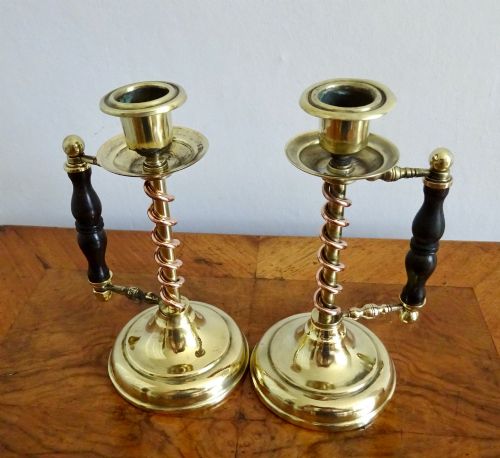


Twisted Wood Candle Holders
Twisted wood candle holders are turned timber stems built to hold a taper steady, prized for their spiralling forms and rich grain.
Twisted Wood Candle Holders
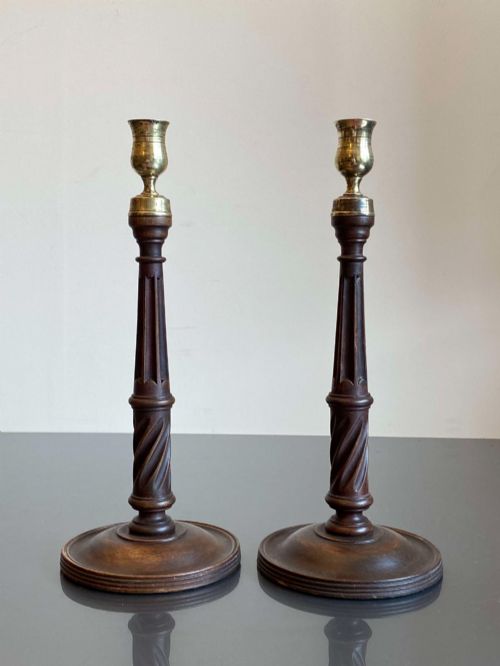
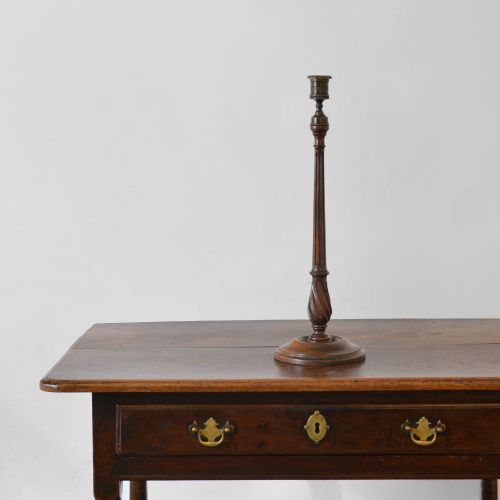
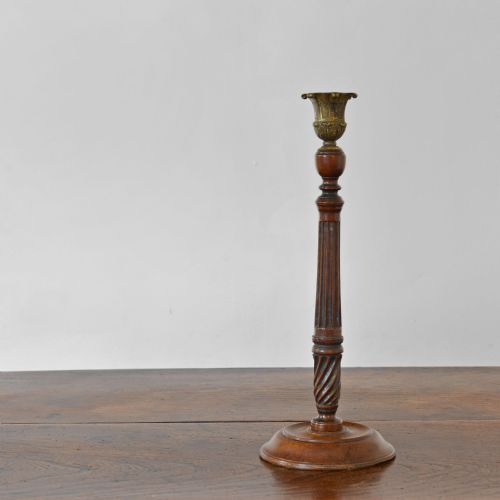
When you search for twisted wood candle holders, you meet turned timber stems designed to support taper candles. These pieces span centuries of domestic lighting, taking forms from simple barley twist shafts to open spiral carvings.
The versions most frequently found on this page date from the Georgian era through to the early twentieth century. Oak, mahogany, walnut, fruitwood and general turned wood dominate the timber selection across these decades.
Makers often combined wood with metal elements such as brass and copper sockets or bases. Candlestick pairs recur often, alongside individual tall shafts.
How they were made
Turners shaped these stems on a lathe to produce the characteristic barley twist and spiral carver profiles. Craftsmen selected dense hardwoods like oak, walnut, mahogany and fruitwood to maintain stability along the slender turned shafts.
Many examples incorporate fitted brass and copper components to secure the candle and protect the timber from heat and wax. The integration of metal tops and weighted bases required precise carpentry to join differing materials securely.
Twisted Wood Candle Holders Retail Price Guide 2026
Typical asking prices for twisted wood candle holders among the pieces listed under this phrase on Sellingantiques today, from the lower quarter to the upper quarter. They describe what is for sale here now, not the wider market.
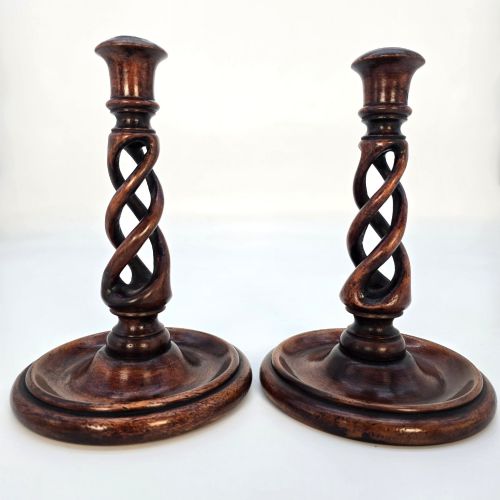
Some wooden spirals are carved right through the centre, leaving an open air path that makes you wonder how the lathe didn't snap.
What varies in quality
Quality rests upon the precision of the turning and the depth of the timber grain. Sharply defined spiral cuts and well-proportioned stems separate finer examples from simpler work.
The choice of material and the integration of brass or copper components influence the character of each piece. Hardwoods with rich figuring and intact metal mounts represent the stronger examples in this group.
The Twisted Wood Candle Holders Glossary
- Barley twist
- A decorative spiral turning resembling a stalk of barley. This profile defines much of the woodwork seen in these lighting pieces.
- Open twist
- A spiral carved with space through the centre rather than a solid core. This technique demands greater skill from the woodturner.
- Turned wood
- Timber shaped on a lathe while rotating. It forms the basis of cylindrical and spiralled candlestick shafts.
- Taper
- A slender candle designed to fit into a socket. These holders were built specifically for such lighting.
Twisted Wood Candle Holders: Frequently Asked Questions
How do I date these holders?
Dating relies upon the timber species, turning style and the construction of any metal mounts. Georgian pieces generally show dense mahogany or fruitwood, while later twentieth-century examples often feature oak.
Changes in turning technique and the presence of brass or copper components help narrow down the period of manufacture.
Are they sold in pairs?
Many listings appear as matched pairs, though individual candlesticks also occur. Pairs are particularly common in twentieth-century oak and brass combinations.
Checking dimensions and wood grain helps confirm whether two pieces originated together as a matched set.
What woods were used?
Makers utilised a range of native and imported timbers including oak, mahogany, walnut and fruitwood. Hardwoods provided the structural strength needed for slender turned stems.
Some pieces combine plain turned wood with contrasting metal sockets made from brass or copper.
How do I care for the wood?
Keep wooden stems away from direct heat sources and naked flames to prevent the timber from drying out or splitting. Gentle dusting preserves the surface finish.
Avoid using harsh liquid polishes on antique timber and metal mounts to protect the original patina.