



Open Twist Candlesticks
Open twist candlesticks bring tactile helical shafts and warm metal or timber into a room.
Open Twist Candlesticks
Open twist candlesticks are lighting accessories defined by their spiralling columns, which create a sense of movement and depth.
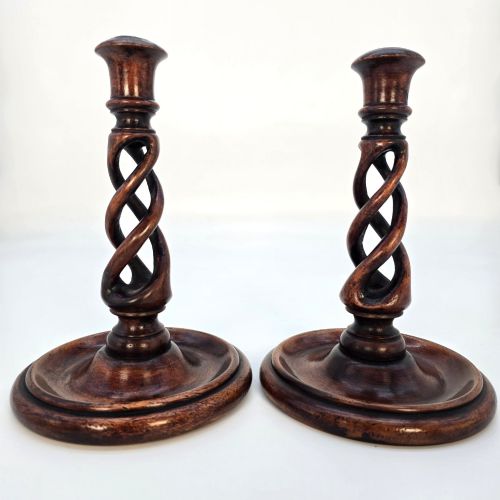
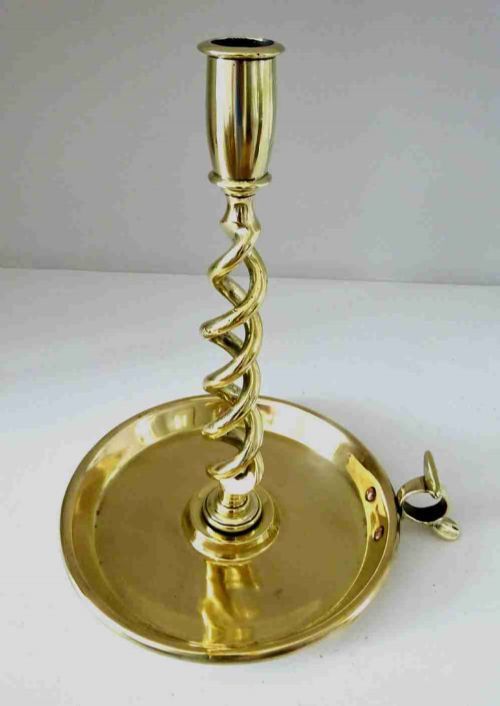
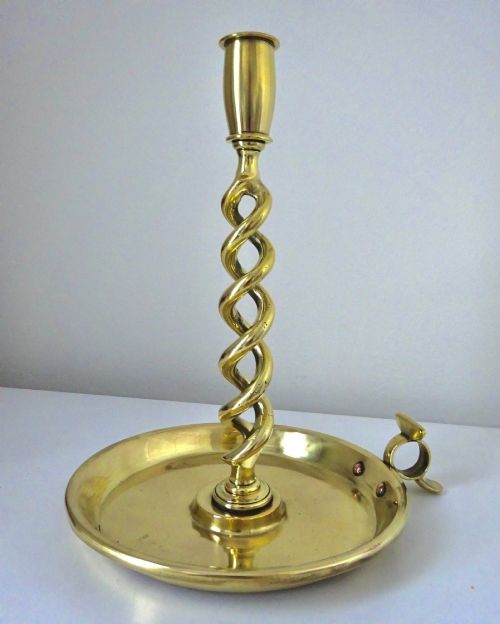
Buyers browsing this selection encounter sturdy oak columns paired with brass fittings, alongside entirely cast brass examples and fruitwood pieces.
The prevailing items date from the eighteenth century through to the Edwardian period and the nineteen-twenties, appearing frequently as balanced pairs.
Materials and construction
Makers shaped timber such as oak and fruitwood using lathe work and hand carving to produce the characteristic open helical void through the centre of the shaft.
Metal versions utilise cast brass components, sometimes combining turned wooden elements with brass drip pans, nozzles, and thistle tops.
Surface finishes include handpainted lacquer on specific regional lamps, contrasting with polished or patinated metal surfaces.
Some towering oak pairs reach eighteen inches tall, commanding attention alongside diminutive eight-inch companions.
Assessing quality and proportion
Quality rests upon the precision of the spiral carving and the stability of the central column, where deeper helical clearance demonstrates greater technical skill.
The integration of fitted brass bases, drip trays, and matching mountings distinguishes superior examples from simpler utilitarian designs.
The Open Twist Candlesticks Glossary
- Barley twist
- A spiralling column resembling the stalk of barley, formed in wood or metal. This profile defines the traditional aesthetic of these stems.
- Double helix
- A decorative form featuring two intertwined spiralling strands running parallel up the shaft. This configuration adds visual density to the stem.
- Drip pan
- A small metal plate positioned beneath the candle nozzle to catch melting wax. Many brass examples incorporate this functional feature.
- Fruitwood
- Dense timber sourced from fruit-bearing trees, utilised by eighteenth-century turners. Its fine grain accommodates intricate twist cutting.
- Thistle top
- A candle socket shaped to resemble the bulbous flower head of a thistle. These appear frequently on twentieth-century oak candlesticks.
Open Twist Candlesticks: Frequently Asked Questions
What periods do these pieces come from?
The selection spans from the eighteenth century up through the Victorian and Edwardian eras into the nineteen-twenties.
Most surviving examples date from the later nineteenth century and the early decades of the twentieth century.
Were these items used for lighting?
These pieces functioned primarily to hold candles for household illumination before electric lighting became widespread.
Several examples are adapted or constructed as table lamps while retaining the original twist shaft form.
How do I identify timber types?
Oak items display a pronounced grain and heavy structure, frequently paired with brass cups and bases.
Fruitwood pieces exhibit a smoother, denser surface texture and generally date to earlier manufacturing periods.
Do these pieces come in pairs?
Many listings comprise matching pairs designed for symmetrical placement on mantelpieces or side tables.
Singular items and occasional trios also appear across the inventory.