


Twisted Wooden Candlesticks
Twisted wooden candlesticks bring tactile warmth and architectural turnery to a room, offering functional candlelight shaped by centuries of timber and lathe work.
Twisted Wooden Candlesticks
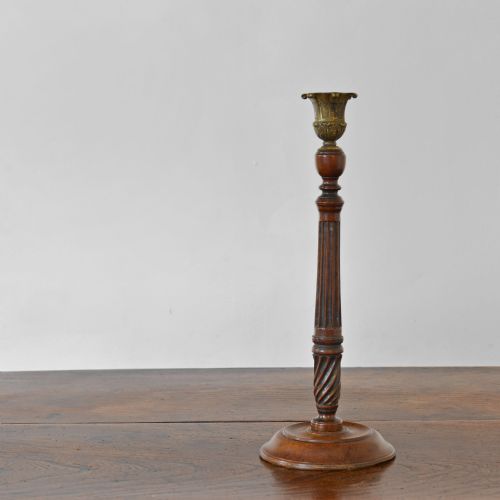
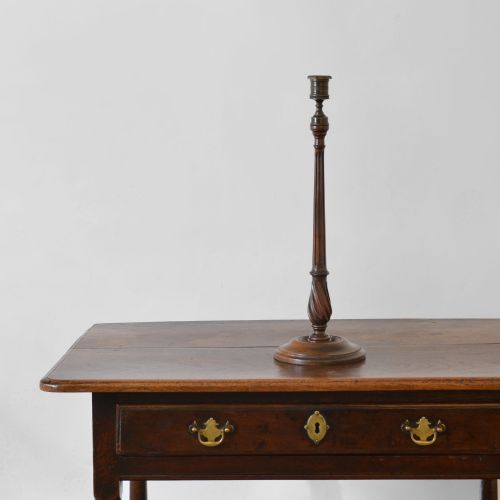
When you search for twisted wooden candlesticks, you are looking at turned shaft lighting made across several centuries. The examples on this page span the Georgian period, the nineteenth century, and early twentieth-century revivals.
Most pieces you meet here are paired oak or mahogany shafts, often rising from brass sockets or bases. You will also encounter fruitwood, walnut, and turned wood forms shaped by Jacobean Revival and Baroque Revival influences.
Makers shaped these objects as standard table lighting, though some later pieces appear adapted as table lamps. The selection ranges from compact early forms to tall barley twist columns.
How they were made
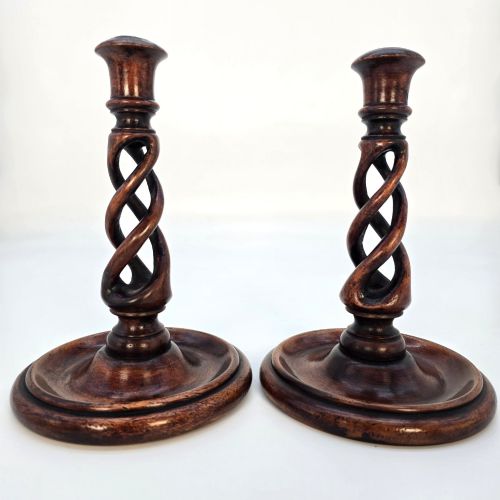
Turners shaped these items on a lathe, cutting spiral or open twist profiles into dense hardwoods like oak, mahogany, fruitwood, and walnut. The precision of the helix reveals the skill of the hand-turned execution.
Many specimens incorporate turned wood stems fitted with brass tops or nozzles to hold the candle safely. Some variants combine carved timber with lacquer finishes or handpainted decoration.
Some nineteenth-century turners managed to carve an entire spiral twist while sitting on a simple wooden shaving horse.
What varies in quality
Quality rests in the rhythm and sharpness of the twist itself. A crisply cut open twist demands greater joinery skill than a shallow surface groove.
The choice of timber and the proportion of the turned column dictate the visual balance. Matching pairs with original brass components hold greater integrity than composite examples.
The Twisted Wooden Candlesticks Glossary
- Barley twist
- A spiral column turned on a lathe to resemble the stem of barley. This profile is common in Jacobean Revival and later pieces.
- Open twist
- A spiral turn where material is cut away to leave an open space through the centre of the helix. It requires fine hand-tooling.
- Fruitwood
- A dense, light-coloured timber such as pear or apple used by turners for smooth finishes. It patinates richly with age.
- Turnery
- Items shaped by rotating wood against a cutting tool on a lathe. This technique defines the profile of every candlestick here.
Twisted Wooden Candlesticks: Frequently Asked Questions
Are twisted wooden candlesticks safe to use?
Most antique wooden candlesticks accommodate standard taper candles, though fitted metal nozzles often protect the timber from direct flame. Users should monitor burning candles closely near dry wood.
For daily living, many owners simply display these pieces as sculptural objects on mantelpieces or side tables without lighting them.
How do I date an oak barley twist?
Dating relies on timber species, tool marks, and the style of the base and brass socket. Earlier pieces from the Georgian period show hand-planed surfaces and dense grain.
Revival pieces from the early twentieth century often feature machine-tooled turnery and brighter brass components.
Why do some candlesticks have brass tops?
Brass sockets were added to protect the wooden shafts from burning down to the timber. They also provided a secure, heat-resistant cup for the candle.
This combination of turned wood and brass appears frequently across nineteenth and twentieth-century examples.
What is the difference between Georgian and revival twists?
Georgian twisted candlesticks generally feature finer proportions and heavier native hardwoods like mahogany or fruitwood. They were produced for illumination in high-status homes.
Later revival pieces from the Victorian and Edwardian eras often use oak with heavier, more pronounced barley twist columns.