




Nineteenth Century Heriz Carpet
A nineteenth century heriz carpet brings bold geometric medallions and robust village weaving into a room.
Nineteenth Century Heriz Carpet
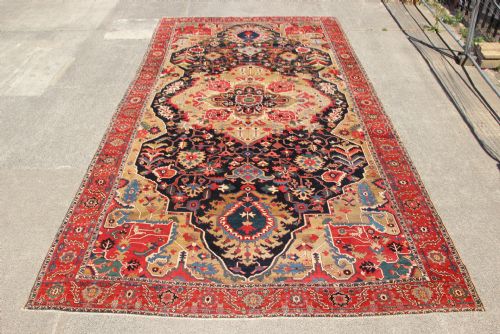
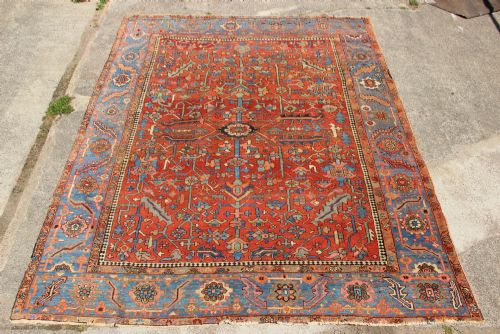
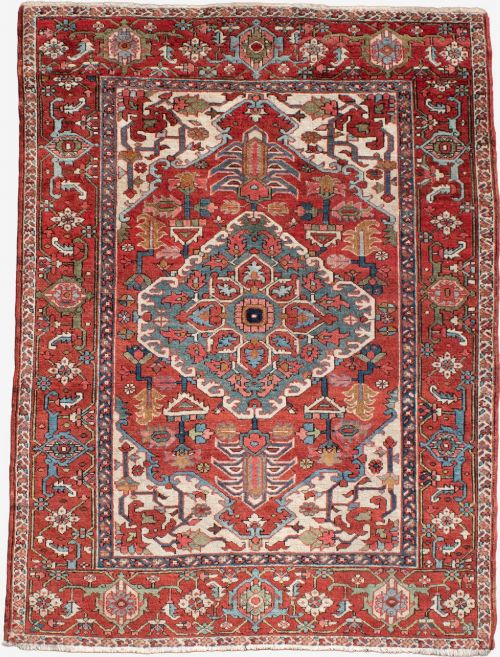
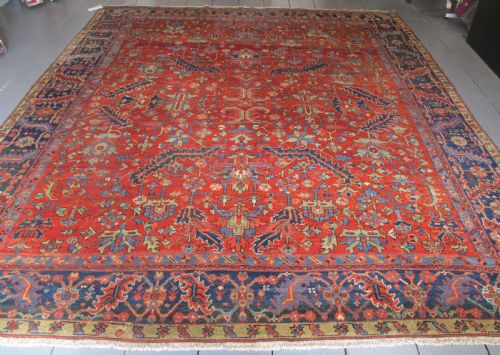
A nineteenth century heriz carpet originates from the northwest region of Persia, offering large-scale geometric designs that anchor a major interior space. These floor coverings are encountered in various formats, ranging from expansive carpets to smaller area rugs and specific village variants.
The selections on this page span several decades of production, including related regional pieces such as Bakshaish, Bakshiash, and Karaja formats. Traditional Persian aesthetic values govern the composition of these floor coverings, displaying strong medallion structures and stylized botanical motifs.
How they were made
Construction relies on durable wool pile knotted onto sturdy cotton foundations, providing the resilience required for heavy daily use. The interplay of these two materials gives the heavy textile its characteristic weight and structure.
Weavers in northwest Persian workshops utilised local wool supplies to build dense, flat surfaces capable of holding saturated vegetable and natural dyes. The knotting technique binds the heavy wool firmly to the cotton warp and weft threads.
Nineteenth Century Heriz Carpet Retail Price Guide 2026
Typical asking prices for nineteenth century heriz carpet among the pieces listed under this phrase on Sellingantiques today, from the lower quarter to the upper quarter. They describe what is for sale here now, not the wider market.
Listings feature pieces dated across the nineteenth and early twentieth centuries, spanning from eighteen-fifty to nineteen-twenty.
What varies in quality
Quality rests in the precision of the geometric drawing and the balance of the central medallion against the field. Finer examples display crisper articulation in the corners and borders, whereas simpler weaving shows broader, more rustic execution.
The handle and density of the wool pile also separate standard village output from the finer Serapi and Heriz productions. Tighter knotting allows for sharper graphic lines in the intricate corner spandrels and central fields.
The Nineteenth Century Heriz Carpet Glossary
- Serapi
- A sub-category of Heriz carpet known for a more open design, coarser weave, and large geometric medallions. These pieces often date to the earlier part of the nineteenth century.
- Bakshaish
- A village weave from the same northwest Persian region, characterised by whimsical, spaced-out geometric patterns and earthy palettes. It shares wool and cotton materials with standard Heriz production.
- Karaja
- A neighbouring Persian carpet type featuring distinctive geometric roundels or medallion repeats in the central field. They utilise wool pile on cotton foundations.
- Medallion
- The central ornamental motif dominating the field of the carpet. In nineteenth century examples, this element usually takes a bold polygonal or octagonal shape.
- Spandrels
- The triangular corner ornaments situated in the corners of the main carpet border. They frame the central field and balance the geometry of the medallion.
Nineteenth Century Heriz Carpet: Frequently Asked Questions
How do I clean a nineteenth century heriz carpet?
Professional specialist cleaning is essential for antique wool carpets to protect the natural dyes and cotton foundations. Regular gentle vacuuming without a beater bar removes surface grit.
Water and harsh chemical detergents cause irreparable harm to nineteenth century textiles. Consult a conservator experienced in antique Persian carpets for any maintenance beyond light dust removal.
Are these carpets suitable for heavy traffic?
The sturdy wool pile and robust cotton foundations of a nineteenth century heriz carpet make it durable for daily living areas. Placing a quality underlay beneath the textile absorbs foot pressure and prevents slipping.
Even durable antique carpets benefit from rotated placement to ensure even wear across the wool pile over the years. Heavy furniture should rest on distribution cups to protect the foundation.
How do I distinguish Serapi from Heriz?
Serapi carpets typically display a looser weave, wider palette, and more spacious geometric drawing than standard later Heriz pieces. They often date to the earlier decades of the nineteenth century.
Standard Heriz weaving tends to be tighter and more structured with densely filled geometric motifs. Both share the same northwest Persian origin and cotton-and-wool material base.
What is a Bakshaish carpet?
Bakshaish refers to an older village carpet style from the Heriz district featuring whimsical, abstracted tribal designs. These pieces often pre-date standard late nineteenth-century Heriz production.
The drawing in Bakshaish examples is more rustic and open, utilising soft earth tones and irregular geometric formats. They are prized for their primitive charm within the northwest Persian tradition.