


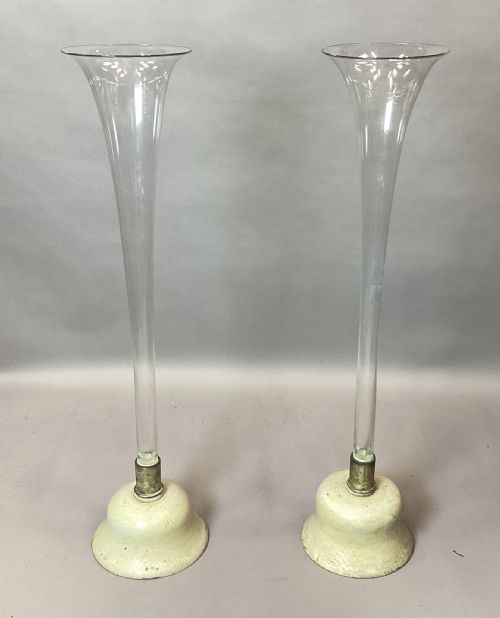


Nineteenth Century Glass Vase
Nineteenth century glass vase examples span deep cranberry, opaline, and cut crystal, offering bold Victorian colour and refined Regency forms.
Nineteenth Century Glass Vase
A nineteenth century glass vase encompasses diverse decorative vessel forms produced across the Victorian and Regency periods, frequently featuring distinct colourways such as cranberry, ruby, opaline, and amethyst. Buyers investigating a nineteenth century glass vase encounter everything from intimate bulb vases and trumpet shapes to substantial pair sets and mounted centrepieces.
The selection on this page demonstrates regular representation of Victorian and mid nineteenth century English, French, and Bohemian origins. Standard iterations include enamel painted florals, Mary Gregory depictions, and overlaid panelled glass.
Alongside standard mantle and table vases, the category broadens into specialised forms like wine coolers, table lamps, and lustres configured from the same foundational materials.
How they were made
Makers shaped a nineteenth century glass vase using foundational glassblowing techniques, frequently casing different layers together as seen in cranberry over crystal and overlaid ruby glass. Soda glass and cut crystal provided the structural body for subsequent ornamentation.
Surface decoration involved hand-applied enamel flowers, delicate gold leaf detailing, and intricate decalcomania transfers fixed internally or externally. Metal mounts in bronze and brass added structural height and architectural framing to French and English pieces.
Object configurations range from standard vases and table lamps to wine coolers, lustres, and large scale centrepieces.
What varies in quality
Quality in a nineteenth century glass vase rests upon the crispness of the glass cutting, the depth and saturation of the coloured layers, and the delicacy of any hand-painted enamel work. Superior examples exhibit precise symmetry in blown forms and meticulous application of gilding.
The integration of secondary materials, such as fire-gilt bronze mounts or heavy cut crystal bases, distinguishes workshop output. Scale also dictates standing, with exceptionally tall trumpet vases or large paired sets commanding greater visual weight.
Richardson's
The Nineteenth Century Glass Vase Glossary
- Cranberry Glass
- A rich pinkish-red glass coloured by the addition of gold chloride during the melting process. It remains characteristic of Victorian decorativeware.
- Opaline Glass
- An opaque, pastel-hued glass developed in France that mimics porcelain while retaining translucent qualities. It frequently serves as a ground for painted enamel flowers.
- Decalcomania
- A technique where printed paper engravings are transferred onto the interior of glass vessels and hand-coloured. This method was popular for interior decoration in the nineteenth century.
- Lustre
- A mantle ornament comprising a vase fitted with a rim of suspended glass prisms that catch and refract candlelight. They are typically encountered in matched pairs from the Victorian era.
- Mary Gregory
- A style of white enamel silhouette painting depicting Victorian children amidst foliage, usually executed on cranberry or dark glass grounds.
Nineteenth Century Glass Vase: Frequently Asked Questions
How do I clean a nineteenth century glass vase?
Wash gently by hand using lukewarm water and mild soap, avoiding abrasive cloths that might damage surface gilding or enamel paint.
Allow the piece to air dry naturally on a soft towel rather than attempting to dry narrow interiors with restricted access.
Are these vases safe to hold water?
Many nineteenth century glass vase examples were intended primarily for display or dry arrangement rather than heavy daily use with water.
Thermal shock or prolonged moisture contact can affect older enameled surfaces, so inspect the interior before filling.
How can I date a glass vase from this era?
Examine the base for pontil marks, colour saturation, and stylistic indicators such as Regency cut crystal patterns or Victorian cranberry hues.
Maker attribution stamps, where present, alongside specific enamel motifs help narrow the manufacturing window.
What is the difference between Bohemian and English glass?
Bohemian production often favoured heavy overlay panels, rich ruby tones, and deep brilliant-cut geometric patterns.
English outputs frequently leaned towards delicate enamel florals, opaline bodies, and distinct cranberry shades.
Why do some vases come as pairs?
Matched pairs were traditionally produced to flank mantelpieces, sideboards, or central mirrors in nineteenth century domestic interiors.
Symmetrical arrangement was a primary design goal for formal reception rooms during the Victorian period.