


Cranberry Overlay Glass
Cranberry overlay glass pieces are layered vessels bringing rich pink and red tones to Victorian decanters, scent bottles, and stemware.
Cranberry Overlay Glass
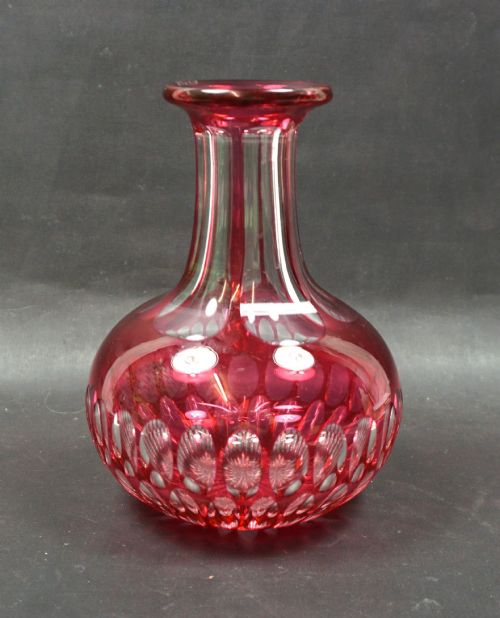
When you search for cranberry overlay glass, you encounter pieces that bridge mid-nineteenth-century domestic display and functional tableware. The selection centres heavily on Victorian decanters, scent bottles, champagne coupes, and wine glasses from English and Bohemian workshops.
The objects take familiar vessel forms such as carafes, vanity sets, and jugs, rendered distinct by a saturated pink or ruby outer layer bonded to a clear crystal core. These items emerge primarily from the nineteenth century, spanning decades from eighteen-fifty through to nineteen-hundred.
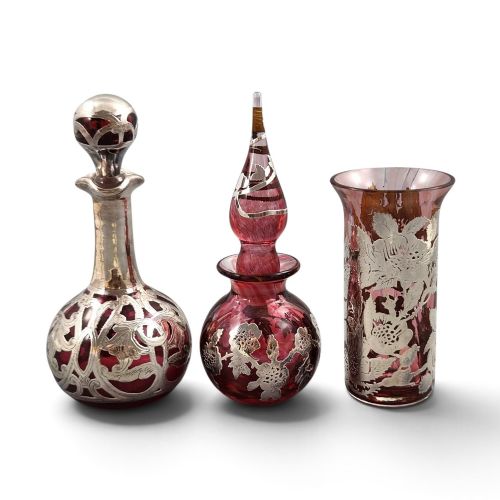
Buyers most frequently meet tablewares and dressing table accessories combining deep red hues with cut crystal or sterling silver mounts. The presence of Bohemian and English origin marks out the dominant traditions available for collection.
Materials and Working Methods
The creation of these objects relies on a dual-layer technique where a gather of clear lead crystal or cut crystal is cased in a layer of coloured glass, often called ruby glass or cranberry glass. Artisans then cut, engrave, or etch through the outer coloured stratum down to the clear base to expose patterns.
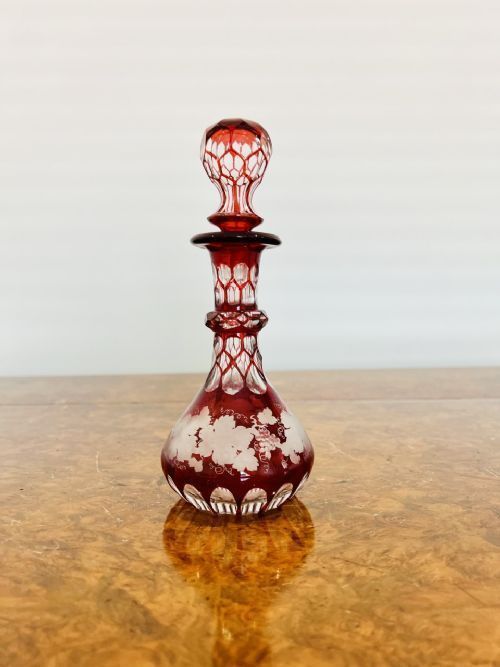
Surface ornamentation on the pieces involves wheel-engraving birds, vines, convolvulus, and floral motifs into the cased exterior. Many items combine this double-layered glass body with sterling silver, silver-plated mounts, or hinged lids.
The physical weight and brilliance depend upon the integration of lead crystal beneath the coloured casing. Acid-etching and deep cutting define the decorative transitions between the outer ruby layer and the clear glass beneath.
Materials recorded in the inventory span cranberry glass, ruby glass, cut crystal, lead crystal, sterling silver, cameo glass, and etched glass.
Judging the Standard of Overlay Work
The distinction between ordinary and exceptional pieces rests upon the precision and depth of the wheel-cutting through the coloured layer. Crisp definition in engraved foliage and birds reveals the hand of a skilled cutter.
Clarity within the underlying lead crystal and uniformity in the thickness of the cranberry casing dictate the visual success of a vessel. Superior examples maintain an even saturation of colour across complex curves and panelled ovoid surfaces.
The integration of metal mounts, such as sterling silver collars or stoppers matching the period of the glass, adds structural integrity and completeness. Original stoppers fitted to decanters and scent bottles preserve the intended proportion of the design.
Thomas Webb and Sons·Gorham·Charles May·The Mousley Brothers·George Brace·William Hutton
The Cranberry Overlay Glass Glossary
- Cranberry Glass
- A transparent pink glass coloured by the addition of gold chloride into the molten batch. It forms the vibrant outer layer on many Victorian tablewares.
- Overlay
- A manufacturing method where a vessel is blown with an inner layer of clear crystal and an outer layer of coloured glass. Cutting away portions of the outer layer reveals contrasting patterns.
- Cut Crystal
- Glass shaped and patterned by abrasive wheels, leaving sharp facets that refract light. It provides the clear foundation visible beneath the cased coloured exterior.
- Lead Crystal
- Glass containing lead oxide, which increases weight, brilliance, and workability. It serves as the base material for high-quality nineteenth-century decanters and stemware.
- Cameo Glass
- A vessel produced by casing glass in two or more contrasting colours and carving away the outer strata to create relief designs. This technique appears on decorative vases from the period.
Cranberry Overlay Glass: Frequently Asked Questions
Are these decanters safe for modern wine?
These historical decanters can hold wine, provided the interior is clean and free from old sediment or residue. Nineteenth-century lead crystal is generally stable for serving beverages.
Avoid leaving acidic liquids inside the vessels for long periods. Hand-wash the decanter promptly after use to protect the integrity of both the glass and any engraved exterior details.
How can I tell English pieces from Bohemian ones?
English examples often feature refined botanical engravings like convolvulus or birds among vines, frequently paired with sterling silver hardware bearing British hallmarks. Bohemian production leans towards heavier panelled ovoid shapes and deep brilliant-cut patterns.
Examining the base and the style of the silver mounts offers clues to origin. Hallmarks provide exact dates and maker locations for items finished in Birmingham or London.
What is the difference between overlay and flashed glass?
Overlay glass involves a substantial, thick outer layer of coloured glass fused over a clear core before cutting. This depth allows artisans to carve deeply into the clear layer underneath.
Flashes of colour rely on a very thin superficial coating of pigment applied to the surface. Scratches on flashed glass often reveal clear crystal immediately, whereas true overlay displays a distinct three-dimensional wall thickness.