




Nineteenth Century Blue Platter
A nineteenth century blue platter brings deep cobalt tones and historic narrative directly to your table, offering an anchor of utility and display.
Nineteenth Century Blue Platter
When you search for a nineteenth century blue platter, you encounter a robust range of serving plates, decorative chargers, and earthenware dishes spanning the Georgian, Victorian, and Meiji periods. These ceramics fulfilled both practical dining needs and grand interior display requirements in country houses and urban homes alike.
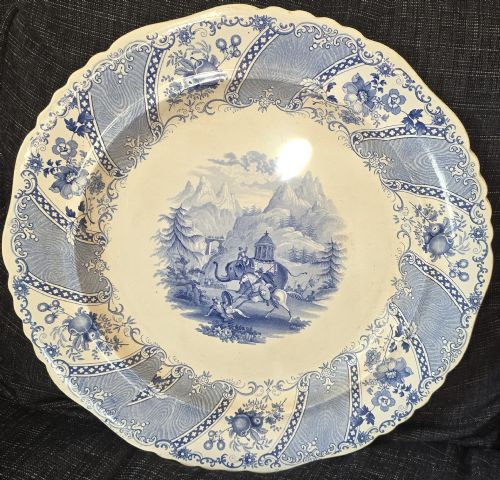
The pieces you meet most frequently on this page combine transfer-printed blue and white patterns with robust bodies in ironstone or earthenware. Makers drew inspiration from classical ruins, bridge scenes, and oriental designs, resulting in dense pictorial compositions across large surfaces.
Origins vary widely across the selection, ranging from English potteries in Staffordshire to continental porcelain works in France and Vienna, alongside Japanese export wares. This international exchange of blue and white ceramic traditions defines the visual landscape of the category.
Materials and methods
Potters utilised earthenware, ironstone, and porcelain as the foundational bodies for these large service pieces. Ironstone provided exceptional durability for heavy country house service, while fine porcelain and earthenware served delicate portraits and transfer-printed landscapes.
Decoration relied primarily on underglaze blue printing or hand-painted cobalt pigments, sealed beneath a clear glass glaze to protect the design. Selected items incorporated supplementary touches such as gold leaf and enamel highlights over the fired glaze.
Firing techniques in regional kilns required precise temperature control to ensure the cobalt oxide reacted correctly under the glaze. This process yielded the distinct depth of blue found across Staffordshire, European, and Japanese workshops.
The selection spans the Georgian, Victorian, and Meiji periods, incorporating English potteries, French porcelain works, and Japanese export wares.
Judging quality
Quality rests significantly on the crispness of the transfer print or the precision of the hand-painted brushwork. Superior pieces display deep, uniform cobalt tones without blurring, while lesser examples suffer from smudged lines and uneven glaze pooling.
The weight and refinement of the ceramic body also distinguish the tier of a platter. Dense, resonant ironstone and translucent porcelain command greater appreciation than heavy, porous earthenware bodies with thick, clumsy rims.
John Davenport of Longport·Thomas Lakin·John Rogers and Son
The Nineteenth Century Blue Platter Glossary
- Charger
- A large decorative plate or platter used traditionally for ceremonial dining or wall display rather than everyday service. These pieces measure considerably wider than standard dinner plates.
- Transfer printing
- A decoration technique where an engraved copper plate transfers an ink design onto tissue paper, which is then pressed onto the ceramic body before glazing. This method enabled complex pictorial scenes to be produced consistently.
- Ironstone
- A heavy, durable type of earthenware patented in the nineteenth century to imitate Chinese porcelain. It resists chipping and staining far better than standard soft paste pottery.
- Imari
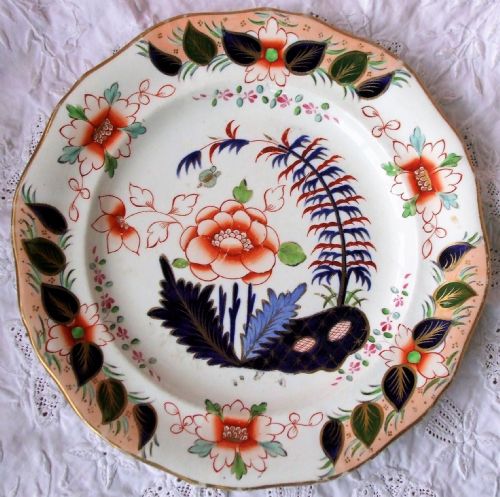
- A style of Japanese export porcelain characterised by a palette of underglaze blue, iron red, and gold. European potteries frequently copied these bold patterns during the nineteenth century.
Nineteenth Century Blue Platter: Frequently Asked Questions
Were these platters used for dining?
Large platters and serving pieces fulfilled practical roles at the nineteenth century dining table, carrying joints of meat and heavy courses for large households.
Many chargers, however, remained on sideboards or hung upon walls purely for visual display.
How do I identify a transfer print?
Transfer-printed patterns display fine, repetitive dot or line matrices under magnification, revealing the engraved copper plate origin.
Close inspection often shows tiny transfer lines overlapping at the borders of complex topographical scenes.
Can I use these for daily meals?
Historic ceramics demand careful hand washing and gentle handling to preserve nineteenth century glazes and delicate underglaze pigments.
Modern dishwashers and microwaves will quickly damage the glaze and any subtle surface gilt.
What distinguishes ironstone from earthenware?
Ironstone possesses a much denser, heavier, and more vitreous body designed to withstand rigorous domestic service without absorbing liquids.
Standard earthenware remains softer, more porous, and lighter in hand.