
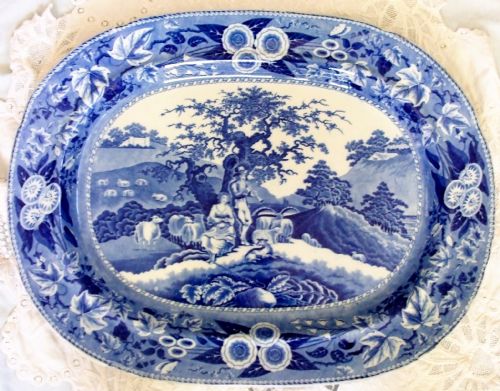
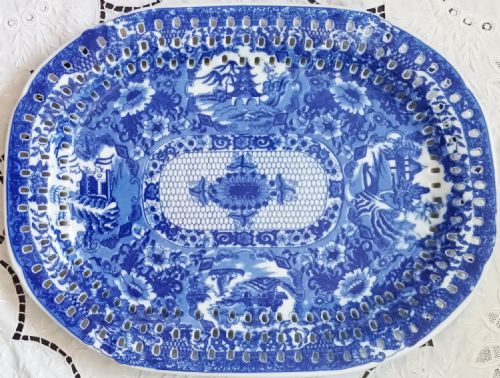


Georgian Blue Transferware Platter
When you search for a georgian blue transferware platter, you are looking for large ceramic serving vessels printed with cobalt scenes.
Georgian Blue Transferware Platter
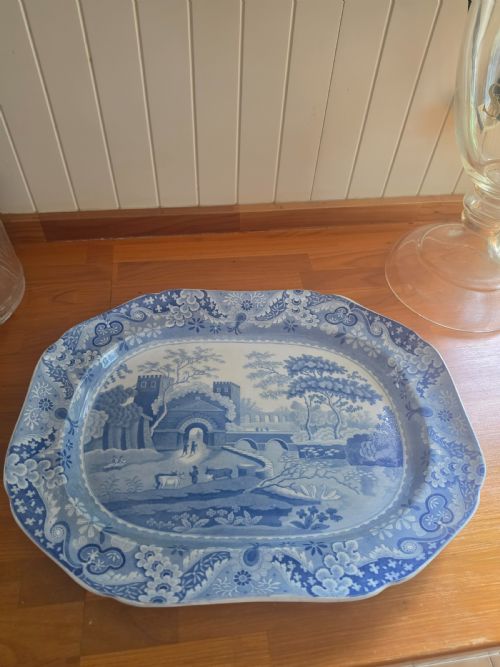
A georgian blue transferware platter is a large ceramic serving dish produced during the late eighteenth and early nineteenth centuries. These pieces were designed for presenting meat and large courses at the dining table, often accompanied by matching drainers or gravy wells.
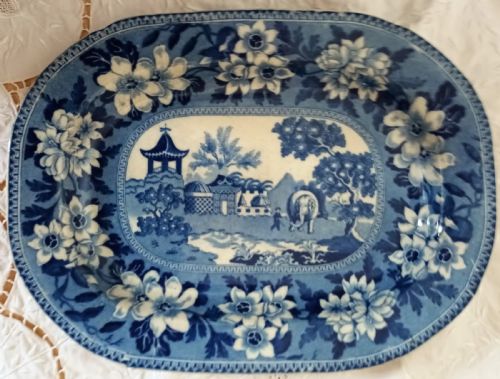
The selections on this page span the Georgian, Regency, and early Victorian periods, originating primarily from English potteries. Collectors encounter subjects ranging from classical ruins and Chinoiserie landscapes to topographical views and narrative patterns like the elephant or piping shepherd.
Serving platters, meat dishes, and chargers dominate the forms available in this category. They reflect the industrial expansion of Staffordshire potteries and the rising popularity of blue and white ceramics in domestic households.
How they were made
Potters shaped earthenware, pearlware, or ironstone into large serving platters before applying cobalt pigment to the surface through copperplate transfer printing. This technique allowed intricate pictorial scenes to be replicated with precision across plates, dishes, and drainers.
A transparent ceramic glaze was applied over the transferred cobalt design and fired in a kiln to vitrify the body and fix the rich blue colour. The interaction between the glaze and the earthenware body often produces subtle pooling and variations characteristic of early nineteenth-century production.
Listings feature earthenware, pearlware, and ironstone bodies decorated with cobalt pigment in Georgian, Regency, and Victorian styles.
What varies in quality
The clarity of the transfer print distinguishes standard production from superior examples, with finer pieces showing sharp lines and deep cobalt saturation without blurring. Potteries achieved different levels of register during printing, affecting how cleanly the pattern aligns across the surface of the platter.
Spode·Davenport·John Rogers And Son·Mason·Thomas Lakin·Brameld And Co·J And R Clews·Don Pottery·Elkin Knight And Bridgwood·Minton·Stubbs
The Georgian Blue Transferware Platter Glossary
- Transferware
- Earthenware or ironstone decorated by transferring a printed design from an engraved copper plate onto the ceramic body using cobalt pigment. This method revolutionised pottery production in the Georgian era.
- Pearlware
- A refined earthenware developed by Josiah Wedgwood and adopted by other potteries, featuring a subtle bluish glaze that pooled in crevices. It served as a popular body for early transfer-printed wares.
- Ironstone
- A durable, dense ceramic material patented in the nineteenth century that combined earthenware clay with feldspar and slag. It resisted chipping and became standard for heavy serving platters.
- Meat drainer
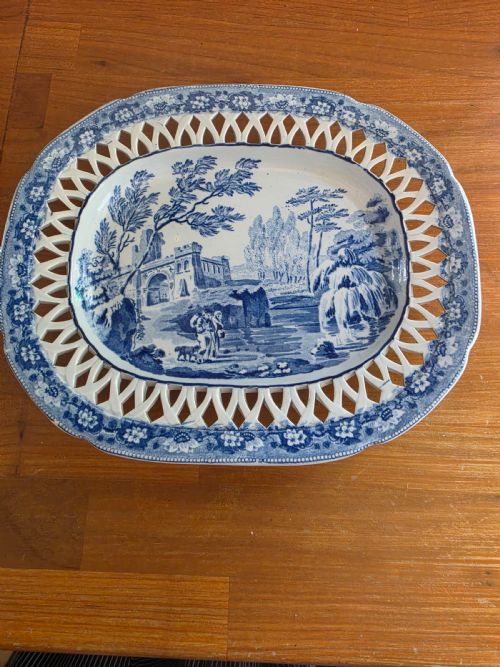
- A ceramic insert pierced with holes or slots that sat inside a platter to keep roast meat elevated from accumulated juices. Drainers are frequently found matching large serving dishes from the period.
- Chinoiserie
- A decorative European style reflecting imaginative interpretations of Chinese art and landscapes. It appears frequently on blue transfer-printed ceramics from the Georgian and Regency periods.
Georgian Blue Transferware Platter: Frequently Asked Questions
What were georgian blue transferware platters used for?
These large ceramic vessels served roast meats and main courses at formal dining tables during the Georgian and Regency periods. Their generous proportions accommodated substantial joints of meat, sometimes paired with a separate ceramic drainer.
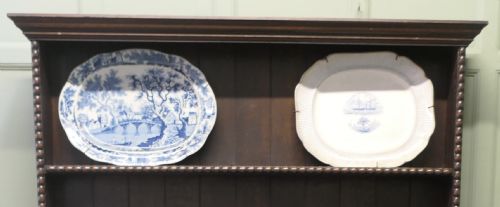
As dining habits evolved, many of these durable earthenware and ironstone pieces transitioned from active service to decorative display on sideboards and walls.
How do I date a blue and white platter?
Dating relies on examining the ceramic body, the shade of the cobalt pigment, and the style of the printed border. Early pieces from around 1780 often utilise pearlware bodies with a bluish glaze tint, whereas robust ironstone platters typically date to the 1820s and 1830s.
Potter's marks impressed into the base or printed maker's names on the reverse provide further chronological clues when present.
What is a meat drainer?
A meat drainer is a perforated ceramic insert designed to fit snugly inside the well of a large serving platter. It allowed meat juices to drain away from the roast during carving and presentation.
Finding a platter with its original matching drainer is particularly satisfying for collectors, as these internal components were easily separated or broken over time.
How do I display a heavy platter safely?
Large platters require sturdy wall brackets or dedicated plate stands with a wide enough lip to support their substantial weight. Ironstone and earthenware bodies are heavy, so secure mounting is essential for safety.
Displaying them in well-lit areas also highlights the depth of the cobalt transfer print and the details of the surrounding border patterns.