
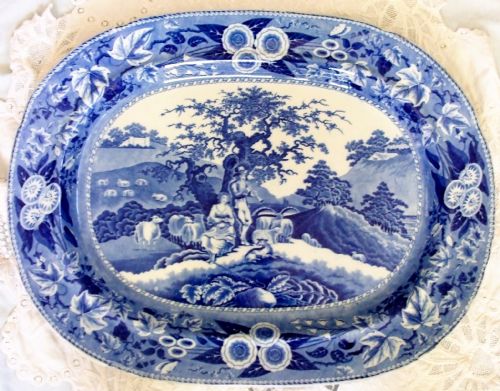


Blue Transfer Printed Platter
A blue transfer printed platter brings bold cobalt scenes to the table, offering a decorative surface that has served British dining rooms for centuries.
Blue Transfer Printed Platter
When you search for a blue transfer printed platter, you encounter large serving vessels shaped for meat, game, and ceremonial dining. These heavy ceramic pieces dominate the table with scenic cobalt landscapes, ruins, and pastoral motifs applied beneath the glaze.
The examples gathered here span the Georgian and Victorian eras, reaching from the opening years of the nineteenth century into later decades. You meet meat platters, serving dishes, and bread stands shaped as ovals or rectangles for practical service.
Makers across Staffordshire and other English centres produced these earthenwares in varied patterns such as Piping Shepherd, London Bridge, and Classical Ruins. Surviving pieces range from massive platters designed for joints of meat down to smaller serving plates.
What varies in quality
Quality rests upon the crispness of the transfer print and the depth of the cobalt pigment beneath the glaze. Sharp lines in complex patterns like architectural ruins or distant bridges indicate superior copper plate engraving and careful firing.
The weight and refinement of the earthenware body also set pieces apart, alongside the smoothness of the lead glaze. Early pearlware bodies and well-balanced meat platters show greater finesse in potting than utilitarian wares.
Listings feature earthenware and pearlware bodies decorated with cobalt pigment under lead glazes across the Georgian and Victorian periods.
Thomas Lakin·Brameld and Co·Mason·John Rogers and Son·Wedgwood·Spode
The Blue Transfer Printed Platter Glossary
- Transfer printing
- A decoration technique using an engraved copper plate to pull an inked design onto tissue paper, which is then pressed onto the ceramic body before firing. This innovation allowed potteries to produce detailed pictorial scenes rapidly.
- Pearlware
- A refined earthenware body developed in the late eighteenth century featuring a subtle bluish glaze that pooled in recesses to mimic Chinese porcelain. It forms the base of many early nineteenth-century platters.
- Cobalt pigment
- The metallic oxide used to achieve the deep blue colour seen in transfer printed ceramics. It withstands high kiln temperatures without losing its distinct hue.
- Lead glaze
- A liquid silica and lead mixture applied over the fired body to create a glossy, impermeable surface. It protects the porous earthenware underneath from moisture and staining.
Blue Transfer Printed Platter: Frequently Asked Questions
How were these platters used?
These large ceramic vessels served grand joints of meat, poultry, and game at the nineteenth-century dining table. Platters often featured integrated wells to catch juices during carving.
They sat centrally during heavy meals before passing down the table for individual portions. Their robust earthenware construction suited daily service in large households.
How do I date a platter?
Dating relies on body composition, pattern style, and maker marks stamped or impressed into the ceramic base. Early nineteenth-century pieces often utilise pearlware bodies with delicate blue tones.
Victorian examples shift towards heavier earthenware and distinct transfer styles like Chinoiserie. Comparing the printed border motifs with documented factory archives helps narrow the decade of manufacture.
Can I use them for serving food?
Most antique platters remain structurally sound for presenting dry foods and cold cuts at the table. Hand washing protects the historical lead glaze and prevents moisture ingress through old crazing lines.
Harsh detergents and modern dishwashers damage the porous earthenware body beneath the glaze. Gentle care preserves both the cobalt pigment and the ceramic substrate.
What is a gravy well?
A gravy well is a small recessed basin incorporated into the surface of a meat platter. It collects juices running from roasted joints during carving.
This practical feature kept liquids pooled away from the meat slices. Platter designs with wells represent specialised vessels made for substantial dining.