

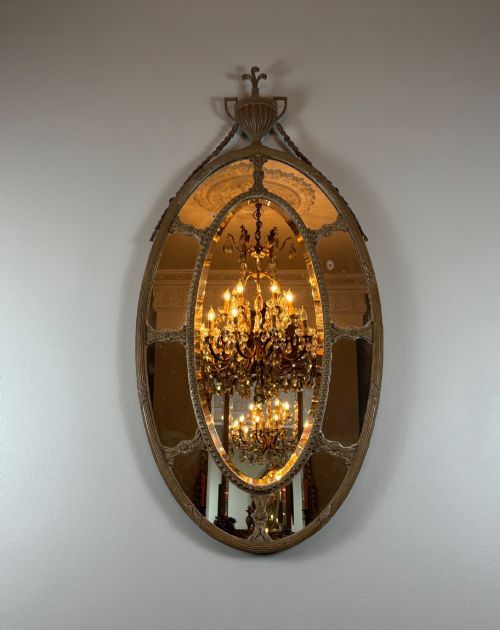
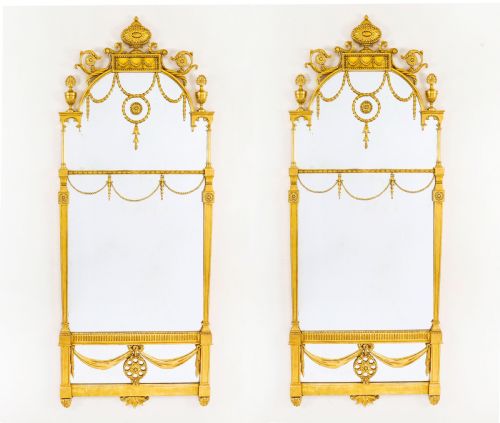


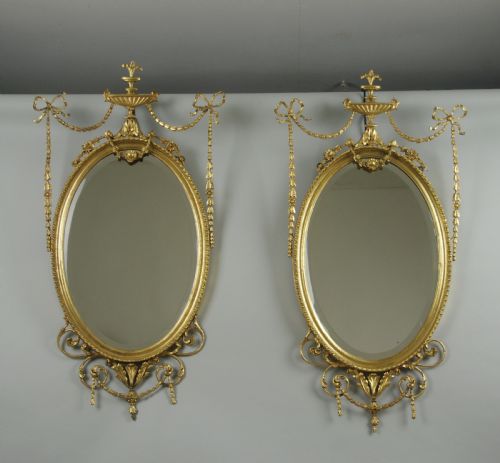


Neoclassical Urn Mirror
These neoclassical urn mirrors bring classical symmetry and refined architectural motifs into domestic spaces, prized for their balanced proportions and decorative urn details.
Neoclassical Urn Mirror
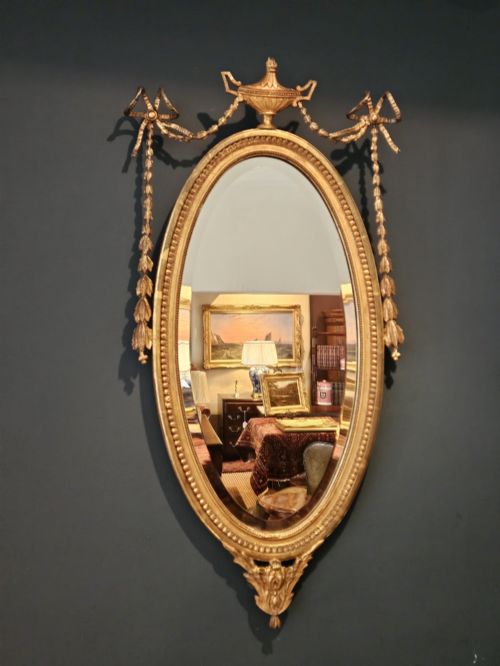
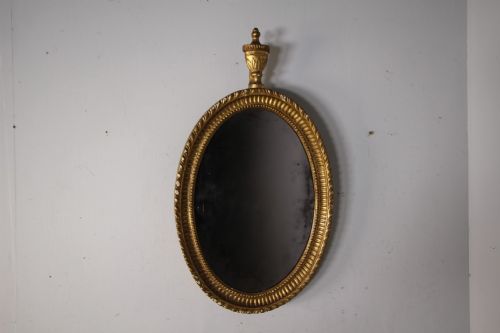
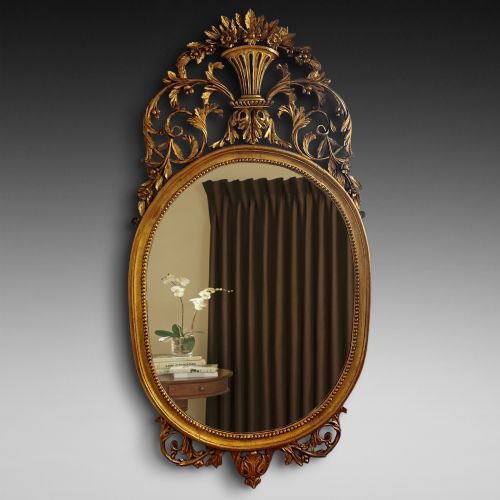
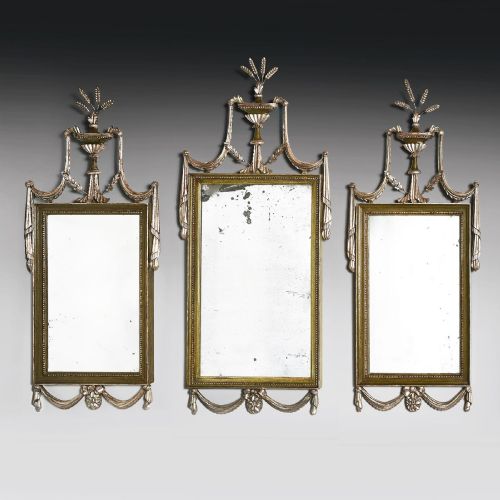
A neoclassical urn mirror combines classical revival aesthetics with wall-hanging functionality, frequently taking the form of an oval wall mirror or a larger overmantle piece. These items draw on eighteenth-century Georgian and Adam revival designs, alongside nineteenth-century interpretations that incorporate traditional swags and classical motifs.
The pieces appearing on this page span several eras from the eighteenth century through to the Edwardian period, encompassing English, French, and Swedish regional variations. Among these, Victorian adaptations and later Adam revival items are common, often retaining the characteristic gilded frames and vertical proportions intended for principal reception rooms.
Materials and construction methods
Reflecting surfaces consist of mirrored glass, sometimes framed as border glass panels or large single plates. Finishing techniques involve traditional gilding methods, ebonising, and parcel-gilt details, complemented by painted surfaces on specific French and English examples.
Some mirrors travelled all the way from Scottish country houses like Coilsfield House to end up gleaming on modern walls.
Distinctions in craftsmanship and finish
Quality rests upon the crispness of the carved or moulded ornamentation, particularly the definition within the urn and swag details adorning the crest. Finer examples display hand-carved woodwork and expertly applied gold leaf, whereas standard pieces rely on heavier composition mouldings with softer relief.
The integrity of the underlying timber frame and the preservation of the original mercury or antique mirror glass influence the overall character. Superior items maintain balanced proportions and sharp detailing across the gesso work, showing minimal restoration to the decorative elements.
Gillows Of Lancaster
The Neoclassical Urn Mirror Glossary
- Neoclassical
- A style inspired by the classical art and architecture of ancient Greece and Rome, emphasising symmetry, restraint, and classical motifs such as urns and swags.
- Giltwood
- Timber that has been coated with a thin layer of gold leaf, creating a luminous metallic surface typical of formal mirrors.
- Gesso
- A plaster-like mixture applied to wood frames as a base for moulding fine decorative details and holding gold leaf.
- Overmantle mirror
- A large horizontal or vertical mirror specifically designed to hang above a fireplace mantelpiece.
- Pier glass
- A tall mirror designed to be hung on the narrow pier of wall between windows.
Neoclassical Urn Mirror: Frequently Asked Questions
What is a neoclassical urn mirror?
A neoclassical urn mirror is a decorative wall hanging featuring classical architectural details, most notably a decorative urn motif often accompanied by swags and drops.
These pieces draw inspiration from eighteenth-century design principles, offering symmetrical forms suited to formal interiors.
Where should I hang an overmantle mirror?
Overmantle mirrors are traditionally hung directly above a fireplace mantelpiece to reflect light and anchor the room's central focal point.
Their substantial scale also allows them to function effectively on main walls in dining rooms or entrance halls.
How do I identify an Adam revival mirror?
Adam revival mirrors display characteristic eighteenth-century neoclassical motifs such as delicate urns, draped husks, swags, and oval frames.
Later Victorian and Edwardian reproductions replicate these same decorative vocabularies with moulded composition and gesso work.
Are these mirrors made of solid gold?
No, the frames are typically constructed from wood, gesso, or composition covered with a thin layer of gold leaf.
This technique provides the appearance of solid gold while keeping the structural weight manageable for wall hanging.