





Neoclassical Porcelain Pedestals
Neoclassical porcelain pedestals bring classical form and refined ceramic modeling into domestic interiors, offering structured elegance for display.
Neoclassical Porcelain Pedestals
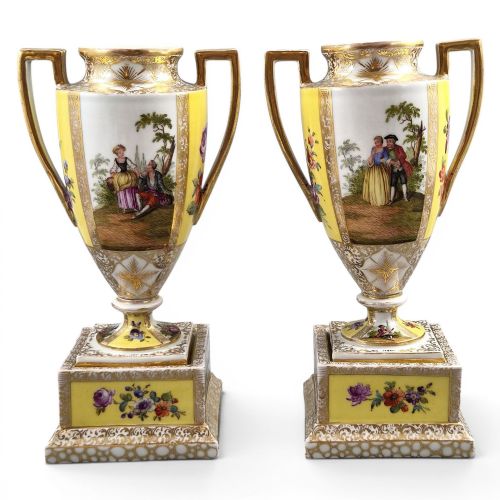
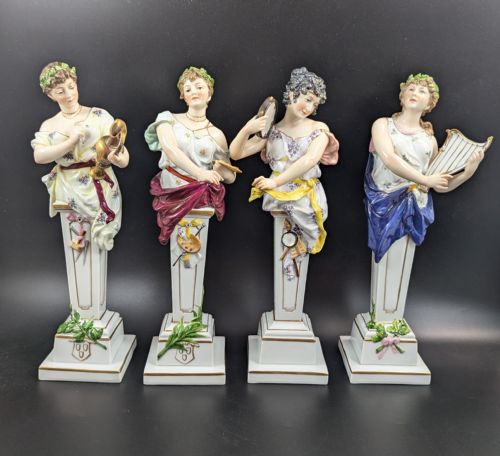
Neoclassical porcelain pedestals encompass urns, vases, busts, and figures produced across the Georgian and nineteenth-century periods. These objects draw directly upon classical antiquity, translating ancient architectural motifs and sculptural forms into high-fired ceramic bodies.
The pieces listed on this page predominantly feature nineteenth-century and Georgian manufacturing, spanning styles from Grand Regency and Rococo Revival to strict Neoclassical designs. Common forms include lidded campana urns, classical vases, and sculptural busts mounted on integrated or matching plinths.
Makers and factories represented in these examples utilise hard-paste porcelain, jasperware, and enamel paint alongside gilt and gold leaf embellishments. Buyers encounter both monumental pairs intended for formal reception rooms and smaller cabinet pieces decorated with white bas-reliefs or hand-painted scenes.
Markers of quality and execution
Quality reveals itself in the crispness of the moulding and the depth of the biscuit or glazed porcelain surface. Finer examples show sharp relief work in jasperware and precise hand-painting in enamels, whereas lesser pieces display softer contours and simpler, repetitive transfer printing.
The application of gilding and the weight of the porcelain body distinguish superior studio production from standard factory output. Well-executed pieces maintain balanced proportions across complex forms like lidded campana urns and multi-figure allegorical groups.
Marie Antoinette occasionally finds herself immortalised in bisque porcelain, watching over the mantelpiece.
Helena Wolfsohn Dresden·Achille Mollica·Naples Capodimonte·Vienna porcelain·Wedgwood
The Neoclassical Porcelain Pedestals Glossary
- Campana urn
- A bell-shaped vessel with a flared rim and foot, commonly associated with classical garden and interior decoration.
- Jasperware
- A fine-grained, unglazed stoneware developed with distinct coloured bodies and applied white ceramic reliefs.
- Hard-paste porcelain
- A true porcelain composed of kaolin and petuntse, fired at very high temperatures to create a dense, translucent body.
- Bas-relief
- A sculptural technique where figures and motifs project slightly from a flat background surface.
- Bisque
- Unglazed fired porcelain valued for its matte, marble-like finish that resembles carved stone.
Neoclassical Porcelain Pedestals: Frequently Asked Questions
What defines neoclassical porcelain pedestals?
These pieces combine ceramic manufacture with classical architectural shapes, including urns, vases, and sculptural busts.
They draw inspiration from ancient Greek and Roman art, featuring symmetrical forms and formal decorative motifs.
How were these urns used historically?
Objects of this form served primarily as decorative ornaments on mantelpieces, sideboards, and dedicated architectural pedestals.
Larger pairs were designed to punctuate grand interiors, while smaller vessels functioned as cabinet pieces.
How should I care for gilded porcelain?
Dust the surface gently with a soft, dry brush and avoid using water or chemical cleaning agents on painted or gilded areas.
Protect the pieces from direct sunlight and unstable humidity to preserve the enamel and gold leaf.
How do I distinguish nineteenth-century pieces?
Look for factory marks, paste composition, and the specific style of enamelling typical of periods like the Georgian era and the late nineteenth century.
Handling helps determine the weight and density of hard-paste porcelain versus later ceramic bodies.