


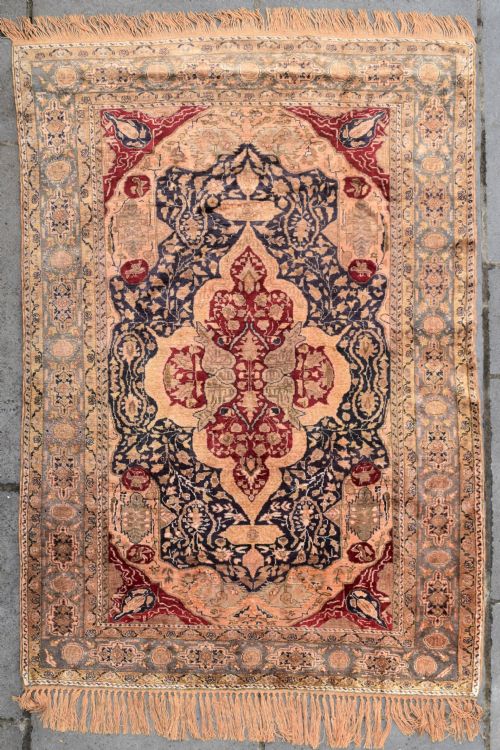


Navy Turkish Rug
A navy turkish rug brings grounding colour and rich Anatolian weaving tradition into a room.
Navy Turkish Rug
A navy turkish rug covers traditional Anatolian weaving styles from village and town workshops, spanning runner rugs, area rugs, prayer rugs and larger carpets. These textiles incorporate rich blue grounds alongside medallion patterns, star motifs and tribal designs.
The pieces on this page range from early nineteenth century Konya and Bergama examples to mid twentieth century silk Hereke, Sivas and Yagcebedir productions. Buyers will encounter room size carpets, long runners and smaller village formats showing distinct regional weaving traits.
How they were made
Weavers constructed these pieces using wool, hand-spun wool, cotton and occasionally floss silk, knotting them on sturdy cotton or wool foundations. Natural and traditional dyes yielded deep navy grounds and contrasting secondary tones.
Individual production methods vary by region, from village workshops utilising heavy wool to urban manufactories employing fine silk for detailed pictorial and geometric compositions.
Navy Turkish Rug Retail Price Guide 2026
Typical asking prices for navy turkish rug among the pieces listed under this phrase on Sellingantiques today, from the lower quarter to the upper quarter. They describe what is for sale here now, not the wider market.
Object forms include runners, area rugs, prayer rugs, large carpets and framed wall art.
What varies in quality
Quality rests in the precision of the knotting, the handling of the wool or silk material, and the depth of the dye work across the field. Finer town carpets show intricate detail, whereas village pieces rely on bold graphic impact and robust hand-spun wool.
The integrity of the foundation and the preservation of the original borders and selvedges determine the standing of each piece. Superior examples maintain crisp geometric lines and vibrant colour saturation in the navy ground.
Kemaliye·Konya·Panderma Bandirma·Yagcebedir·Bergama·Ushak·Sivas·Hereke·Dosemealti
The Navy Turkish Rug Glossary
- Yastic
- A small Turkish cushion cover or pillow rug, traditionally woven in village formats for domestic use. These pieces often feature concentrated tribal designs.
- Hereke
- A town near Istanbul renowned for producing exceptionally fine silk and wool carpets, often associated with court workshops. Pieces from this origin show high knot densities.
- Medallion
- A central ornamental motif set into the field of a rug, frequently seen in star and geometric configurations across Anatolian weaving.
- Selvedge
- The reinforced side edges of a rug, finished to prevent the warps and wefts from fraying during daily use.
- Prayer rug
- A textile featuring a distinct mihrab or arch design at one end, traditionally used for daily Islamic prayer rituals.
Navy Turkish Rug: Frequently Asked Questions
How do I care for an old rug?
Vacuum gently without a beater bar and keep the textile away from direct sunlight to protect the dyes.
Professional cleaning by a specialist in antique textiles ensures the wool and silk fibres remain intact over time.
Where were these pieces woven?
They originate from various regions across Anatolia, encompassing both nomadic tribal areas and established weaving towns.
Specific districts like Ushak, Bergama and Sivas each developed distinct structural methods and design vocabularies.
Are these pieces suitable for hallways?
Long runner formats function well in corridors and high traffic walkways when paired with a quality underlay.
Sturdier wool village pieces handle daily foot traffic effectively while adding warmth and pattern to functional spaces.
What is the difference between village and town rugs?
Village rugs display bolder geometric motifs and heavier hand-spun wool, reflecting localized tribal traditions and domestic production.
Town rugs utilise finer knotting, often incorporating cotton foundations and floss silk to achieve intricate floral and architectural patterns.