
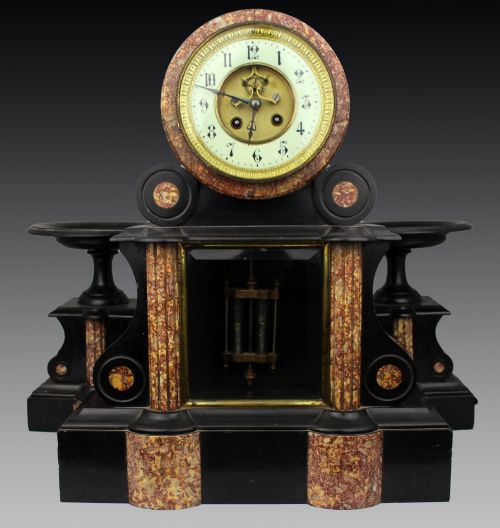


Mid Century Mantel Clock
A mid century mantel clock brings mechanical precision and striking design into a room, spanning styles from the 1950s and 1960s to mid 19th century revival pieces.
Mid Century Mantel Clock
A mid century mantel clock encompasses functional timepieces designed for domestic interiors, originating primarily from the 1950s and 1960s alongside earlier 19th century French and traditional styles. Buyers searching this phrase will find a diverse mix of forms, ranging from desk clocks and carriage clocks to larger garniture sets and perpetual motion designs.
The 1960s examples often reflect Mid-Century Modern or Art Deco influences, featuring clean dials and geometric brass or gilt cases. Alongside these modern designs, the selection frequently includes 19th century French gilt bronze, marble, and slate pieces that share shelf and mantel placement with their later counterparts.
Materials and Construction
Cases combine metals such as brass, gilt brass, gilt bronze, steel, and rhodium plating with glass domes and enamel dials, while specific examples incorporate burr walnut, marble, and slate. Mechanical movements range from 8-day mechanisms and 15-jewel configurations to perpetual motion systems and electro-mechanical wind mechanisms.
Workmanship relies on precision gearing and specialised casing, from heavy carriage clock frames to complex skeletal movements and bell-jar enclosures. Surviving pieces show combinations of cast metals, applied patinated bronze, and detailed dials executed by established makers.
Mid Century Mantel Clock Retail Price Guide 2026
Typical asking prices for mid century mantel clock among the pieces listed under this phrase on Sellingantiques today, from the lower quarter to the upper quarter. They describe what is for sale here now, not the wider market.
Some promotional desk clocks proudly advertised motor cars and tyres right alongside the ticking time.
Assessing Quality and Execution
Quality reveals itself in the sophistication of the movement and the integrity of the housing materials, such as heavy gilt bronze versus standard plated metal. Finer examples display refined dial execution, jewelled mechanisms, and original protective elements like glass bell-jars or matching presentation stands.
The distinction between standard production items and premier pieces rests on mechanical complexity, such as perpetual motion calibres or multi-day wind capabilities, paired with well-preserved finishes on marble, wood, and metal components.
Japy Freres·L Epee·Imhof·Smiths·Jaeger LeCoultre·Elliott of London·Luxor·Kienzle
The Mid Century Mantel Clock Glossary
- Atmos clock
- A mechanical timepiece driven by changes in atmospheric temperature and pressure, eliminating the need for manual winding. This perpetual motion system was famously produced by Jaeger-LeCoultre.
- Garniture set
- A clock accompanied by matching decorative side ornaments, such as urns or candelabra, designed to sit together on a mantelpiece.
- Carriage clock
- A small, portable spring-driven timepiece originally built for travelling, typically featuring a rectangular brass case with glass panels and a folding handle on top.
- Escapement
- The mechanical linkage that controls the unwinding of a clock's mainspring by translating rotational force into regulated impulses.
- Skeleton timepiece
- A clock designed with an open framework that exposes the gear trains and internal movement to view from the sides.
Mid Century Mantel Clock: Frequently Asked Questions
How do Atmos clocks work?
An Atmos clock operates using a hermetically sealed capsule containing a gas and liquid mixture that expands and contracts with temperature variations. These microscopic shifts wind the mainspring continuously without human intervention.
This ingenious mechanism allows the clock to run indefinitely under normal indoor conditions, provided it remains stationary and level on its mantel or desk.
Where should I place a mantel clock?
Mantel clocks suit flat, stable surfaces such as fireplace mantels, sideboards, bookshelves, and executive desks. Heavier stone or marble models require sturdy support due to their substantial weight.
Positioning the clock away from direct sunlight and drafts protects delicate internal mechanics and exterior finishes like gilt bronze or wood veneer.
How do I wind an 8-day clock?
An 8-day clock requires manual winding using a matching key inserted into the dial arbours every week. Care must be taken not to overwind the mainspring once resistance is felt.
Regular servicing ensures the gear train maintains accurate timekeeping between winding intervals without straining the escapement.
What is the difference between a carriage clock and a desk clock?
Carriage clocks originated as sturdy, portable travel timepieces featuring glass panels and carrying handles, often housed in heavy brass or gilt cases. Desk clocks are generally stationary units designed specifically for flat surface display in offices or homes.
While both occupy similar domestic spaces today, carriage clocks retain their distinct travelling heritage and robust protective framing.