
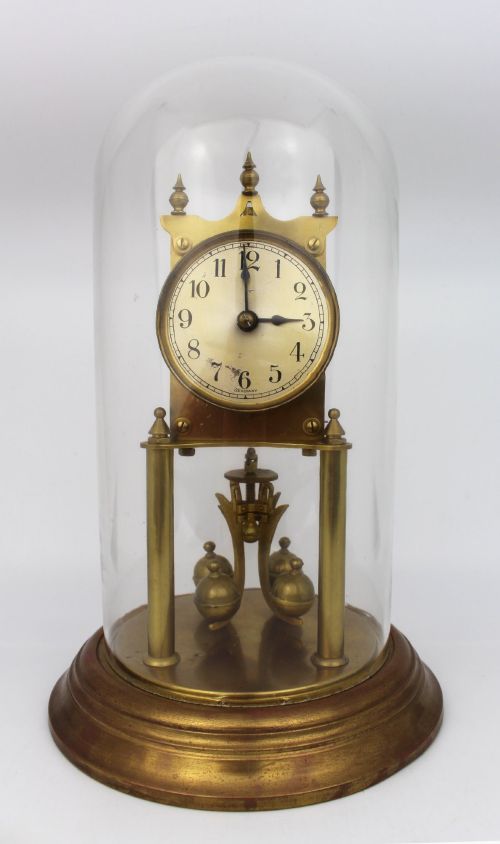


Torsion Pendulum Clock
A torsion pendulum clock is a mechanical timekeeper driven by a slow, twisting suspension spring, sought after for its mesmerising, continuous rotary motion.
Torsion Pendulum Clock
A torsion pendulum clock relies on a rotational pendulum that oscillates back and forth rather than swinging. These pieces appear on this page across several periods, stretching from the Edwardian era through the mid-twentieth century.
The selection here includes traditional anniversary clocks housed beneath glass domes alongside perpetual motion mantel clocks. Origins span Germany and Switzerland, with makers such as Jaeger-LeCoultre and B H A represented.
Forms range from classic round dials to square dials and bell-jar cases, constructed in materials from brass and rhodium to wood and enamel.
How they were made
Construction combines brass, steel, and metal components housed beneath protective glass domes or bell-jar cases. Movements utilise specialised mechanisms, including fifteen-jewel perpetual motion systems and year-long gear trains.
Surface finishes include gold gilt and rhodium plating applied to metal frames, paired with enamel or metal dials. Wooden elements appear in some housings, while original boxes and paperwork accompany certain Swiss pieces.
Torsion Pendulum Clock Retail Price Guide 2026
Typical asking prices for torsion pendulum clock among the pieces listed under this phrase on Sellingantiques today, from the lower quarter to the upper quarter. They describe what is for sale here now, not the wider market.
Listings feature brass, rhodium, gold gilt, and glass materials across periods spanning the nineteenth century through the 1960s.
What varies in quality
Quality rests upon the complexity and precision of the movement, distinguishing standard year-long mechanisms from sophisticated perpetual motion calibres. The choice of exterior plating, such as rhodium or gold gilt over brass, alters the character of the finish.
Integrity of the original housing, from clear glass domes to bell-jar cases and accompanying paperwork, shapes the completeness of the piece. Dial design also contributes, with variations between round formats and square configurations.
Jaeger-LeCoultre·Le Coultre·B H A
The Torsion Pendulum Clock Glossary
- Torsion pendulum
- A suspended pendulum that rotates around its vertical axis rather than swinging from side to side. This slow twisting action conserves energy, allowing the clock to run for months or a full year between windings.
- Anniversary clock
- A common term for a torsion pendulum clock designed to run for four hundred days on a single wind. They are often associated with domestic mantel displays from the Edwardian period and earlier.
- Atmos clock
- A mechanical timepiece manufactured by Jaeger-LeCoultre that is driven by changes in temperature and atmospheric pressure. It requires no manual winding and operates indefinitely through a hermetically sealed capsule.
- Bell-jar case
- A blown glass cover shaped like a bell that protects the delicate torsion mechanism from dust and air currents. These housings sit upon circular bases fitted to the clocks.
- Rhodium plating
- A hard, reflective metallic coating applied to brass or base metals to provide a bright silver-coloured finish. It protects the underlying components from tarnishing.
Torsion Pendulum Clock: Frequently Asked Questions
How do these clocks wind?
Most traditional torsion pendulum clocks require a key to wind the mainspring manually once a year, typically around an anniversary date.
Atmos models operate entirely differently, using sealed bellows that expand and contract with daily temperature shifts to wind the mechanism automatically.
Why does the pendulum twist?
The mechanism uses a thin strip of spring steel rather than a traditional pivot and anchor. As the gear train releases energy, the suspended weight rotates in one direction until the torsion of the spring reverses the motion.
This circular oscillation consumes very little power, which is why these movements can run for extended periods without manual intervention.
Where should I place an Atmos clock?
These pieces need a stable, level surface away from direct sunlight, drafts, and heavy vibrations to maintain accurate timekeeping.
Because the movement relies on ambient temperature fluctuations, a room with a moderate, natural daily variation in climate helps the internal gas capsule function correctly.
Are glass domes original?
Many surviving examples retain their original blown glass covers or bell-jar cases, which were fitted closely to protect the delicate suspension spring from drafts.
Replacement domes appear frequently due to the fragile nature of old glass, so examining the fit against the base offers clues to its history.