


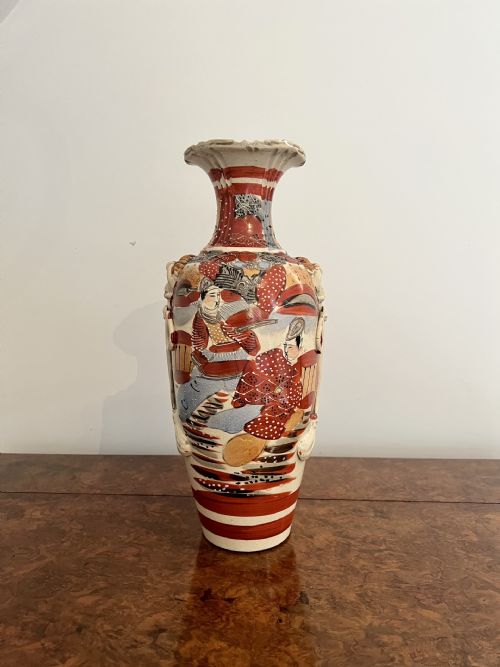
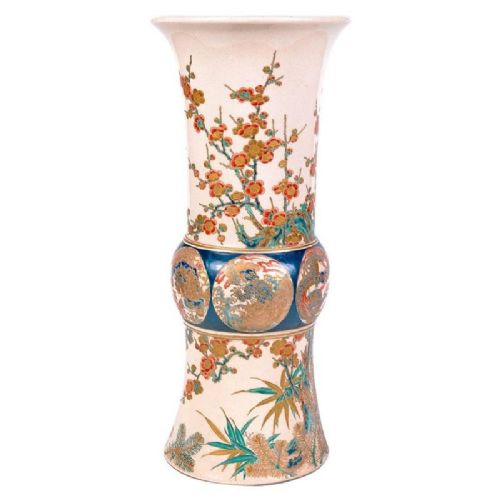


Meiji Satsuma Floor Vase
These meiji satsuma floor vase pieces are grand earthenware vessels brought from Japan, offering collectors intricate enamel work and gold leaf.
Meiji Satsuma Floor Vase
When you search for a meiji satsuma floor vase, you find tall earthenware vessels decorated during the late nineteenth and early twentieth centuries. The selection includes large pairs, bulbous forms, and lidded urns originating from the Meiji period.
Most items on this page date from the nineteenth century up to nineteen twenty, often carrying Japanese export styles. Buyers frequently encounter tall two-handle vases and large decorative display pieces finished with intricate painted motifs.
How they were made
Potters built these vessels using earthenware and porcelain, shaping large bodies to stand as prominent floor pieces. Artisans then applied detailed enamel decoration across the ceramic surface.
Makers embellished the designs using gold leaf and gilt highlights to frame figurative panels and geometric insets. This combination of ceramic body, coloured enamel, and gold leaf defines the physical construction.
Meiji Satsuma Floor Vase Retail Price Guide 2026
Typical asking prices for meiji satsuma floor vase among the pieces listed under this phrase on Sellingantiques today, from the lower quarter to the upper quarter. They describe what is for sale here now, not the wider market.
Listings span periods from eighteen eighty to nineteen twenty, featuring earthenware, porcelain, enamel, and gold leaf.
What varies in quality
The standard of painting and the precision of the enamel work distinguish the finer examples from standard production. Artisans who executed complex geometric inset panels or delicate figural scenes achieved a higher artistic level.
Scale and proportion also influence the standing of a piece, particularly in matched pairs of significant height. The careful application of gold leaf and the crispness of the earthenware form separate the best examples.
Kinkozan
The Meiji Satsuma Floor Vase Glossary
- Meiji Period
- The era in Japanese history spanning from eighteen sixty-eight to nineteen twelve, noted for increased export of decorative arts. Pieces from this time often feature elaborate enamel and gilt ornamentation.
- Earthenware
- Porous pottery fired at lower temperatures, commonly used as the base body for these decorative vessels. It provides a heavy structure suitable for large floor display pieces.
- Enamel
- Opaque glass paste applied to the ceramic surface and fired to create colourful painted designs. This technique allows for rich, permanent coloration on the vase body.
- Gilt
- A thin layer of gold applied to surface details, enhancing the decorative contrast against the enamel. It brings a reflective quality to specific areas of the pattern.
Meiji Satsuma Floor Vase: Frequently Asked Questions
How do I date a satsuma floor vase?
Dating relies on stylistic markers and manufacturing methods associated with the nineteenth century and the Meiji era. Export pieces often reflect the aesthetic preferences of specific decades.
Examination of the earthenware body and enamel style helps establish whether a piece originates from the late nineteenth century or the early twentieth century.
Were these vases made for export?
Many satsuma vessels from this era were produced specifically for international markets following the opening of Japanese trade. They catered to Western demand for elaborate decorative arts.
This export focus accounts for the scale of large floor vases and the grand decorative schemes found on pieces from the Meiji period.
How should I display a floor vase?
Due to their substantial height and weight, these vessels require a stable, secure position away from heavy traffic areas. Placing them directly on the floor lets their scale and detailed panels stand out.
Pairs look balanced when positioned symmetrically in large rooms, while single tall vases work well as focal points in corners or hallways.