
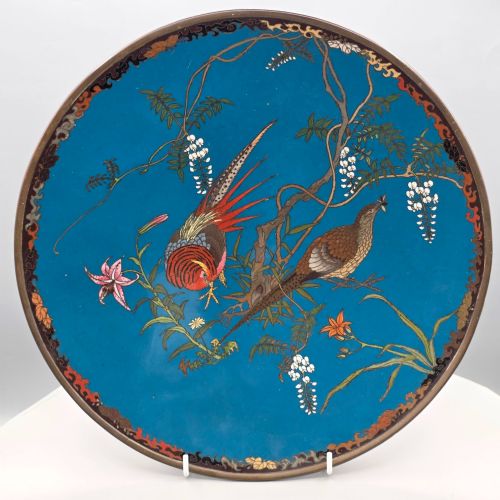
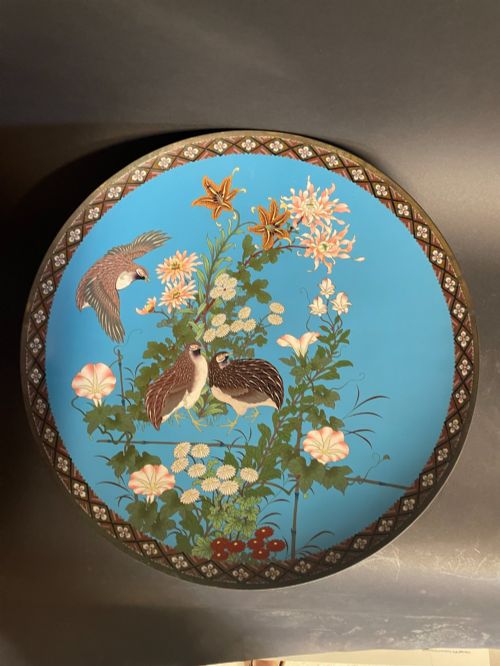
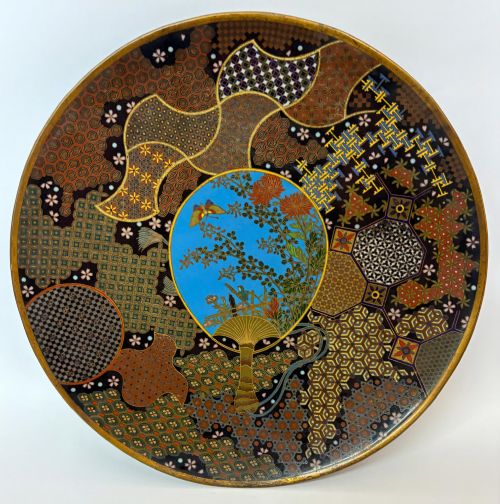


Meiji Period Decorative Plaque
These Japanese meiji period decorative plaque examples are large round vessels and trays that bring rich nineteenth-century metalwork and ceramics into a room.
Meiji Period Decorative Plaque
A meiji period decorative plaque typically takes the form of a large charger, round dish, or tray spanning thirty centimetres or more across. These works serve as substantial wall hangings or table centrepieces rather than tableware.
The objects derive from nineteenth-century Japan, spanning the decades from the eighteen-sixties through to nineteen-hundred. The selection on this page relies heavily on cloisonne enamel and Imari porcelain.
Subjects range from dragons, birds, and aquatic life to human figures like samurai and figures from folklore. Octagonal trays and round dishes represent the primary geometric formats available.
How they were made
Cloisonne enamel pieces begin with a base of brass or copper onto which thin metal wire creates individual cells for coloured enamel pastes. Firing fixes the glassy powders into place before polishing reveals the intricate linear design.
Porcelain chargers employ hand-painted pigments beneath or above glaze, sometimes incorporating totai shippo methods where enamel adheres directly to a ceramic body. Mixed-metal details and gold gilt enhance specific metallic surfaces.
Certain works introduce unusual textures, such as simulated tree bark or applied cinnabar lacquer layered over the core material.
Listings span the nineteenth century, utilising bronze, copper, brass wire, porcelain, and gold gilt alongside traditional enamel.
What varies in quality
The precision of the wirework and the depth of the enamel colour set the standard for cloisonne vessels. Finer examples display meticulous symmetry in complex motifs like dragons and foliage without pooling or pitting in the glaze.
Signatures on the reverse or base often distinguish individual studio output from standard commercial production. Scale also dictates tier, with massive chargers commanding attention through sheer ambition of manufacture.
The Meiji Period Decorative Plaque Glossary
- Charger
- A large ornamental plate or platter designed for display rather than dining. These form the primary canvas for nineteenth-century enamel and porcelain work.
- Cloisonne
- A technique where thin metal wires are soldered to a metal base to form cells that hold coloured enamel pastes. Subsequent firing and polishing create a smooth decorative surface.
- Totai shippo
- A method of applying cloisonne enamel directly onto a ceramic or porcelain body rather than metal. This unusual process combines ceramic forms with wirework cells.
- Imari
- A style of Japanese export porcelain decorated in underglaze blue, iron red, and gold. These colourful plates often feature dense floral and geometric panels.
- Komai style
- Metalwork associated with the Komai company, featuring intricate designs inlaid in gold and silver upon a dark rusted or patinated iron or brass ground.
Meiji Period Decorative Plaque: Frequently Asked Questions
How were these decorative plaques displayed?
Nineteenth-century households typically mounted large chargers on walls using specialised wire hangers or displayed them upright on heavy wooden stands.
Today, they function similarly as bold focal points above mantelpieces or within cabinet displays.
What subjects appear on these pieces?
Common motifs include dragons, koi fish, birds such as ibis and cranes, and scenes featuring samurai warriors.
Floral arrangements involving chrysanthemums and bamboo also recur frequently across the enamel and porcelain surfaces.
How do I distinguish cloisonne from porcelain?
Cloisonne relies on a metal foundation of brass or copper with raised wire outlines separating fields of coloured glass paste. Porcelain pieces present a ceramic body with painted glazes and a smooth vitrified surface.
What is the Meiji period?
The Meiji period spans from eighteen-sixty-eight to nineteen-twelve, marking an era of rapid modernization and international artistic export in Japan.
Craftsmen during this time produced exceptional metalwork and ceramics for Western markets.