

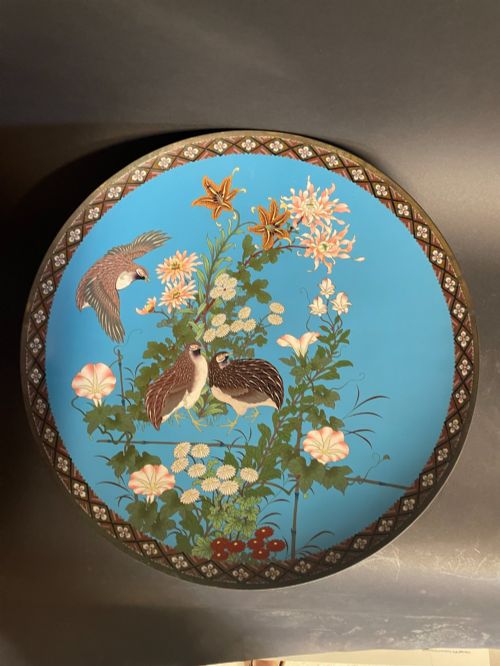


Bird Motif Charger
A bird motif charger brings the natural world indoors through enduring craftsmanship, offering a striking focal point for any room.
Bird Motif Charger
A bird motif charger represents a diverse category of large decorative plates, dishes, and plaques featuring avian subjects across various periods.
Buyers frequently encounter Japanese cloisonne enamel and Imari examples from the nineteenth century alongside Chinese export and European ceramic pieces.
These items function primarily as decorative centrepieces or wall displays, showcasing detailed imagery of birds such as ibis, house sparrows, and other winged subjects.
Materials and construction methods
Many pieces utilise cloisonne enamel on metal foundations, incorporating fine wirework to separate coloured enamel sections that depict avian plumage and botanical backgrounds.
Ceramic examples employ porcelain, pottery, and ironstone decorated with blue and white glazes, polychrome pigments, or majolica techniques.
Alternative forms utilise carved wood, bronze, or lacquer to create substantial decorative plates and plaques.
Listings span the eighteenth, nineteenth, and early twentieth centuries, featuring origins in Japan, China, and Austria across ceramic, metal, and enamel mediums.
Distinctions in quality and execution
The sophistication of the bird imagery and the precision of the background detailing dictate the calibre of each piece, distinguishing simple production from masterwork execution.
Material application, such as the fineness of enamel wires or the clarity of hand-painted polychrome glazes, marks the distinction between standard items and superior examples.
The presence of artist signatures and the structural integrity of larger bronze or wooden forms influence the overall standing of an object.
Shozo
The Bird Motif Charger Glossary
- Charger
- A large decorative plate or platter intended for display rather than table service. These substantial vessels provide a wide canvas for elaborate bird and nature scenes.
- Cloisonne
- A decorative metalwork technique where thin metal strips are soldered to a base to form compartments, which are then filled with coloured enamel paste and fired.
- Imari
- A traditional style of Japanese porcelain featuring characteristic blue, iron red, and gold decorative schemes. These wares often incorporate intricate borders alongside central motifs.
- Majolica
- A type of earthenware coated with an opaque tin glaze and painted with metallic oxide colours. This technique produces vibrant, glossy surfaces suited to botanical and animal subjects.
- Kutani
- A style of Japanese coloured porcelain known for rich polychrome enamel painting and detailed pictorial designs. Pieces from this tradition frequently display birds within natural settings.
Bird Motif Charger: Frequently Asked Questions
How were bird motif chargers used?
These large plates primarily served as decorative centrepieces on tables, sideboards, or walls rather than for serving food.
Their substantial size and detailed imagery allowed households to showcase fine craftsmanship and artistic depictions of nature within their living spaces.
What materials are common?
The selection includes ceramic pieces made from porcelain, pottery, and ironstone, alongside metal works utilising bronze, brass, copper, and cloisonne enamel.
Some examples also incorporate carved wood and lacquer to form heavy decorative plaques and centrepieces.
How do I identify Japanese periods?
Distinguishing between periods like the Edo, Meiji, and later decades relies on observing stylistic shifts in the artwork, glaze compositions, and manufacturing signatures.
Edo period items often reflect traditional Imari palettes, while Meiji pieces frequently demonstrate advanced cloisonne and Kutani painting techniques.
Are these chargers fragile?
Ceramic and enamel pieces require careful handling to avoid chipping the glaze or damaging the delicate metal wires used in cloisonne work.
Bronze and wooden examples offer greater structural durability but still benefit from stable display environments away from moisture and direct sunlight.