
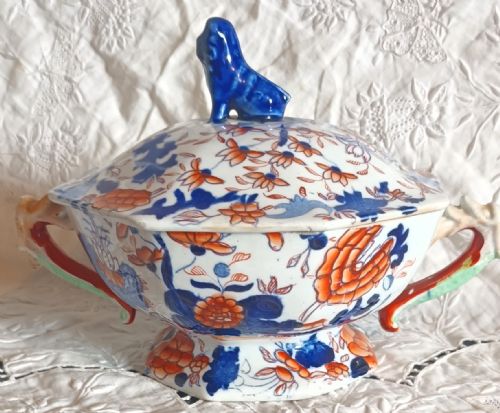


Masons Ironstone Tureen
These masons ironstone tureen pieces are durable ceramic vessels created for grand dining tables, offering both utility and striking decorative presence.
Masons Ironstone Tureen
A masons ironstone tureen serves as a practical vessel for soup, sauce, or vegetables while displaying robust ceramic construction. Buyers encounter forms ranging from large soup tureens with stands to smaller sauce tureens complete with ladles.
The inventory spans the 19th Century, incorporating Georgian, Regency, and Victorian periods. Pieces frequently exhibit English Chinoiserie and Victorian Imari styles, including distinct patterns such as Mandarin, Green Mandarin, Bamboo, Japan Basket, and Grasshopper.
Materials and Techniques
Potters utilised durable ironstone ceramic and earthenware bodies designed to withstand heavy table use. These sturdy structures received protective glaze coatings to seal the clay surfaces.
Decoration relied upon hand-applied enamel colours and gold leaf or gilt details. Artisans executed intricate Chinoiserie and Imari motifs directly onto the ceramic body before or after initial firing.
Grasshoppers and mandarins persistently leap across early 19th Century ceramic walls, proving that fine dining once required a touch of wildlife.
Quality Variations
Superior examples display crisp, well-defined transfer or hand-painted details in the enamel and gold leaf. Finer pieces retain matching covers and original stands, preserving the complete service ensemble.
Differences appear in the precision of the ceramic moulding and the vibrancy of patterns like the Grasshopper or Mandarin designs. The application of gilt highlights and glaze consistency distinguishes standard utilitarian wares from high-status service pieces.
Mason's Ironstone
The Masons Ironstone Tureen Glossary
- Ironstone
- A patented ceramic body invented in the 19th Century to provide a tough, durable alternative to porcelain. It resists chipping while offering a fine surface for colourful glazes.
- Chinoiserie
- European artistic interpretation of Chinese and East Asian decorative motifs. This style appears frequently on early 19th Century serving vessels.
- Imari
- A decorative style featuring rich cobalt blue, iron red, and gilt accents inspired by Japanese export ceramics. Victorian makers adapted this palette for heavy earthenware tureens.
- Soup Tureen
- A large, deep vessel equipped with a lid and sometimes a matching stand, designed specifically for serving broth or soup at the dining table.
- Sauce Tureen
- A smaller scaled vessel used for holding and pouring table sauces or gravies, often supplied in pairs alongside ladles.
Masons Ironstone Tureen: Frequently Asked Questions
What were masons ironstone tureen vessels used for?
These ceramic vessels held soup, vegetables, or sauces at formal dining tables during the 19th Century. Their robust construction kept contents warm while serving multiple guests.
Larger soup tureens sat centrally on large tables, whereas smaller sauce tureens were positioned closer to individual diners.
How do I care for a vintage tureen?
Wash the ceramic body gently by hand using mild soap and warm water. Avoid soaking pieces with gilt or enamel decoration to protect the surface.
Display the tureen on a stable sideboard or in a cabinet away from heavy traffic areas to prevent accidental knocks.
Are these tureens safe for food use?
Historic ironstone can contain older glaze materials that may react with acidic foods over extended periods. Most collectors prefer to use them for dry display or gentle presentation rather than active cooking or daily dining.
Inspect the interior glaze for any wear or crazing before considering serving food from antique vessels.
How do I identify Georgian pieces?
Georgian and Regency examples typically date between 1810 and 1830, exhibiting early Chinoiserie patterns like Mandarin or Grasshopper. They display dense ironstone bodies with rich enamel painting.
Later Victorian pieces often incorporate heavier moulded details and different floral or Imari motifs characteristic of the late 19th Century.