
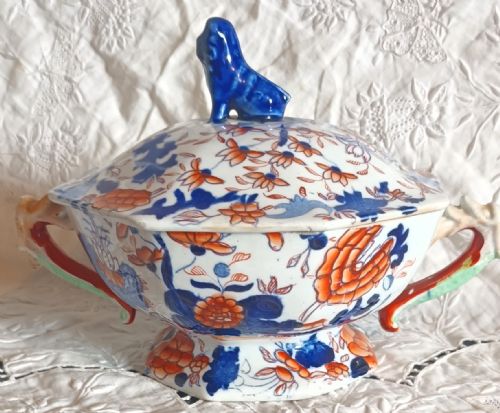


English Ironstone Vegetable Dish
An English ironstone vegetable dish brings heavy earthenware utility and bright nineteenth-century transfer printing straight to the dining table.
English Ironstone Vegetable Dish
When you search for an english ironstone vegetable dish, you encounter robust covered bowls and lidded tureens created to serve food in nineteenth-century dining rooms. The pieces on this page span the Georgian and Victorian eras, taking the form of large covered bowls, sauce tureens with ladles, and vegetable tureens complete with stands.
Makers utilised durable ceramic bodies designed to withstand daily use while carrying rich decorative schemes. Most examples you meet date from the nineteenth century, including Georgian and Victorian periods featuring blue and white transfer prints, Chinoiserie patterns, and Japan basket designs.
How they were made
Potters built these serving vessels using ironstone ceramic and earthenware bodies, glazed to create a hard-wearing surface that resisted chipping. Workshops applied detailed transfer printing in blue and white, alongside hand-painted enamels in green mandarin and other polychrome motifs.
Finishing touches often included gold leaf and gilt highlights applied over the glaze to accentuate handles, finials, and rims. The resulting pieces combined industrial durability with refined decorative arts techniques.
Some nineteenth-century sauce tureens survived complete with their original tiny ladles, dodging centuries of clumsy kitchen staff.
What varies in quality
Quality rests upon the crispness of the transfer print and the precision of the hand-applied enamel colours. Pieces with intact gilt highlights and original matching stands or ladles demonstrate superior original craftsmanship.
The sophistication of the pattern dictates the visual impact, ranging from simple blue and white transfer prints to intricate Chinoiserie and Japan basket compositions executed with multiple enamel tones.
Mason's Ironstone
The English Ironstone Vegetable Dish Glossary
- Ironstone
- A heavy, durable ceramic invented in the nineteenth century as a robust alternative to porcelain. It takes glazes and transfer printing exceptionally well.
- Tureen
- A deep covered bowl designed for serving soups, sauces, or vegetables at the table. These often include matching lids and occasional under-stands.
- Transfer print
- A decorative technique where an engraved copper plate transfers a design onto tissue paper, which is then stamped onto the ceramic body before glazing. This method allowed for intricate, repeatable patterns.
- Chinoiserie
- European decorative motifs inspired by Chinese art and landscape designs. Popular on nineteenth-century ceramics.
- Gilt
- A thin layer of gold or gold-coloured material applied to ceramic rims and handles for decoration. It adds a polished finish to the vessel.
English Ironstone Vegetable Dish: Frequently Asked Questions
What is an english ironstone vegetable dish used for?
These covered vessels served vegetables, sauces, and stews at grand nineteenth-century dining tables. The lids helped keep food warm during long meals.
Today, they function well as decorative centrepieces, side table ornaments, or functional serving pieces for family gatherings.
How do I date an english ironstone vegetable dish?
Dating relies on maker marks, pattern styles, and the specific composition of the ceramic body. Georgian pieces often display early patent marks and hand-painted Chinoiserie or mandarin palettes.
Victorian examples frequently utilise transfer printing methods and distinct registry marks that indicate the exact year of production.
How do I care for my vegetable dish?
Wash the ceramic gently by hand using warm water and mild soap to protect the glaze and any delicate gold leaf highlights. Avoid harsh scrubbing pads or abrasive detergents.
Keep ironstone pieces away from modern dishwashers and sudden temperature changes to prevent hairline cracks in the historic glaze.
Are these dishes safe for food use?
While ironstone is fundamentally a dense ceramic material, nineteenth-century glazes and enamel decorations may contain trace materials. Many collectors prefer to use them for dry presentation or display.
If you plan to serve hot food, inspect the interior glaze for wear and ensure the piece remains stable and clean.