
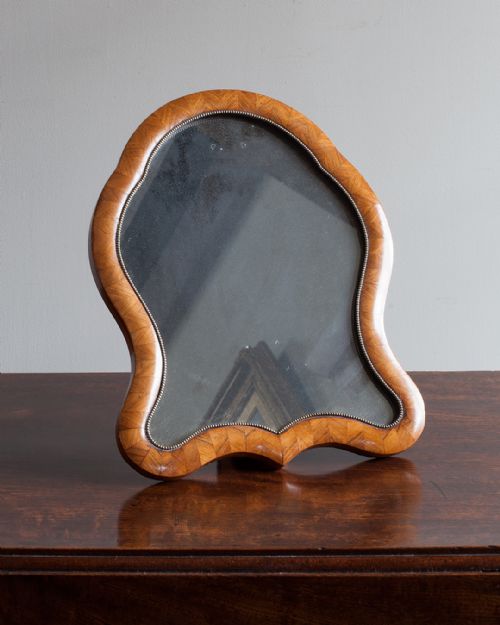


Marquetry Tabletop Mirror
These marquetry tabletop mirror examples bring warmth and intricate wood patterns to a dressing space, combining practical glass with exceptional decorative detail.
Marquetry Tabletop Mirror
A marquetry tabletop mirror sits on a chest or dressing table, offering a movable reflective surface framed by detailed wood veneers. The pieces seen here span the eighteenth, nineteenth, and twentieth centuries, taking the form of toilet mirrors, dressing table mirrors, and swing mirrors.
Dutch marquetry and Georgian styles dominate the selection, often featuring complex floral or geometric inlays in walnut, mahogany, and satinwood. Alongside standard swing mirrors, the listings include occasional tabletop cabinets that incorporate display space or small drawers beneath the glass.
How they were made
Cabinetmakers constructed these frames using secondary timbers veneered with exotic and native woods like kingwood, walnut, and mahogany. Boxwood inlay and brass mounts frequently accent the surfaces, while original mirror glass sits within adjustable swing frames.
Marquetry technique involves piecing together fine veneers of different coloured woods, such as satinwood, to form pictorial or floral designs before gluing them to the carcass. Ormolu mounts and porcelain plaques occasionally appear on related tabletop furniture from the nineteenth century.
The listings span the eighteenth to the twentieth centuries, featuring walnut, mahogany, satinwood, and kingwood veneers.
What varies in quality
Quality rests upon the precision of the veneer work and the depth of the floral or geometric marquetry. Finer examples display crisp, intricate boxwood inlay without lifting veneers, while lesser pieces show simpler patterns and heavier, less refined timber selection.
The sophistication of the frame architecture and the survival of original brass hardware or mirror glass dictate the standing of a piece. Better proportioned dressing mirrors maintain a balanced swing action and solid timber backboards.
The Marquetry Tabletop Mirror Glossary
- Marquetry
- The art of applying pieces of veneer to a structure to form decorative patterns and pictures. This technique defines the visual character of Dutch and Georgian mirror frames.
- Toilet mirror
- A small mirror designed to stand on a dressing table or chest of drawers for personal grooming. These often incorporate small drawers in the base.
- Kingwood
- A dense, richly grained tropical timber utilised in high-end nineteenth-century cabinetmaking. Its dark brown colour and distinct figuring suit detailed veneer work.
- Ormolu
- Gilded bronze used for decorative mounts and accents on furniture. It appears alongside porcelain plaques on nineteenth-century tabletop pieces.
Marquetry Tabletop Mirror: Frequently Asked Questions
How do I clean the wood frame?
Dust the marquetry gently with a dry, soft cloth to prevent dirt accumulation in the fine veneer joints. Avoid using harsh chemical polishes or excessive moisture, which can damage old timber and lift inlay.
Apply a microcrystalline wax sparingly once or twice a year if the wood appears dry. Buff lightly with a clean cloth to maintain a natural, protective sheen.
Are the mirror plates original?
Many nineteenth-century and earlier mirrors have replacement glass due to foxing, silver loss, or breakage over time. Original mirror plates often exhibit subtle distortions, minor age spots, and uneven thickness.
Examining the silvering on the reverse and how the glass is secured in the rebate helps determine its age. Replacements are common and do not necessarily diminish the decorative utility of the piece.
Where should I place the mirror?
Position the mirror on a sturdy dressing table, chest of drawers, or sideboard of appropriate proportions. Ensure the surface is level so the swing mechanism functions properly without straining the side pivots.
Keep the piece away from direct sunlight and strong heat sources like radiators to prevent the veneers from drying out or warping. Stable room humidity preserves both the wood and the inlay.