
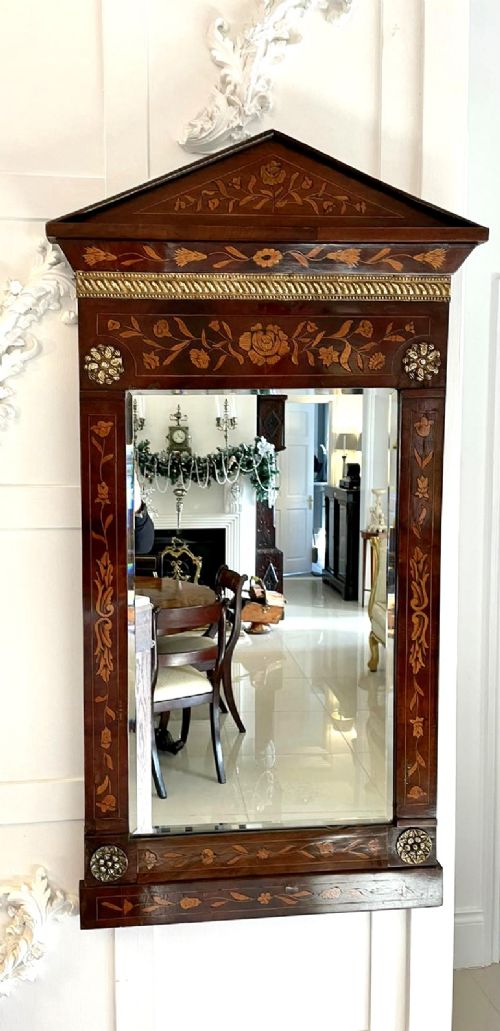


Dutch Marquetry Mirror
These dutch marquetry mirror examples bring floral artistry and rich timber into a room, offering both practical reflection and intricate historic craft.
Dutch Marquetry Mirror
When searching for a dutch marquetry mirror, buyers look at pieces defined by elaborate inlaid floral and foliate patterns set into timber grounds. The pieces seen span wall mirrors, hanging wall mirrors, pier mirrors, overmantle mirrors, cushion mirrors, and cheval mirrors alongside dressing table mirrors, toilet mirrors, and dressing mirrors.
The versions most commonly met on this page are toilet mirrors and dressing table mirrors designed to sit on furniture, as well as wall mirrors intended to hang. These objects date from the eighteenth century, the nineteenth century, and around eighteen fifty, reflecting periods such as George III and Victorian times.
Makers and cabinetmakers constructed these frames using materials including walnut, mahogany, fruitwood, and boxwood, combined with mirror glass and brass hardware. Styles range from Dutch marquetry and floral marquetry to Dutch Neo-Classical, Dutch Baroque, and Victorian marquetry.
How they were made
Cabinetmakers built the structural carcases of these frames using solid timbers such as mahogany or walnut, providing a stable foundation for the decorative surfaces. They selected fruitwoods and boxwood for the inlay work, cutting contrasting veneers to form floral and foliate designs.
Craftsmen applied the marquetry pieces meticulously into recesses carved within the primary wood ground, securing them with animal glues. Many examples incorporate carved corner spandrels or cushion mouldings that frame the glass panels.
Dutch Marquetry Mirror Retail Price Guide 2026
Typical asking prices for dutch marquetry mirror among the pieces listed under this phrase on Sellingantiques today, from the lower quarter to the upper quarter. They describe what is for sale here now, not the wider market.
Listings on this site feature walnut, mahogany, fruitwood, and boxwood applied across eighteenth and nineteenth-century forms.
What varies in quality
The standard of cutting and the choice of timbers create the primary distinctions across these objects. Finer examples display precise, tightly fitted fruitwood and boxwood veneers that form crisp floral details, whereas simpler versions show broader, less complex pictorial execution.
The depth of carving on elements like corner spandrels and cushion frames also marks the grade of the piece. Superior items maintain harmonious proportions between the timber frame and the figured marquetry panels.
The Dutch Marquetry Mirror Glossary
- Marquetry
- Decorative veneer work arranged in pictorial patterns. Craftsmen piece together different coloured woods to create floral or architectural designs across the surface.
- Cushion mirror
- A frame with a rounded, convex profile resembling a cushion. This style projects outward from the wall to catch light from multiple angles.
- Toilet mirror
- A small mirror mounted on a miniature dressing stand or swing frame. These pieces historically stood on chests of drawers for personal grooming.
- Spandrel
- The roughly triangular space between the outer curve of an arch and a rectangular frame. On these mirrors, carved wooden spandrels often reinforce the corners.
- Fruitwood
- Dense timber harvested from fruit-bearing trees such as pear or apple. Artisans utilise these pale and warm-toned woods for contrasting inlay details.
Dutch Marquetry Mirror: Frequently Asked Questions
How do I hang a heavy wall mirror?
Wall mirrors require secure fixings screwed directly into structural wall studs or masonry using appropriate wall plugs. The weight of the timber frame and glass demands robust brackets distributed evenly.
Professional mirror hangers should assess the hanging wire or integrated D-rings on the back of the frame to ensure safe support.
Where should I place a dressing table mirror?
These mirrors function best placed on top of a matching dressing table, chest of drawers, or sideboard at a comfortable height for seated use. Positioning them near a natural light source enhances their reflective utility.
Ensure the surface beneath is level and stable to support the swing mechanism of the mirror frame safely.
How do I clean antique mirror glass?
Clean the glass gently using a soft microfibre cloth slightly dampened with distilled water or a mild glass cleaner. Avoid spraying liquid directly onto the glass so it does not seep behind the plate and damage the silvering.
Keep moisture away from the surrounding wood and marquetry inlay to protect the historic finish and glues.
How do I care for marquetry wood?
Maintain the timber by applying a microcrystalline wax polish occasionally to nourish the wood and protect the veneer. Keep the pieces away from direct sunlight and heat sources to prevent the wood from drying out or warping.
Dust the surface regularly with a soft, dry cloth to prevent particulate accumulation within the fine joints of the inlay.
Are these mirrors original antiques?
The pieces listed originate from historical periods including the eighteenth and nineteenth centuries, featuring period construction techniques and timber ageing. Evaluating the secondary woods, backboards, and fixing methods helps confirm their age.
Inspect the backboards and hand-cut joinery to understand the manufacturing period of each individual frame.