
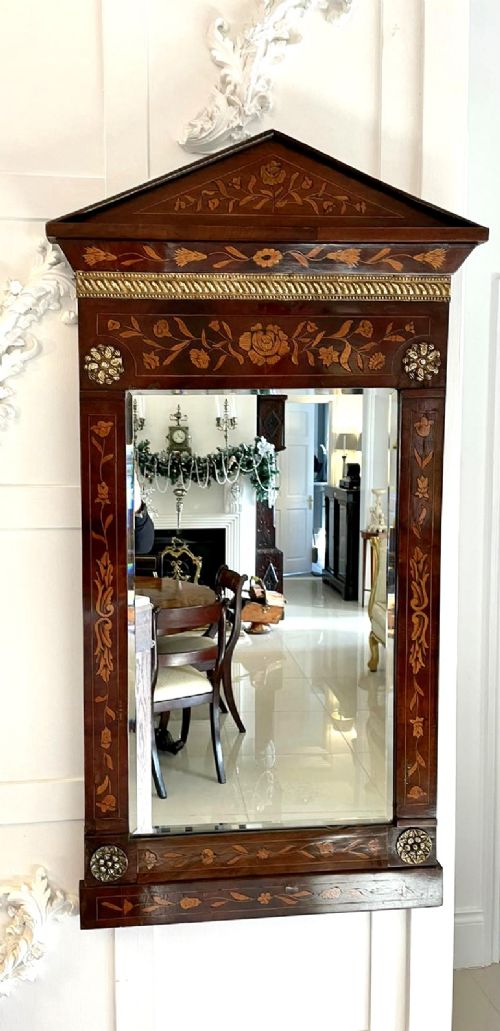


Dutch Floral Marquetry Mirror
A Dutch floral marquetry mirror brings intricate floral wood inlay and rich walnut or mahogany into a room.
Dutch Floral Marquetry Mirror
When you search for a dutch floral marquetry mirror, you encounter wall mirrors, hanging wall mirrors, and dressing table mirrors. These pieces span the eighteenth century, the nineteenth century, and the early nineteenth century around eighteen hundred and eighteen ten.
You are most likely to meet toilet swing mirrors and dressing mirrors designed for tabletop use or hanging on a wall. The forms include rectangular frames, sometimes featuring carved corner spandrels alongside the detailed floral marquetry.
The aesthetic bridges Dutch baroque, Dutch neo-classical, and Victorian marquetry styles. These furnishings serve both practical reflection and decorative display within period interiors.
How they were made
Cabinetmakers constructed the foundational frames using timber such as walnut, mahogany, and fruitwood. These primary woods provided a stable canvas for the elaborate decorative veneer work.
Artisans applied fruitwood marquetry and boxwood inlay to create floral motifs across the surface. Glass and mirror glass were fitted into the frames, occasionally complemented by brass hardware.
Listings feature walnut, mahogany, fruitwood, and boxwood combined with mirror glass and brass.
What varies in quality
The refinement of the floral marquetry and inlay work dictates the visual standard of the piece. Crisp execution of floral details and balanced composition across the fruitwood and boxwood set superior examples apart.
The choice of primary timber, whether figured walnut or rich mahogany, influences the depth and presence of the frame. The integration of carved elements, such as corner spandrels, adds structural and artistic complexity.
The Dutch Floral Marquetry Mirror Glossary
- Marquetry
- Decorative veneer applied to furniture in patterns and pictures. This technique uses different coloured woods to create floral designs on the frame surface.
- Spandrel
- The triangular space between the outer curve of an arch and a rectangular boundary. Carved corner spandrels appear on certain mirror frames.
- Toilet mirror
- A small mirror mounted on a frame for use on a dressing table. These pieces often feature a swing mechanism to adjust the glass angle.
- Fruitwood
- Timber sourced from fruit-bearing trees such as pear or apple. Artisans utilise these lighter woods for contrasting details in marquetry.
- Boxwood
- A dense, pale yellow wood used for fine inlay work. It provides sharp contrast against darker walnut and mahogany surfaces.
Dutch Floral Marquetry Mirror: Frequently Asked Questions
Where were these mirrors placed?
These mirrors functioned as tabletop accessories on dressing tables and toilet tables. They also hung directly on walls in bedrooms and living spaces.
Smaller swing versions allowed users to adjust the angle for personal grooming. Wall-mounted rectangular variants served decorative purposes in reception rooms.
How do I distinguish eighteenth and nineteenth-century pieces?
Eighteenth-century examples often display baroque or early neo-classical proportions and specific floral arrangements. Nineteenth-century interpretations frequently incorporate Victorian marquetry tendencies and modified framing.
Examining the construction methods and underlying timber helps determine the manufacturing period. Walnut frames tend to appear earlier, while mahogany becomes prominent around eighteen hundred and into the nineteenth century.
What woods appear in the inlay?
Makers utilised fruitwood and boxwood to construct the floral marquetry patterns. These lighter materials stand out against the darker walnut and mahogany backdrops.
The combination of contrasting timbers creates the characteristic pictorial depth seen on the frame borders.
Are these mirrors meant to hang or sit on tables?
The inventory includes both hanging wall mirrors and dressing table mirrors with swing stands. Wall-hung versions feature fixed hanging hardware on the reverse.
Table mirrors utilise hinged supports or swing frames attached to small bases. Both formats showcase the same detailed floral marquetry.