
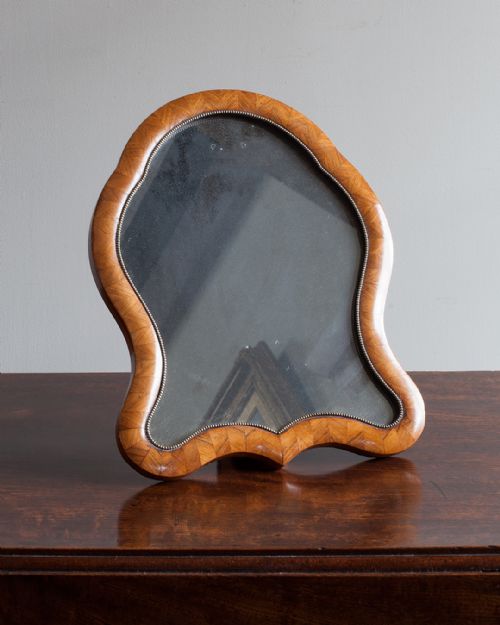


Marquetry Swing Toilet Mirror
A marquetry swing toilet mirror brings warmth and intricate woodwork to a dressing table, offering adjustable reflection within an elaborate frame.
Marquetry Swing Toilet Mirror
A marquetry swing toilet mirror is a table-standing glass set into a pivoting frame above a small base or box, designed for personal grooming. These pieces appear in forms such as dressing table mirrors, toilet mirrors, and table mirrors.
Most examples found here date from the eighteenth and nineteenth centuries, spanning Georgian periods up to the Victorian era. The Dutch marquetry style dominates alongside French Rococo revival and Sheraton revival influences.
Makers utilised woods including walnut, mahogany, satinwood, kingwood, and harewood, embellished with boxwood inlay. The mirror glass tilts on brass pivots between upright supports mounted on shaped bases.
Materials and construction methods
Cabinet makers constructed the foundational carcases from dense timbers such as mahogany and walnut, often applying veneers of kingwood, satinwood, or harewood to the visible surfaces. Detailed floral and architectural designs were formed by cutting contrasting sections of boxwood inlay into the primary veneer.
The pivoting mirror frame holds a bevelled or flat mirror glass secured by a thin backboard. Brass fittings, including screw pins and adjustment arms, allow the glass to tilt smoothly between the upright standards.
Many of these mirrors feature tiny secret drawers hidden inside their bases for storing powder and small trinkets.
Factors that separate grades of quality
The precision and complexity of the boxwood inlay separate standard examples from finer works, particularly where floral marquetry covers the entire base and frame. Sharper contrast between the inlaid timbers indicates greater skill in the workshop.
The Marquetry Swing Toilet Mirror Glossary
- Marquetry
- Decorative veneer work formed by fitting together small pieces of different coloured wood to create pictorial or geometric patterns. This technique transforms a plain wooden surface into a detailed picture.
- Swing mirror
- A looking glass hung on pivots between two upright posts so that the angle of reflection can be adjusted. It allows the user to tilt the glass as needed.
- Kingwood
- A dense, heavy South American timber with dark violet-brown colouring and fine lighter streaks, prized for quality cabinet making. It was frequently used as a veneer on high-end furniture.
- Boxwood
- A pale, hard wood with a fine, uniform grain used extensively for contrasting inlay work. Its pale tone stands out sharply against darker walnut and mahogany veneers.
- Toilet mirror
- A small mirror made for use on a dressing table or chest of drawers during personal grooming. These items became popular during the Georgian period.
Marquetry Swing Toilet Mirror: Frequently Asked Questions
What is a marquetry swing toilet mirror?
A marquetry swing toilet mirror is a table-top looking glass mounted on pivots within a decorative wooden frame, designed for grooming.
These pieces typically feature a small box or shaped base beneath the pivoting mirror plate, decorated with inlaid floral or geometric patterns.
How were these mirrors used?
They were placed on dressing tables, chests of drawers, or washstands to assist with hair styling, shaving, and applying cosmetics.
The user adjusted the angle of the glass using brass side screws to achieve the desired reflection.
How do I date a toilet mirror?
Dating relies on observing the timber species, the style of the inlay, and the construction of the base frame.
Georgian and eighteenth-century examples often display simpler, cleaner lines or restrained mahogany and harewood veneers, whereas later nineteenth-century pieces frequently feature dense Dutch marquetry.
Where should I place it at home?
These mirrors sit well on top of modern or antique dressing tables, sideboards, or chests of drawers in a bedroom or hallway.
Their compact size allows them to add character and reflective light to smaller surfaces without dominating a room.