
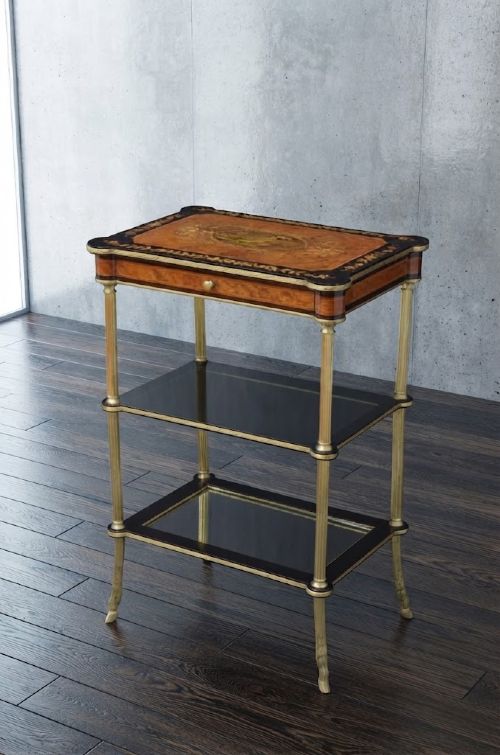
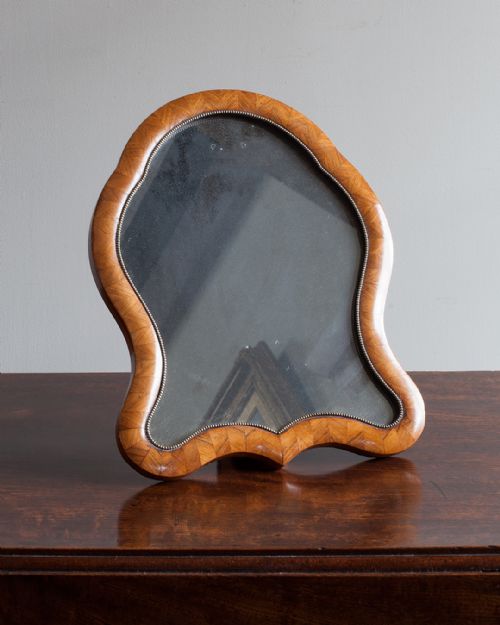
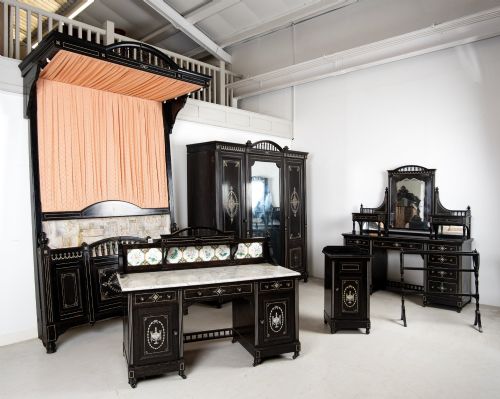

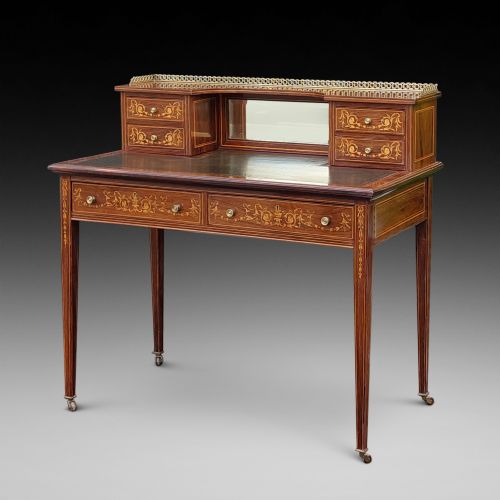


Marquetry Table Mirror
A marquetry table mirror brings rich floral and geometric wood-inlay to a bedroom dressing surface.
Marquetry Table Mirror
A marquetry table mirror sits upon a chest, desk or dressing table, offering a swivelling glass plate framed in intricate wood veneer work. These pieces span the Georgian, Victorian and Edwardian eras, reflecting changing tastes in bedroom furniture.
The form typically combines a rectangular or arched swing mirror with a box base or upright supports, often incorporating small drawers for trinkets. Examples range from compact travel items to substantial dressing glasses.
Dutch makers heavily influence this category, producing distinctive floral pictorial marquetry, alongside English interpretations in satinwood, mahogany and walnut. You are most likely to encounter nineteenth-century walnut and mahogany specimens featuring classical or botanical inlay.
Materials and construction
Cabinetmakers constructed the main carcase using solid foundational woods like mahogany or oak, then applied contrasting veneers of satinwood, walnut, rosewood and harewood. Craftsmen cut intricate pictorial or geometric patterns into the veneer using fine saws.
The mirror plates utilise cast or silvered glass held within pivoted frames of brass or turned wood. Brass brackets, armatures and tiny bone or ivory escutcheons allow the glass to tilt smoothly on its vertical axis.
Evaluating quality
Quality rests upon the precision of the veneer cutting and the botanical variety within the floral inlay. Superior examples display crisp shading in the wood pieces, achieved by scorching edges in hot sand.
Construction details dictate longevity, including hand-cut dovetails on the base drawers and substantial brass fittings rather than iron. The depth of colour in the primary timbers separates standard production from exceptional cabinet work.
Maple & Co·Edwards & Roberts·Gillows·Jas Shoolbred
The Marquetry Table Mirror Glossary
- Marquetry
- The art of applying decorative pieces of veneer to a structural carcase to form pictorial designs. This technique differs from simpler inlay by assembling the entire pattern on paper before gluing it down.
- Swing mirror
- A looking glass mounted on vertical pivots within a frame that allows the angle to be adjusted. These units typically rest on a small bureau or table base.
- Satinwood
- A lustrous, hard timber native to Ceylon and India with a golden-yellow sheen. Cabinetmakers favoured it during the Georgian and Edwardian periods for light-reflecting tabletop surfaces.
- Ormolu
- Gilded bronze used for decorative mounts, handles and feet on finer nineteenth-century furnishings. The metallic lustre complements dark rosewood and mahogany veneers.
Marquetry Table Mirror: Frequently Asked Questions
How do I clean the mirror glass?
Use a soft, lint-free cloth with a mild vinegar solution applied directly to the cloth rather than the glass. Avoid getting moisture near the wooden frame or the silvered backing.
Take care around old bevelled edges where sealant may have degraded over the decades.
Can I adjust the swing mirror?
Most models feature brass screw caps or tension nuts on the upright arms which can be gently tightened. Do not force the glass if the pivots feel seized from old wax accumulation.
Apply a tiny drop of lubricant to the thread if the movement is stiff.
Where should I place the mirror?
Position the piece on a sturdy dressing table or chest of drawers away from direct sunlight to protect the dyed veneers. Ensure the supporting surface is level so the swing frame hangs true.
Keep the timber away from modern radiators to prevent veneer shrinkage.
How do I date an antique mirror?
Examine the timber species, screw types and the backing boards of the glass plate. Georgian and Victorian pieces show hand-cut dovetails and older glass silvering methods.
Compare the floral marquetry style against known period pattern books.