





Marquetry Needlework Table
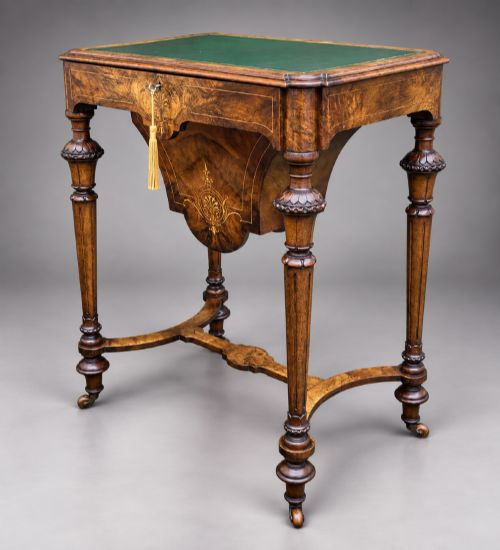
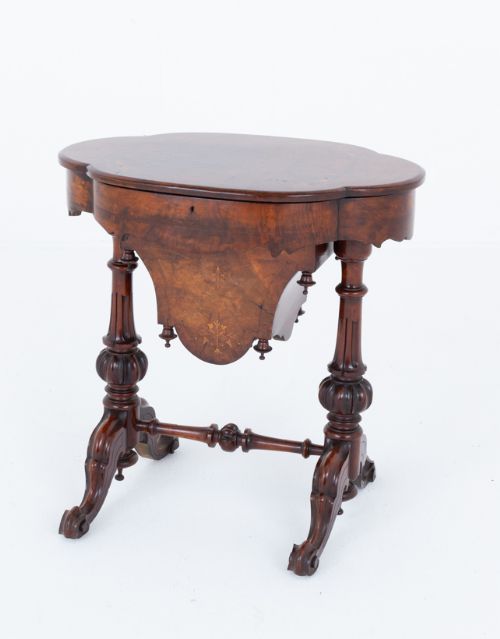
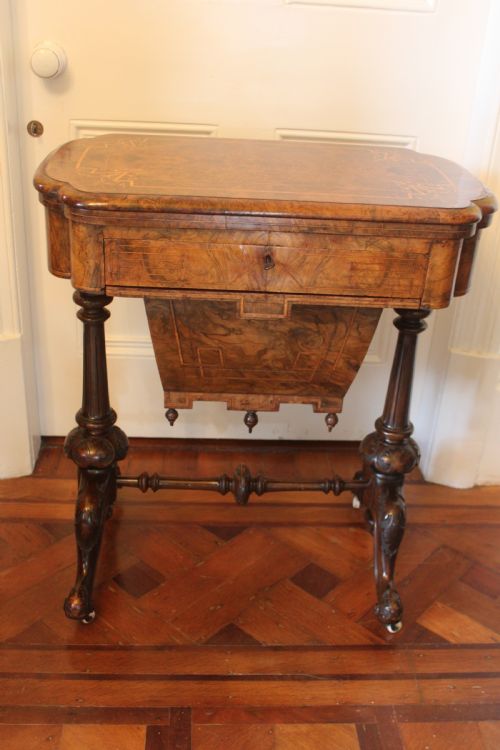
A marquetry needlework table brings together intricate wood veneers and practical utility, offering a refined Victorian surface for sewing and domestic tasks.
Marquetry Needlework Table
A marquetry needlework table functions primarily as a specialised piece of domestic furniture designed for sewing, games, and light writing. These tables frequently appear from the nineteenth century, spanning Victorian, Edwardian, and Regency periods with varied forms such as trumpet shapes, work boxes, and occasional tables.
The most common examples on this page are Victorian burr walnut and rosewood pieces featuring fitted interiors and hinged lids. Makers combined utilitarian compartments with decorative inlaid surfaces to serve the nineteenth-century drawing room.
Origins stretch across English workshops, Continental makers, and Irish centres like Killarney, using regional timbers and distinct decorative traditions. Buyers encounter varied formats including games combinations and dedicated sewing boxes.
Elements of Distinction
The sophistication of the veneer work and the complexity of the marquetry patterns separate standard examples from finer pieces. Superior tables display crisp cutting in the inlay and a varied palette of contrasting specimen woods.
Internal execution dictates overall quality, particularly the complexity of the fitted interior and the condition of the original fabric components. Tables with well-organized, intact compartments and robust mechanical joints command greater attention.
The choice of primary timber influences desirability, with heavily figured burr walnut and rich rosewood representing the peak of period taste. Subtle details like brass stringing and secondary mahogany linings further elevate the standing of an individual piece.
Marquetry Needlework Table Retail Price Guide 2026
Typical asking prices for marquetry needlework table among the pieces listed under this phrase on Sellingantiques today, from the lower quarter to the upper quarter. They describe what is for sale here now, not the wider market.
Listings feature pieces spanning the nineteenth century, with burr walnut and rosewood serving as the dominant primary materials.
Waring & Gillow·John MaClean
The Marquetry Needlework Table Glossary
- Marquetry inlay
- Decorative patterns formed by fitting contrasting wood veneers into a prepared surface. This technique creates pictorial or geometric designs across tabletops and lids.
- Trumpet work table
- A sewing table characterised by an octagonal or flared body shaped like a musical instrument, standing on a slender column and carved base.
- Killarney ware
- Distinctive Irish turned and inlaid wooden items produced from arbutus and other native woods, often featuring intricate geometric mosaic motifs.
- Specimen wood
- Individual varieties of timber selected for their unique colour and grain, used collectively in table tops to showcase botanical diversity.
- Fitted interior
- An internal arrangement of lidded compartments, small boxes, and velvet-lined trays designed to hold sewing tools and accessories securely.
Marquetry Needlework Table: Frequently Asked Questions
What is a marquetry needlework table used for?
These pieces served as practical furniture for domestic textile crafts, holding threads, needles, and ongoing sewing projects inside dedicated internal compartments.
Beyond sewing, many versions doubled as games tables or occasional surfaces for the Victorian drawing room, combining utility with decorative display.
How do you date a Victorian work table?
Dating relies on identifying timber choices like burr walnut or rosewood alongside specific stylistic markers such as French Rococo revival curves or simpler Edwardian lines.
Construction methods within the fitted interior and the presence of specific inlay techniques also help narrow the decade of manufacture.
Where were these tables made?
Production took place across English workshops, Continental furniture centres, and Irish regional hubs such as Killarney.
English and Continental makers tended to use burr walnut, rosewood, and satinwood, while Irish examples frequently utilised native arbutus wood.