
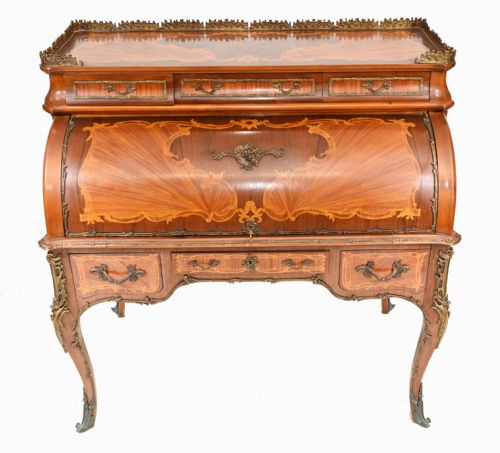


Marquetry Cylinder Desk
These marquetry cylinder desks bring together precise fitted writing compartments and intricate wood inlay.
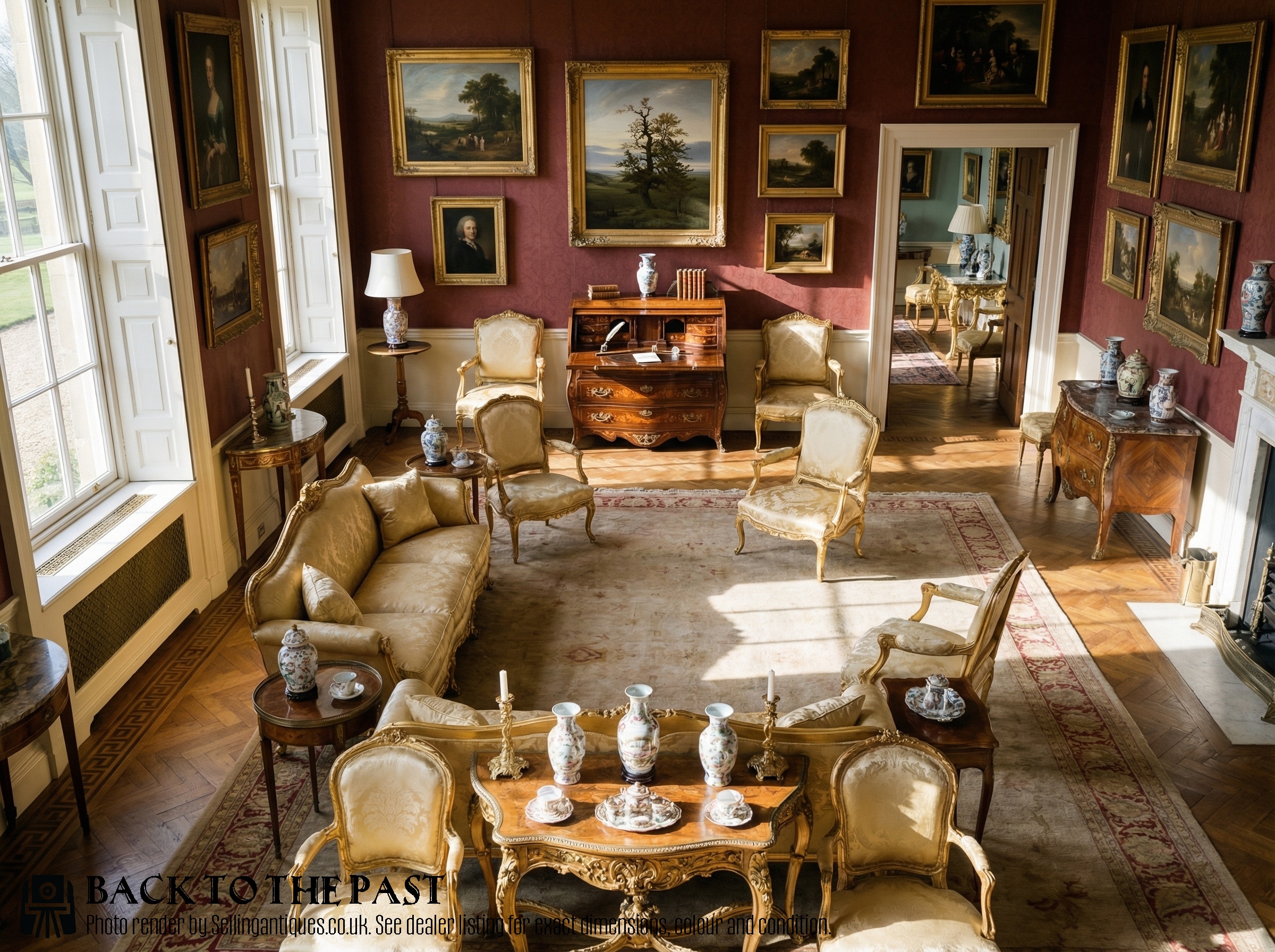
Marquetry cylinder desks
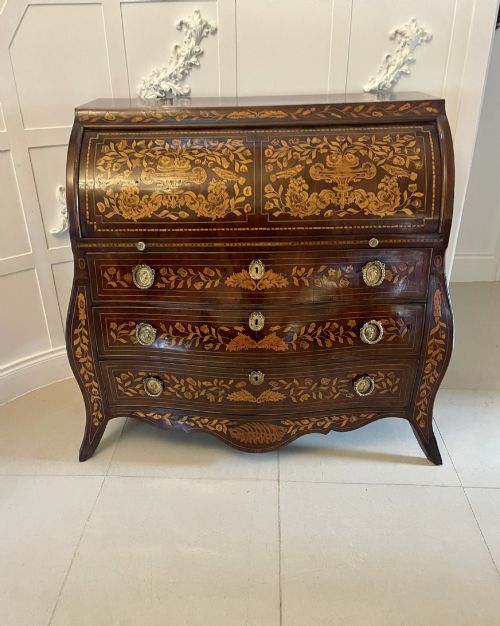
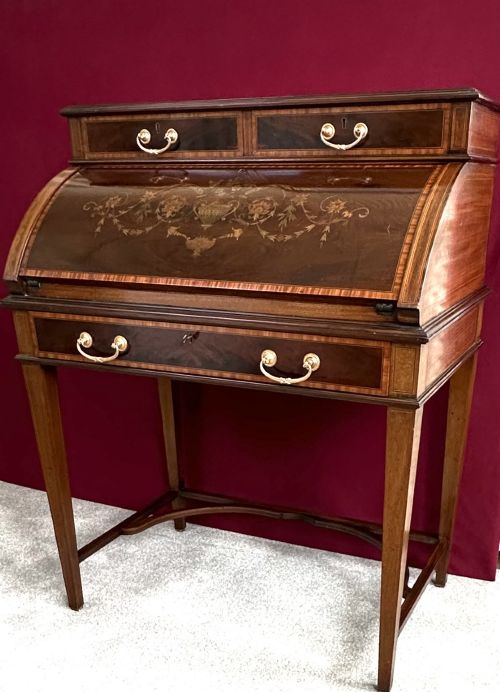
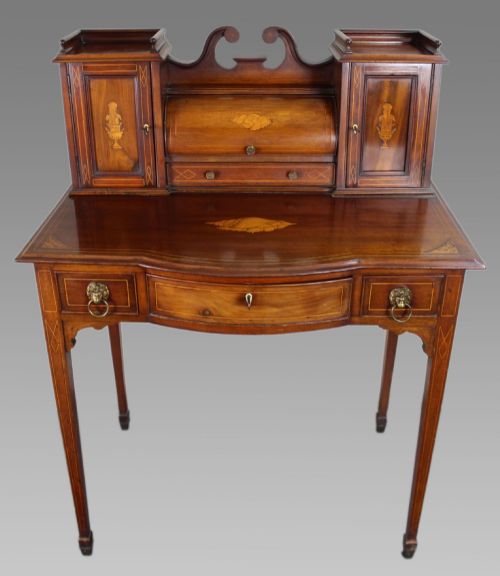
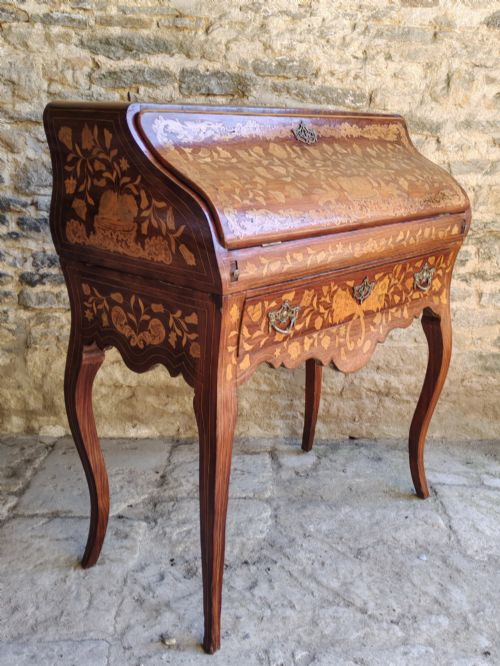
A marquetry cylinder desk combines a curved roll top that conceals the writing surface with elaborate patterned wood inlay across the exterior.
The pieces on this page span the eighteenth century, the Victorian era, and the Edwardian period, incorporating revival styles such as Louis XVI, Dutch Rococo, and Sheraton Revival.
Forms range from compact ladies bureaux and miniature display desks to large walnut and mahogany bureau cabinets with bombe fronts or piano tops.
Materials and construction
Carinthian and domestic timbers such as walnut, mahogany, satinwood, kingwood, rosewood, and fruitwood form the primary carcass and secondary framing.
Craftsmen applied fruitwood inlay and diverse veneers to create floral and geometric patterns, often mounting brass handles, hinges, and ormolu accents for structural and decorative enhancement.
Retail Price Guide 2026
Typical UK retail prices for marquetry cylinder desk, calculated from the Sellingantiques database of over a million retail prices indexed since 2003. This retail price guide relies exclusively on Sellingantiques data; no external sources or auction records are used, so the figures do not describe the wider market.
Listings feature walnut, mahogany, satinwood, and fruitwood inlaid with floral marquetry.
Judging quality
Superior examples demonstrate precision in the rolling mechanism and seamless alignment of the cylinder shutter with the interior stationery compartments.
The refinement of the marquetry design, the variety of contrasting timbers employed, and the crispness of the brass or ormolu mounts dictate the standing of each piece.
Edwards and Roberts
The Marquetry Cylinder Desk Glossary
- Marquetry
- The art of forming decorative patterns by fitting together thin slices of wood veneer of different colours and grains. This technique covers the curved cylinder fronts and drawers of these desks.
- Cylinder desk
- A writing desk featuring a quarter-circle rotating wooden shutter that pulls down to cover the writing surface and interior pigeonholes. When closed, it hides the working area entirely.
- Ormolu
- Gilt bronze mounts used as decorative feet, handles, and borders on nineteenth-century revival pieces. The finish mimics solid gold.
- Bombe
- A swelling, outward-curved contour found on the front and sides of specific continental bureau forms. It requires advanced cabinet-making skill to veneer accurately.
Frequently Asked Questions
How does a cylinder desk work?
The curved wooden cylinder slides along a curved track within the desk carcass, guided by internal pivots or grooves. Pulling the writing slide forward often retracts the cylinder automatically.
This mechanism conceals the interior pigeonholes and small drawers when the desk is not in use, protecting the contents from dust.
What is the difference between a bureau and a cylinder desk?
A traditional bureau uses a sloping hinged flap that folds down to form the writing surface. A cylinder desk uses a rotating curved barrel.
Cylinder desks generally offer more structured interior fittings, including small drawers and open compartments revealed by the rolling action.
How do I care for antique marquetry?
Keep the wood away from direct sunlight and steady humidity levels to prevent the fine veneers from lifting or cracking. Regular polishing with traditional beeswax maintains the finish.
Avoid placing hot cups or liquids directly onto the polished surfaces, as moisture penetrates old polishes quickly.
Are these desks suitable for daily use?
Many of these desks function well for modern writing and laptop use, provided the sliding mechanism moves smoothly. The fitted interior compartments suit modern stationery storage.
Care should be taken with the sliding cylinder to avoid forcing the mechanism if wood movement occurs due to seasonal temperature changes.