






Marble Mantelpiece Urns
Marble mantelpiece urns combine carved stone and cast metal to bring neoclassical formality to a room.
Marble Mantelpiece Urns
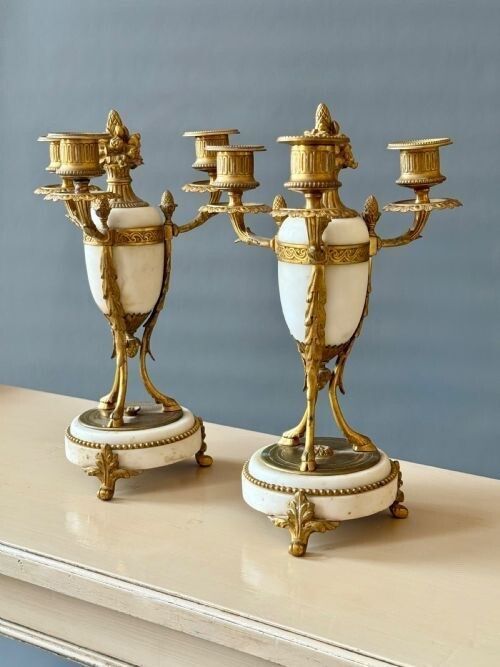
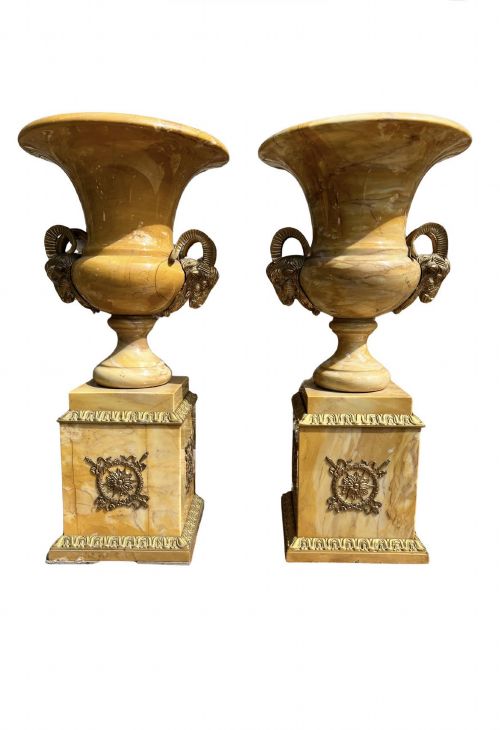
When you search for marble mantelpiece urns, you encounter ornamental vessels and garniture sets designed to sit on a fireplace ledge or console. The forms draw on classical antiquity and the Grand Tour, often taking the shape of amphorae, tazzas or cassolettes with reversible lids. Most examples on this page date from the nineteenth century, including Victorian pieces and specific years like eighteen ninety and nineteen thirty.
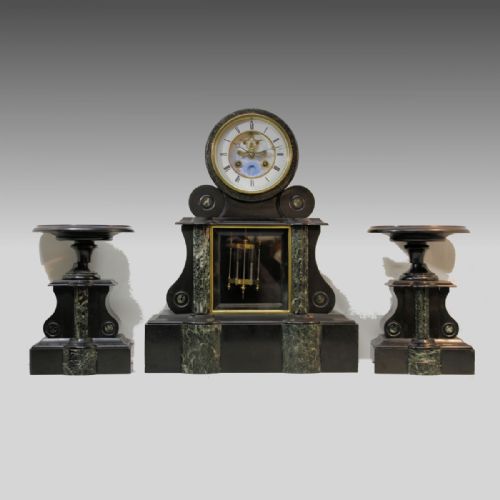
French and Italian workshops dominate the origin of these items, frequently pairing stone plinths with cast mounts. You find pairs of vases alongside clock garnitures where a central timepiece is flanked by matching urns or candelabra. The aesthetic leans heavily on Neoclassical, Louis XVI, and French Empire styles, alongside occasional Gothic Revival touches.
What varies in quality
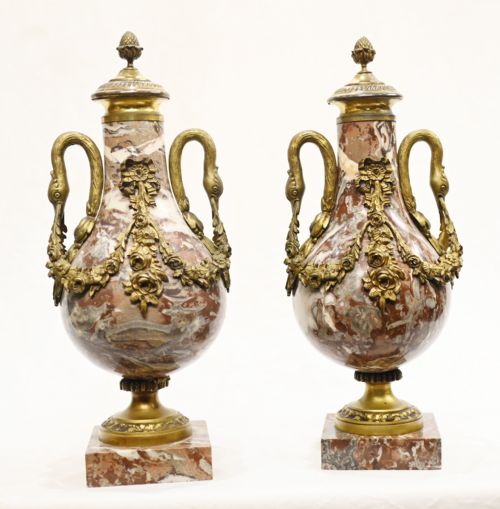
The distinction between ordinary and exceptional pieces lies in the crispness of the metal chasing and the selection of the marble. Superior mounts exhibit sharp relief work and deep, even fire gilding, whereas lesser examples show softness in the cast foliage and handles. The mineral grain and colour consistency of the stone also dictate the grade of the piece, with richly figured Sienna and uniform white marbles commanding attention.
Proportion and the integration of components define the visual success of an urn. High-grade items demonstrate balanced weight between the heavy stone vessel and the delicate metal mounts, with tight joints and well-finished interiors.
Listings feature nineteenth-century items spanning the Victorian era, eighteen seventy, eighteen ninety, and nineteen thirty.
The Marble Mantelpiece Urns Glossary
- Cassolette
- A decorative vase with a reversible lid that presents either a solid stone face or a burner pierced for fragrance. This dual function makes them a versatile ornament on a mantelpiece.
- Garniture
- A set of three or more matching decorative objects, typically comprising a central clock flanked by two urns or candelabra. They were designed to furnish a fireplace mantel as a unified decorative scheme.
- Ormolu
- Finely ground metallic gold applied to a bronze base through mercury amalgamation, creating a rich golden surface. This technique was widely used on French Empire and Louis XVI style mounts.
- Tazza
- A shallow cup or vase set on a pedestal and base, modelled after ancient Roman drinking vessels. They frequently appeared as Grand Tour souvenirs brought back by travellers.
- Grand Tour
- The eighteenth and nineteenth century custom of travelling through Europe to study classical art and antiquity. Souvenirs purchased on these journeys heavily influenced the design of these decorative objects.
Marble Mantelpiece Urns: Frequently Asked Questions
Where did these urns sit?
These decorative vessels stood upon fireplace mantelpieces, often arranged symmetrically as pairs or as part of a clock garniture set.
They also decorated large sideboards, pier tables, and pedestals in nineteenth century reception rooms.
How do I identify a Grand Tour piece?
Grand Tour items typically replicate classical architecture or excavated artefacts encountered by travellers in Italy during the nineteenth century. They combine fine Italian marbles with cast bronze details.
Look for classical motifs such as acanthus leaves, handles formed of serpents or swans, and forms based on antique vases.
What is a clock garniture?
A clock garniture is a matched suite consisting of a central mantel clock accompanied by two side pieces, which may be urns, vases, or candelabra. They were manufactured as a single decorative ensemble to adorn a room.
The matching elements repeat the materials and decorative vocabulary of the central clock, using marble and bronze.
Are these urns waterproof?
Most of these decorative pieces are assembled from multiple sections of stone and metal joined with adhesives or mechanical fasteners. They served as ornamental objects rather than functional vessels for water and flowers.
Placing liquid inside can damage the internal structure, particularly where marble meets metal mounts.