


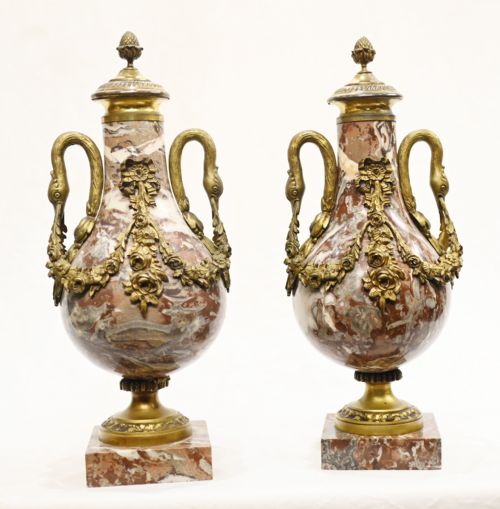


French Empire Cassolettes
French Empire cassolettes are reversible decorative urns designed for burning incense, combining classical form with rich metalwork.
French Empire Cassolettes
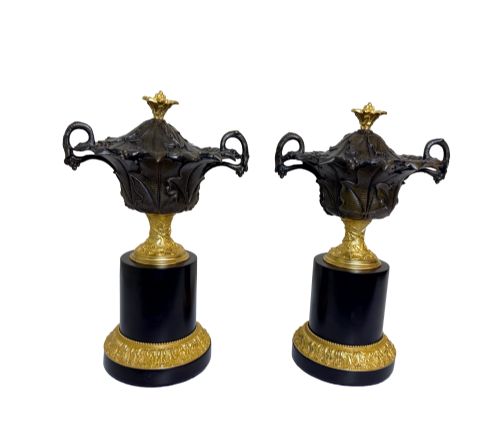
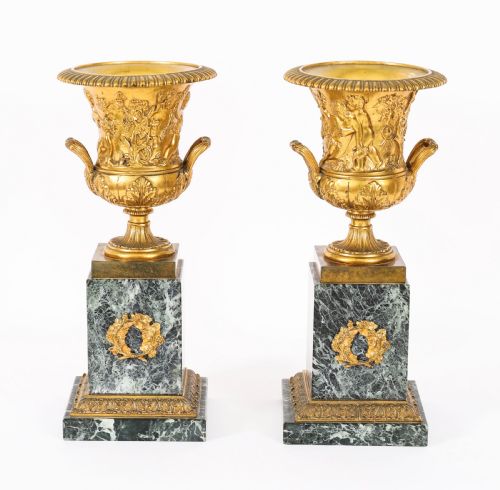
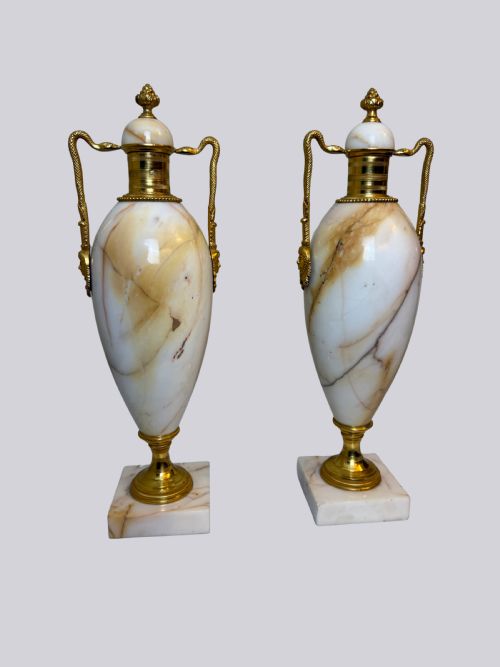
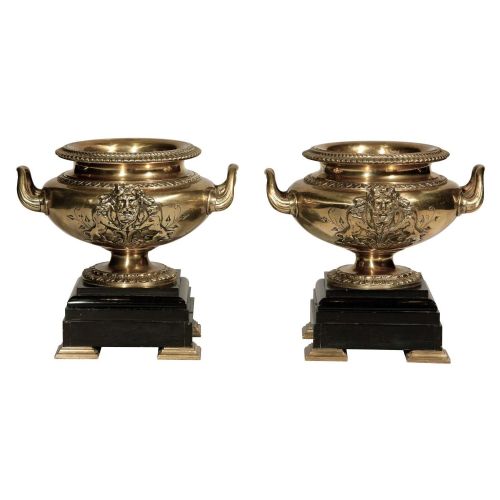
When you search for french empire cassolettes, you are looking at dual-purpose ornamental urns that typically feature a reversible lid, allowing them to serve as either vases or incense burners. The examples seen here appear primarily in pairs, taking the form of decorative urns, amphorae, and tazzas mounted on plinth bases.
The pieces on this page span the nineteenth century, including items attributed specifically to the French Empire period alongside later Neoclassical Revival and Gothic Revival interpretations. Most of these ornamental urns stand upon square or pedestal bases, with many originating from Grand Tour travels or continental workshops during the eighteen-sixties to eighteen-nineties.
How they were made
The construction relies heavily on the combination of cast metals and carved stone, using materials such as gilt bronze, ormolu, and patinated bronze alongside various marbles and white onyx. Metal components are cast and chased to produce crisp classical details, which are then mounted directly onto turned or squared stone plinths.
Makers utilised contrasting textures by pairing bright gilding or silvered finishes with dark patinated bronze or veined green and black marbles. The reversible lids often feature a burning bowl on one side and a solid finial on the reverse, requiring precise fitting during manufacture.
Some nineteenth-century homeowners used these urns to mask the smell of tobacco smoke in the drawing room.
What varies in quality
Quality in these decorative vessels is determined by the crispness of the metal chasing and the depth of the gilding or ormolu finish. Superior examples display sharply defined acanthus leaves, handles, and classical mounts rather than soft, worn casting details.
The selection of the stone base also separates standard production from finer pieces, with uniform marble or translucent white onyx indicating careful material sourcing. Furthermore, the weight and thickness of the cast bronze elements reveal the care taken during production.
The French Empire Cassolettes Glossary
- Cassolette
- A decorative vessel with a reversible lid designed to function as a perfume burner or an urn. The rotating top allows the user to display either a solid finial or a receptacle for incense.
- Ormolu
- Finely ground high-carat gold applied to a bronze base using a mercury amalgamation process. This technique gives the metal a rich, warm lustre characteristic of the period.
- Grand Tour
- A cultural journey of Europe undertaken by wealthy young men in the eighteenth and nineteenth centuries. Tourists often returned with classical antiquities and decorative bronzes.
- Tazza
- A shallow cup or vase on a pedestal foot, used for display or as a decorative centrepiece. These items often mirror the proportions of classical drinking vessels.
- Patinated Bronze
- Bronze that has been chemically treated to produce a dark, protective surface layer. This dark tone provides a visual contrast against gilt bronze mounts.
French Empire Cassolettes: Frequently Asked Questions
What is a cassolette?
A cassolette is a decorative urn featuring a reversible lid that transforms the vessel from a standard vase into an incense burner. The top can be turned to show either a solid decorative finial or a perforated bowl.
These pieces were popular as mantelpiece ornaments in French interiors during the nineteenth century. They combine utility with classical decorative motifs derived from antiquity.
How do I use a cassolette?
Historic cassolettes are generally displayed as ornamental objects rather than utilised for active burning today. The delicate nature of nineteenth-century gilding and marble bases makes them better suited for mantelpieces or console tables.
If the lid is reversible, you can lift it and rotate the insert to change the visual profile of the urn. Handle the pieces carefully by the body rather than delicate handles or finials.
How do I clean gilt bronze?
Gilt bronze and ormolu require gentle dusting with a soft, dry brush to prevent the accumulation of dirt within the chased details. Avoid commercial metal polishes, which can strip the thin layer of gold from the bronze beneath.
Moisture should be kept away from the marble or onyx bases, as dampness can stain or weaken porous stone. Professional conservation is recommended for heavily tarnished surfaces.
What is the difference between an urn and a cassolette?
A standard decorative urn has a fixed, non-removable lid or an open top designed strictly to hold flowers or stand empty. A cassolette specifically includes a rotating or reversible cover intended for burning perfumes.
Both forms appear frequently in French Empire and Neoclassical design. Their silhouettes often mimic ancient Greek and Roman amphorae.
Are these pieces antique?
The pieces listed here date from the nineteenth century, encompassing the French Empire period, subsequent Neoclassical Revivals, and Grand Tour productions. They reflect the nineteenth-century fascination with classical antiquity.
Materials such as patinated bronze, gilt bronze, and various marbles are typical of workshops operating during this era. Dating relies on stylistic cues and manufacturing techniques standard to the eighteen-hundreds.