

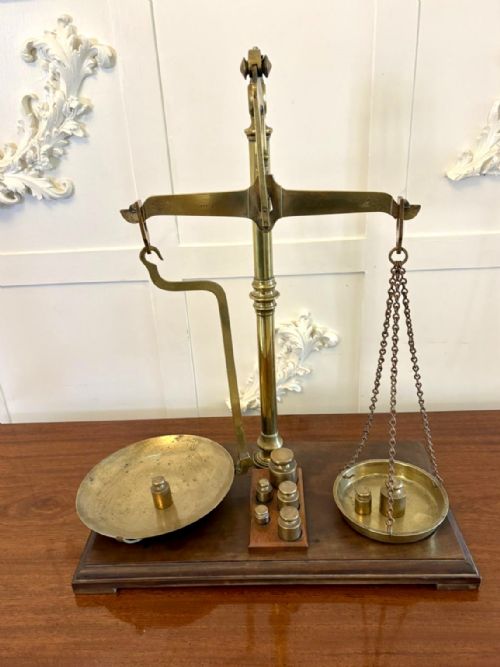

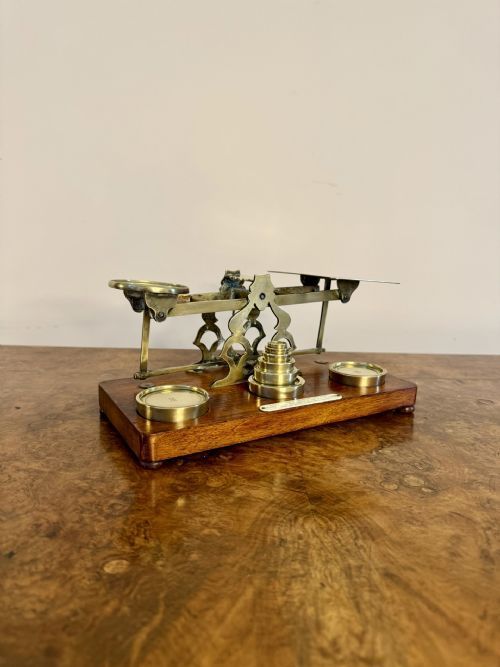


Mahogany Brass Scales
Mahogany brass scales unite precision mechanics with rich timber cabinetry, serving collectors of scientific and domestic bygones.

Mahogany Brass Scales
Mahogany brass scales combine polished hardwood bases with gleaming metal balance arms, pointers, and pans, designed for measuring weight accurately in professional, commercial, or domestic settings.
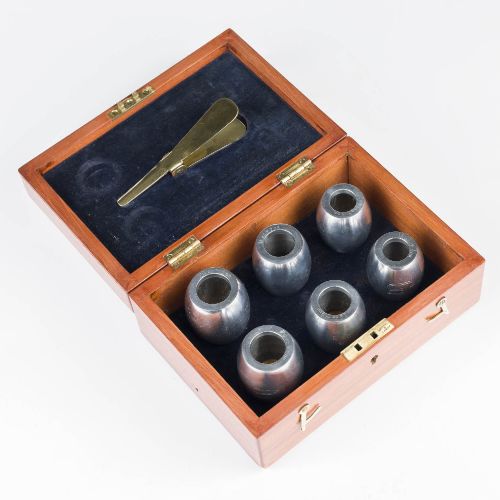
The versions most commonly met on this page include letter scales for correspondence, heavier postal scales, and compact travelling apothecary sets housed in fitted wooden boxes.
Examples span from the Georgian period through the Victorian and Edwardian eras up to the mid-twentieth century, showing shifts from artisanal workshop production to robust industrial manufacture.
Materials and construction
Craftsmen built the plinths and boxes using dense mahogany, often shaped with stepped mouldings or waisted profiles, then polished the timber to a smooth sheen.
The operating mechanisms rely on cast and turned brass for the beams, pillars, and balancing pans, paired occasionally with steel knife-edge pivots to reduce friction.
Many sets incorporate fitted compartments lined with velvet or leather to secure matching brass weights alongside the main balance.
Listings span the Georgian, Victorian, Edwardian, and twentieth-century periods, utilising mahogany, brass, glass, velvet, and leather.
Factors of quality
Quality rests in the precision of the mechanics, where fine adjustment screws and clean pivot points permit smooth, level movement without sticking.
The joinery of the mahogany base or fitted case indicates the standard of the maker, showing tight mitres and well-fitted compartments rather than hasty construction.
Signed examples bearing the marks of established makers or retailers on the brass beam or ivory scale plate command greater attention than unsigned pieces.
De Grave Short & Co·Robert Brettell Bate·Day & Millward·S Mordan & Co·Parnall & Sons·W & T Avery·Oertling·Charles Baker·Stephen Houghton & Son·Bartlett & Sons·Negretti & Zambra·T J Smith Son & Downes
The Mahogany Brass Scales Glossary
- Beam scale
- A weighing device consisting of a horizontal lever pivoted at its centre with arms of equal length. This forms the fundamental mechanism for most traditional balance scales.
- Dump weight
- A short, heavy cylindrical brass weight designed to sit securely on a scale base. These weights often accompany postal and letter scales.
- Chondrometer
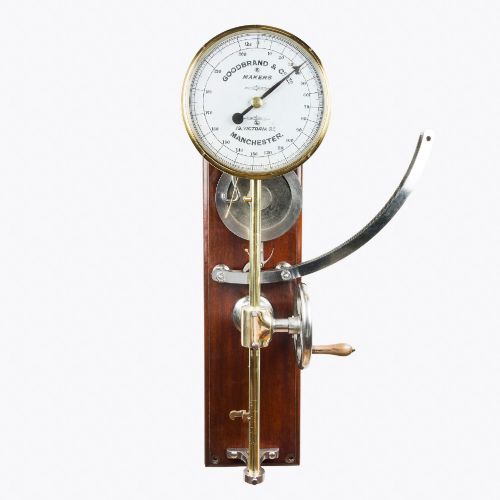
- A specialised instrument used to measure the weight per bushel of grain. Such devices combine brass balance beams with calibrated measures.
- Apothecary scales
- Precision instruments used by chemists for weighing medicinal ingredients. They frequently fold into compact mahogany travelling cases with glass pans.
- Letter scales
- Compact balance devices designed for weighing envelopes and small parcels to determine postage rates. They usually feature small brass pans mounted on mahogany plinths.
Mahogany Brass Scales: Frequently Asked Questions
How do I clean the brass on these scales?
Polishing brass requires a gentle cloth and a mild metal cleaner, taking care to avoid any adjacent mahogany wood surfaces.
Aggressive rubbing can wear away engraved maker inscriptions, so gentle maintenance preserves both the finish and the historical marks.
Are the matching weights usually original?
Many sets retain their original stacked or waisted brass weights, which fit neatly into dedicated slots within the mahogany base.
Replacement weights appear frequently, so checking whether the stamps match the maker of the scale helps confirm originality.
Can these scales still be used for weighing?
While these instruments were engineered for precise measurements in offices and surgeries, modern calibration differs.
Most buyers display them as decorative historical objects rather than relying on them for exact daily weighing tasks.
How can I tell a postal scale from an apothecary set?
Postal scales generally feature fixed brass platforms or open pans mounted on mahogany plinths to receive letters quickly.
Apothecary sets usually pack into enclosed wooden boxes with small glass pans and delicate folding beams intended for medical measurements.