




Polished Brass Scales
Polished brass scales are traditional weighing instruments combining gleaming metal work and timber bases, prized by collectors for their striking Victorian and Edwardian utility.
Polished Brass Scales
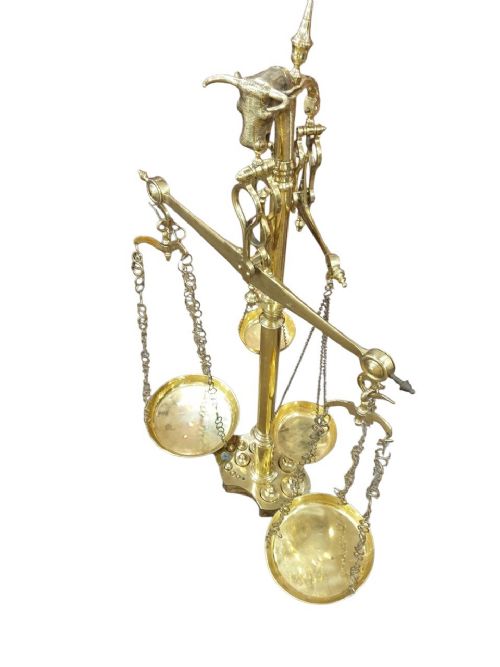
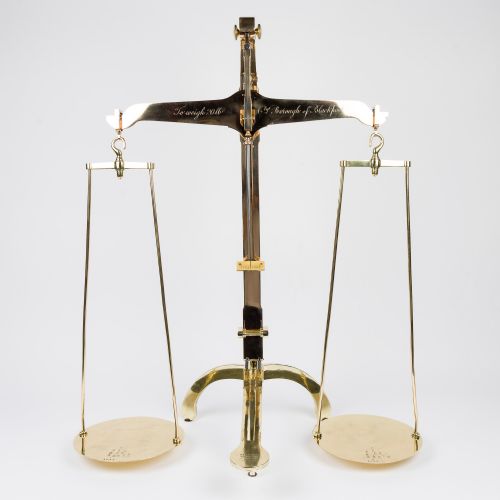
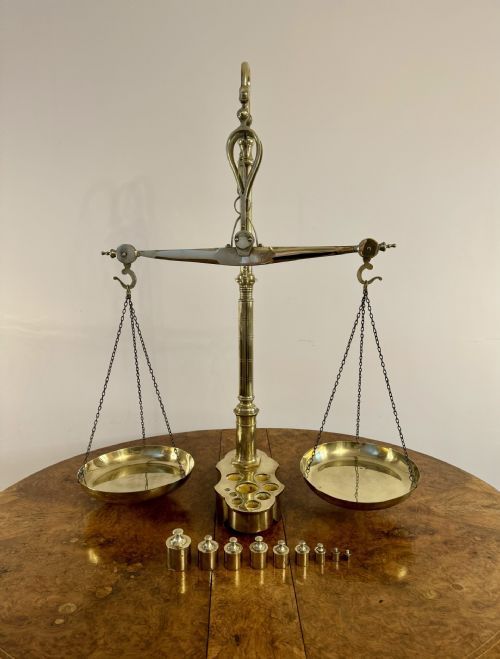
When you search for polished brass scales, you encounter functional beam scales, postal balances, and sets of standard weights spanning the Victorian, Edwardian, and early twentieth century periods. These objects range from massive butcher sets and municipal balances from places like Blackpool and Liverpool to domestic letter scales set upon mahogany bases.
How they were made
Makers utilised solid brass for the primary beams, pans, and balance components, polishing the metal to a bright, reflective finish that defined the scientific and commercial equipment of the era. This brass work was frequently mounted upon seasoned mahogany timber bases or paired with iron and steel structural elements to ensure stability.
Municipal and commercial sets incorporated precision-stamped standard weights bearing regional inscriptions, while hanging variations utilised articulated chains and balanced beams to maintain accuracy in weighing goods and correspondence.
Polished Brass Scales Retail Price Guide 2026
Typical asking prices for polished brass scales among the pieces listed under this phrase on Sellingantiques today, from the lower quarter to the upper quarter. They describe what is for sale here now, not the wider market.
The listings span from the late Victorian period through the Edwardian era to nineteen-twenty, featuring brass, mahogany, steel, and iron.
What varies in quality
Quality in polished brass scales is determined by the crispness of maker inscriptions, the retention of original matching weights, and the integrity of the timber base. Pieces commissioned for municipal authorities or bearing documented maker stamps display superior mechanical refinement compared to unmarked domestic examples.
The balance of the beam and the uniformity of the brass casting separate standard commercial production from exceptional apparatuses. Surviving sets retaining their complete series of regional standard weights command greater interest from collectors.
W&T Avery·Parnall & Sons of Bristol·De Grave
The Polished Brass Scales Glossary
- Beam scales
- Weighing instruments utilising a central fulcrum and balancing arms to determine mass. These form the primary mechanical structure for most antique weighing apparatuses.
- Avoir standard weights
- Official units of mass conforming to the avoirdupois system, frequently stamped with regional council details. They provide exact calibration for commercial and municipal transactions.
- Mahogany
- A dense tropical hardwood utilised for the heavy timber bases supporting letter scales and postal balances. Its rich grain contrasts effectively against polished brass components.
- Postal or letter scales
- Compact balance devices designed for weighing correspondence to determine postage rates. They typically feature flat brass pans mounted on wooden platforms.
- Free hanging balance
- Scales suspended from a single upper point rather than mounted on a rigid base. Frisian examples demonstrate this specific stylistic variation.
Polished Brass Scales: Frequently Asked Questions
What were polished brass scales used for?
These instruments served commercial, municipal, and domestic functions ranging from butchery and postal weighing to official standards verification. Regional authorities utilised them for market regulation and trade compliance.
Domestic variants handled correspondence and small household goods, reflecting the administrative needs of Victorian and Edwardian society.
How do I identify a Victorian set?
Victorian examples often feature heavy brass beam construction mounted on mahogany bases, sometimes bearing stamps from regional inspectors or makers such as Parnall & Sons.
Stylistic cues include traditional cast brass components and municipal inscriptions dating from the late nineteenth century.
Are weights usually included with the scales?
Many listings include matching sets of standard brass or iron weights, occasionally marked for specific counties or cities like Liverpool and Northamptonshire.
Complete sets retaining their original fitted weights are particularly valued for their historical completeness.
How should I clean polished brass?
Maintenance requires minimal intervention to preserve the historic surface patina developed over decades of existence. Gentle dusting and avoidance of abrasive compounds protect the original metal finish.
Displaying the pieces away from excessive moisture prevents corrosion on the steel and iron components.