




Victorian Brass Beam Scales
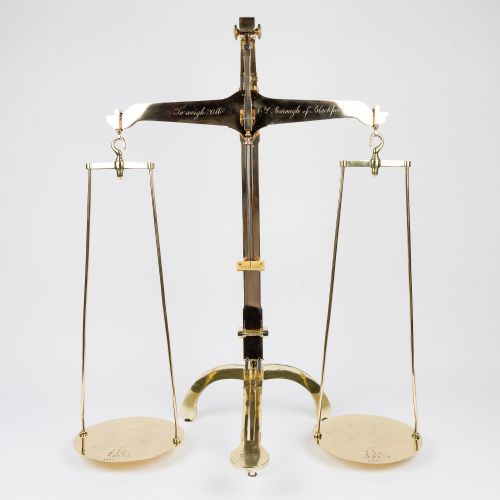
Victorian brass beam scales are precision weighing instruments combining functional mechanics with warm metalwork, prized for their balance and historic presence.
Victorian Brass Beam Scales
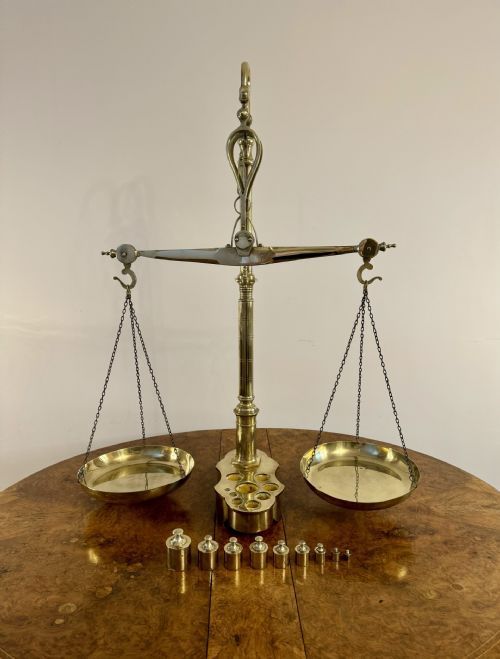
Victorian brass beam scales are traditional weighing devices designed for accurate measurement across trades, households, and laboratories. When you search for victorian brass beam scales, you encounter balanced instruments mounted on timber bases or housed in glass cases, ranging from delicate apothecary sets to robust commercial postal balances.
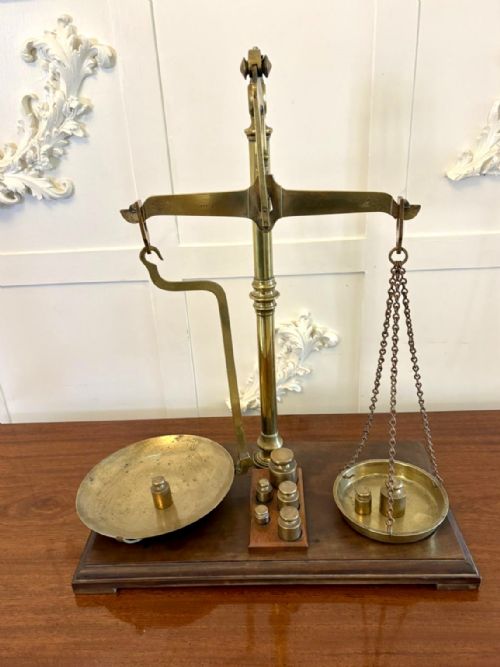
The versions most commonly met on this page include apothecary balances, letter and postal scales, and larger verification or dairy scales. Many incorporate fitted wooden bases made from mahogany or oak, often housing original brass weights within dedicated drawers or compartments.
Originating largely from the nineteenth and early twentieth centuries, these pieces reflect a period when utilitarian objects received meticulous craftsmanship. They serve today as decorative desktop accessories or focal points in studies and kitchens, retaining their mechanical integrity alongside their aesthetic appeal.
How they were made
The construction of these instruments relies primarily on bright brass for the beams, pans, and indicator pointers, chosen for its resistance to corrosion and ability to hold a fine polish. This metalwork pairs with hardwood bases, predominantly mahogany and oak, providing a stable platform for the delicate pivoting mechanism.
Listings feature oak, mahogany, and hardwood bases paired with brass, iron, steel, and bronze metalwork.
What varies in quality
Quality in these instruments rests upon the precision of the central bearing and the exact symmetry of the beam. Finer examples demonstrate superior responsiveness and return precisely to zero when unloaded, reflecting expert initial calibration.
The standard of surrounding cabinetry and metal casting distinguishes domestic pieces from heavy commercial or laboratory instruments. Well-figured mahogany bases, crisp maker stamps on the brass, and complete sets of matching weights elevate an example above standard utility wares.
Day & Millward·Parnall & Sons of Bristol·De Grave Short & Co·Bartlett & Sons·De Grave & Co London·W & T Avery of Birmingham
The Victorian Brass Beam Scales Glossary
- Beam
- The horizontal metal lever balanced on a central fulcrum. It transfers weight from the hanging pans to the indicator.
- Apothecary balance
- A sensitive scale enclosed in glass or built for medical measurement. These often feature fractional grain weights stored in velvet-lined boxes.
- Verification balance
- A heavy-duty scale used by official inspectors for checking commercial weights and measures. They bear official stamps from city authorities.
- Knife-edge pivot
- The hardened steel wedge resting against an agate or steel plane. This critical joint minimises friction for accurate movement.
- Bell weight
- A cylindrical brass weight shaped like a small bell with a looped handle. They fit neatly into stepped sets beside large commercial scales.
Victorian Brass Beam Scales: Frequently Asked Questions
How do I use them today?
Most surviving instruments function well for light domestic tasks or decorative display. They add historic character to kitchen counters or study desks.
Keep the delicate brass and timber out of direct sunlight and damp environments to preserve the finish.
Are the weights usually original?
Many sets retain their corresponding brass weights, often stored inside a wooden drawer in the base. Commercial scales frequently include matched sets of bell weights.
Replacements do occur, so check whether the stampings on the weights match the maker of the scale.
How do I date these scales?
Dating relies on maker marks, style of timber housing, and official verification stamps punched into the brass. Victorian examples often feature mahogany bases with turned feet.
Later pieces extending into the early twentieth century show subtle shifts in typographic style and metal finishing.
Why do some have glass cases?
Glass cases protect sensitive apothecary and laboratory balances from air drafts that disturb precise measurements. They keep dust away from the knife-edge pivots.
These enclosed units typically sit on heavy hardwood boxes containing the smallest grain weights.