





Brass Beam Balance
These brass beam balance pieces are precision measuring instruments combining metal and wood, valued for their mechanical integrity and traditional workshop presence.
Brass Beam Balance
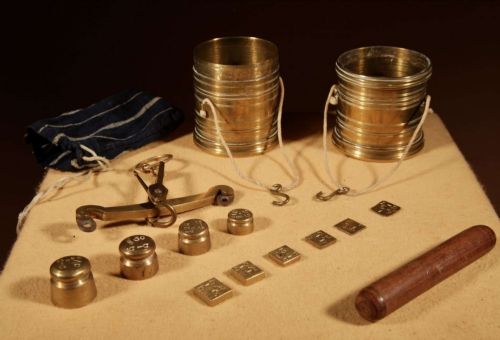
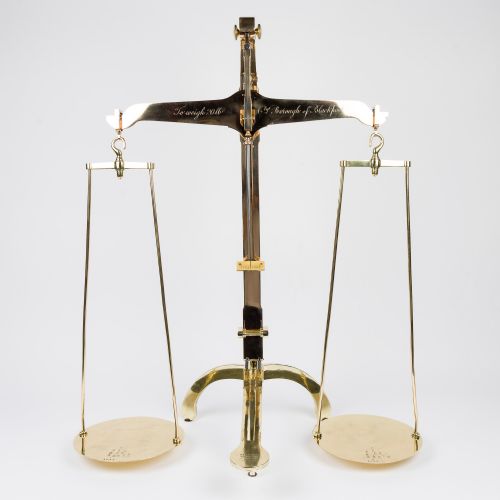
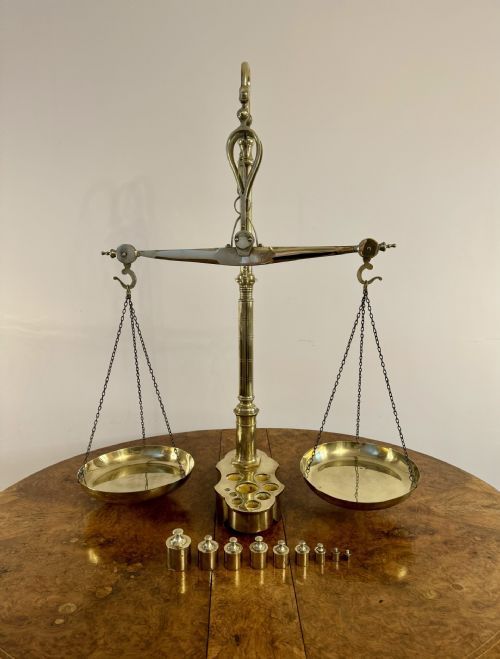
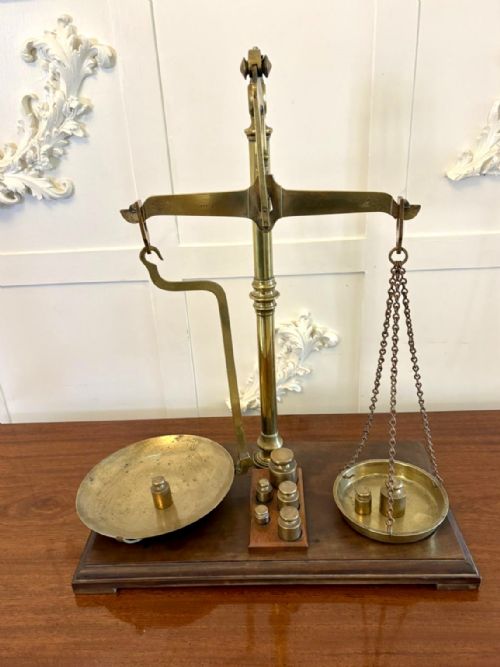
A brass beam balance relies on a central fulcrum and suspended pans to determine mass, appearing primarily as Victorian and Edwardian scientific, postal, and commercial instruments. You will encounter various forms here, ranging from enclosed chemist precision scales to robust shopkeeper models and portable devices.
The objects span from the early nineteenth century through to the mid-twentieth century, showing distinct regional variations including Dutch traditional designs alongside British institutional makers. Most examples combine a polished metal beam with timber drawer bases in mahogany or oak, often retaining their original weights.
How they were made
The primary construction pairs cast and sheet brass for the beams, indicators, and pans with dense hardwoods such as mahogany and oak for the fitted bases and cabinetry. Wrought iron and cast iron frequently provide structural reinforcement and weight within the heavier commercial and verification bases.
Makers utilised precision turning and filing to balance the central arms, incorporating steel knife-edge bearings to minimise friction during weighing. Glass panels appear in protective cabinetry for delicate chemist instruments, while textile elements occasionally line storage compartments.
Brass Beam Balance Retail Price Guide 2026
Typical asking prices for brass beam balance among the pieces listed under this phrase on Sellingantiques today, from the lower quarter to the upper quarter. They describe what is for sale here now, not the wider market.
Some scales weighed out letters for the post office before digital codes existed.
What varies in quality
Quality rests upon the precision of the central bearing and the accuracy with which the beam returns to absolute equilibrium. Finer instruments exhibit crisp maker signatures, high-grade brass castings without porosity, and meticulously fitted hardwood housings.
The presence of complete, matching sets of original weights and original glass components elevates an example above modified or incomplete specimens. Proportion and scale also dictate value, with larger institutional balances and specialised portable chondrometers showing superior mechanical complexity.
Robert Brettell Bate·Day & Millward·Parnall & Sons·De Grave Short & Co·Oertling·Bartlett & Sons
The Brass Beam Balance Glossary
- Beam
- The central horizontal metal arm of the scale that pivots on a fulcrum to compare weights.
- Chondrometer
- A specialised portable instrument used specifically for determining the bushel weight of grain.
- Fulcrum
- The central pivot point upon which the balance beam rests and swings.
- Verification
- The official testing and stamping of a scale by authorities for commercial or municipal trade use.
Brass Beam Balance: Frequently Asked Questions
How do I use a brass beam balance?
Place the instrument on a completely level surface and check that the pointer rests at the centre of the scale. Objects and standard weights are then added to opposing pans until the beam achieves horizontal equilibrium.
Fine adjustments are made using the small leveling screws or thumb nuts usually positioned at the ends or base of the beam. Once the pointer stabilizes precisely in the middle, the mass is read directly from the aggregated weights.
Are these scales still accurate for weighing?
Many surviving instruments retain their mechanical precision if the delicate knife-edge bearings remain undamaged and clean. Periodic calibration against modern standard weights ensures reliable measurements for general use.
However, commercial verification standards have lapsed for antique instruments, meaning they serve primarily as decorative objects or functional display pieces rather than legal trade scales.
How should I clean the brass components?
Dust the surfaces gently with a soft, dry cloth to remove grit before attempting any polishing. If metal cleaner is applied, use it sparingly to avoid staining adjacent timber or fabric linings.
Many collectors prefer to leave an aged patina on the brass rather than achieving a bright mirror finish. Protective micro-crystalline wax can be applied lightly to seal the metal and prevent further tarnishing.
How can I date my balance scale?
Examine the timber base style, construction joints, and any engraved maker inscriptions on the metal beam. Victorian and Edwardian examples often feature specific institutional stamps or maker plaques that narrow the production decade.
Design shifts from Georgian cabinetry to later industrial forms also provide reliable chronological markers. Patent dates or municipal verification stamps stamped into the brass offer further clues to the manufacturing period.