
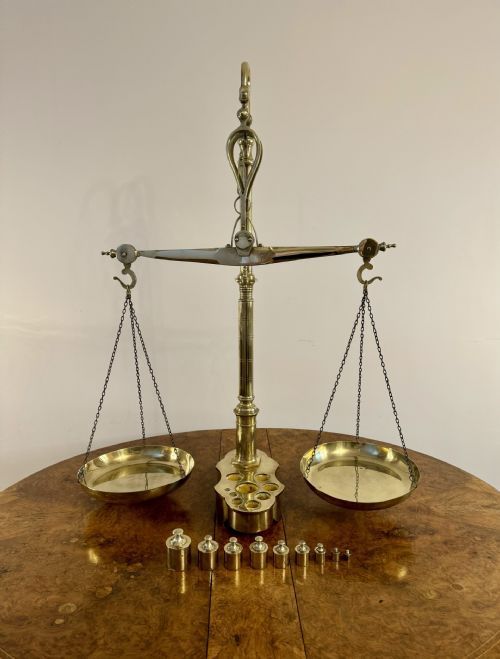


Vintage Apothecary Scales
These vintage apothecary scales are precise brass and mahogany instruments used for compounding medicines, bringing genuine scientific heritage to a room.
Vintage Apothecary Scales
When you search for vintage apothecary scales, you encounter functional scientific instruments designed for weighing medicines and precise quantities. These pieces span from the late nineteenth century through to the mid twentieth century, reflecting practical uses in dispensaries and laboratories.
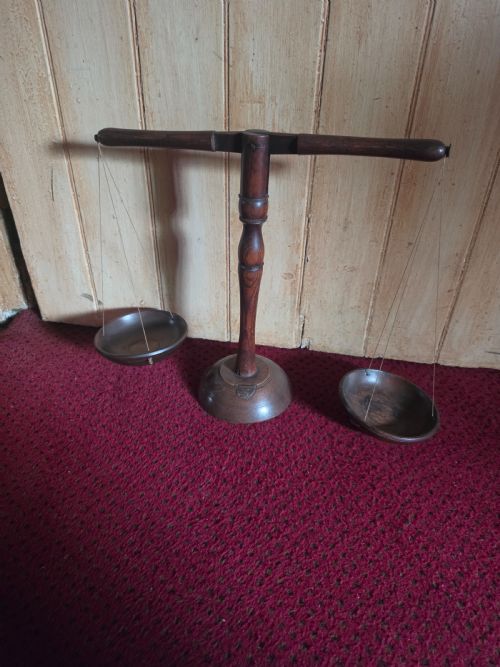
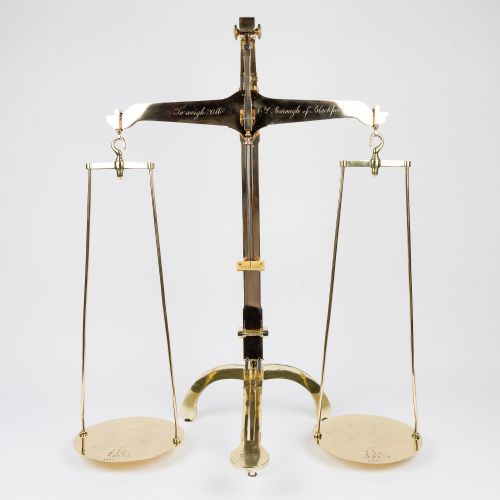
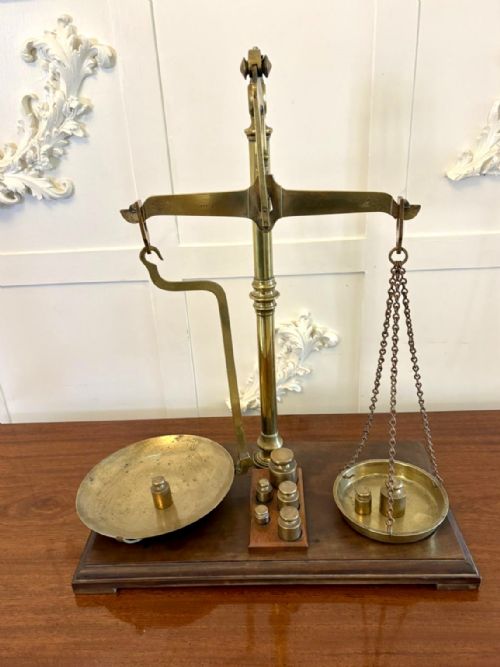
The most common examples on this page are balance scales featuring brass beams and pans mounted on mahogany or oak bases, often accompanied by their original weights. Forms range from enclosed box balances to large freestanding beam scales produced for civic and commercial weighing.
Origins vary from British workshops to European and American makers, with styles encompassing Victorian, industrial, and scientific designs. These instruments capture an era when dispensing required mechanical precision and visual dignity.
How they were made
Makers utilised cast brass for beams, pans, and indicator needles, prized for its stability and resistance to corrosion during chemical work. Bases and housing boxes were constructed from dense hardwoods such as mahogany and oak, joined carefully to support delicate pivoting mechanisms.
Iron and wrought iron provided structural strength for heavier frames and hanging mechanisms, while glass panels protected sensitive balances from air currents in professional settings. Individual components were hand-finished and adjusted to ensure exact equilibrium.
Materials across these listings include brass, mahogany, glass, iron, wrought iron, copper, cast iron, and hardwood.
What varies in quality
The distinction between standard utility balances and superior examples lies in the fineness of the metalwork and the integrity of the housing. High-grade instruments incorporate delicate beam shaping, sensitive knife-edge pivots, and original maker signatures engraved into the metal or printed on the timber cases.
Completeness dictates the standing of a piece within the range, particularly the presence of matching sets of brass weights housed in fitted wooden blocks. Surviving original glass covers and legible paper or engraved verification labels further elevate the historical integrity of the scale.
Day & Millward·Parnall & Sons of Bristol·De Grave, Short, & Co·Oertling·Bartlett & Sons·Fairbanks Scale Co·De Grave & Co. London
The Vintage Apothecary Scales Glossary
- Balance scales
- A weighing device operating on the principle of equal arms, where an unknown mass in one pan is balanced against known weights in the other. This mechanical arrangement forms the basis of all traditional apothecary and laboratory weighing.
- Beam
- The horizontal metal bar that pivots centrally on a fulcrum, carrying the weighing pans at either end. The sensitivity of the instrument depends largely on the precision of this central pivot.
- Troy ounce
- A system of units of mass traditionally used for precious metals and medicines. Sets of weights in this standard frequently accompany pharmaceutical balances.
- Treen
- Small handmade wooden objects and containers. In this context, it refers to turned wooden scale components or fitted weight boxes.
Vintage Apothecary Scales: Frequently Asked Questions
How do I use vintage apothecary scales?
These instruments operate on a simple equal-arm balance principle, where objects are placed on one pan and matched with weights on the other until the central needle points plumb.
They serve primarily as decorative display pieces in modern interiors rather than for accurate daily measuring, as calibration drifts over time.
Are original weights usually included?
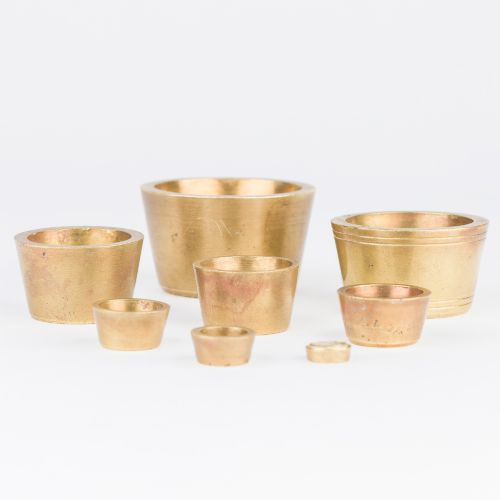
Many listings include matching brass weights, often housed in fitted wooden blocks with individual slots for each size.
When weights are missing, collectors frequently source period-correct replacements to complete the set and restore the visual balance of the piece.
How do I date these scales?
Dating relies on maker stamps, architectural styles of the wooden bases, and official verification marks stamped onto the brass beams by inspectors.
Victorian pieces typically feature rich mahogany woodwork and ornate cast brass columns, while mid-century examples adopt simpler industrial forms.
Can I clean the brass parts?
Gentle dusting with a soft cloth preserves the natural aged patina that collectors value on antique scientific instruments.
Strong metal polishes should be avoided because they strip away historical surface character and can damage delicate maker engravings.