
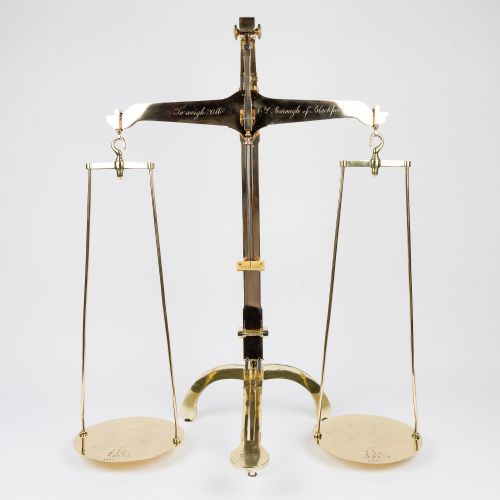
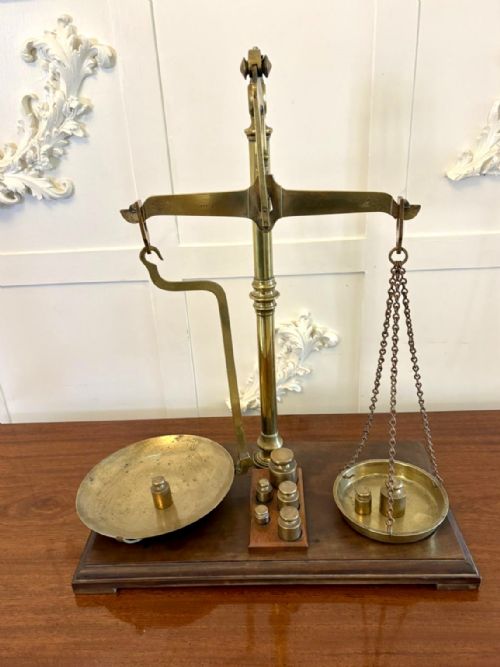
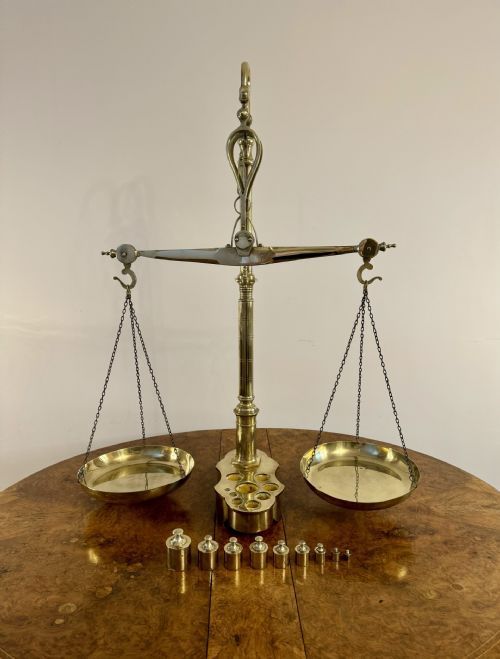


Victorian Beam Balance
These Victorian beam balance scales bring tactile precision into a room, offering a functional antique with genuine historical weight.
Victorian Beam Balance
A victorian beam balance is a weighing device constructed around a central pivoting arm, designed to determine mass through counterpoise and gravity.
The versions met on this page include apothecary scales, letter and postal scales, verification balances for city boroughs, and personal weighing scales.
Originating across the nineteenth century and into the early twentieth century, these instruments bridge domestic utility, trade, and scientific precision.
Materials and Construction
Makers utilised polished brass for the beams and pans, pairing the metal with dense hardwoods such as mahogany and oak for the mounting bases.
Iron, cast iron, and wrought iron provided the necessary structural weight and support for larger trade and verification scales.
Glass components and copper elements appeared alongside metal and wood to complete specific functional assemblies.
Inspectors carted these heavy brass beams across Victorian counties to keep local grocers honest.
Assessing Quality and Execution
The highest quality examples exhibit precise engineering in the pivot and beam, ensuring accurate equilibrium without sluggish movement.
Finish and material selection separate utilitarian workshop tools from refined apothecary and postal instruments housed in fitted hardwood cases.
Day and Millward·Parnall and Sons of Bristol·De Grave Short and Co·Bartlett and Sons·De Grave and Co London
The Victorian Beam Balance Glossary
- Beam balance
- A weighing instrument consisting of a rigid bar pivoted at its centre with pans suspended from each end. This traditional design measures mass by comparing an unknown load against known weights.
- Verification balance
- A heavy-duty scale used by official inspectors to check commercial weights and measures for accuracy. These institutional pieces often bear borough inscriptions.
- Apothecary balance
- A sensitive scale designed for weighing medical ingredients with exact precision. They frequently feature small brass pans and delicate glass indicators.
- Postal scales
- Compact desktop devices calibrated for letters and parcels, commonly mounted on wooden plinths. They reflect the administrative expansion of the period.
Victorian Beam Balance: Frequently Asked Questions
How do I date a beam balance?
Examine the materials, base construction, and any accompanying maker plaques or stamps. Patent dates and borough verification stamps also provide reliable chronological markers.
Stylistic shifts from heavy cast iron to refined brass mounted on mahogany help place a piece within the nineteenth or early twentieth century.
Were these scales used in homes?
Many smaller examples, such as letter and postal scales or personal weighing scales, served domestic and office environments. Larger instruments remained in municipal, trade, and laboratory settings.
Households utilised compact models for daily correspondence and personal health monitoring.
Can these scales still weigh accurately?
While many retain their mechanical integrity, they require careful calibration and complete sets of matched weights to function precisely. Most buyers display them as decorative historical objects rather than working laboratory tools.
Gentle handling protects the delicate knife-edge pivots from wear.
What maintenance do brass beams need?
Brass components benefit from light dusting and occasional cleaning with a non-abrasive cloth to preserve the metal surface. Avoid aggressive polishing that removes the historic patina accumulated over decades.
Wooden bases respond well to traditional beeswax to nourish the grain.