


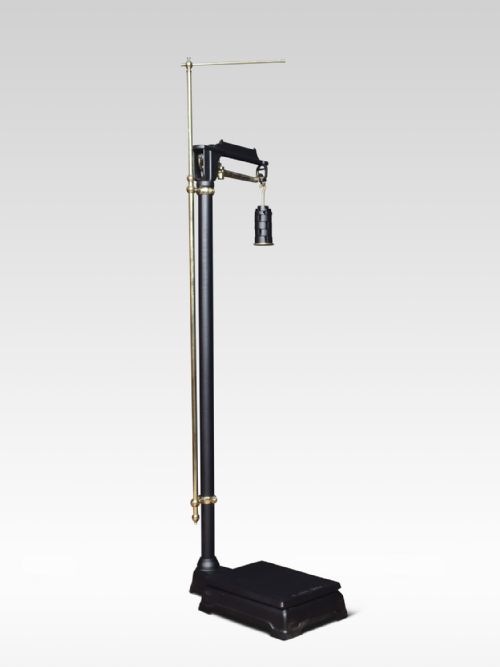
Brass Apothecary Balance
A brass apothecary balance brings precise nineteenth-century science into a modern interior.
Brass Apothecary Balance
When you search for a brass apothecary balance, you encounter scientific instruments and weighing scales spanning the Victorian period through to the mid-twentieth century.
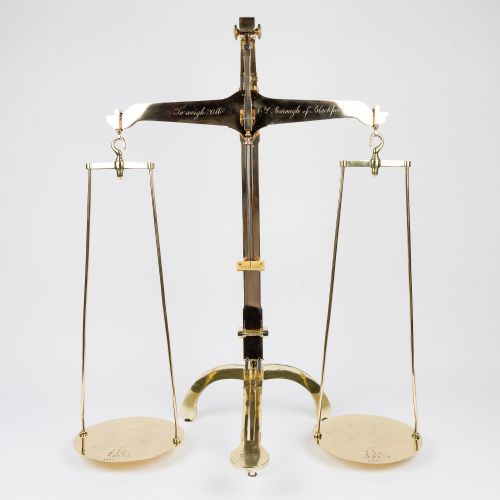
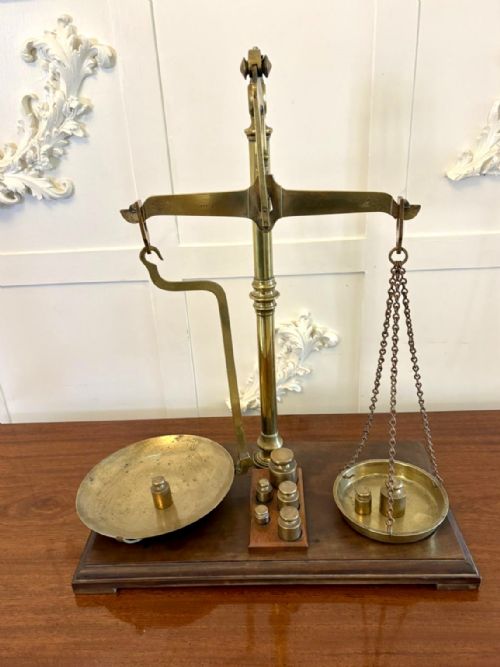
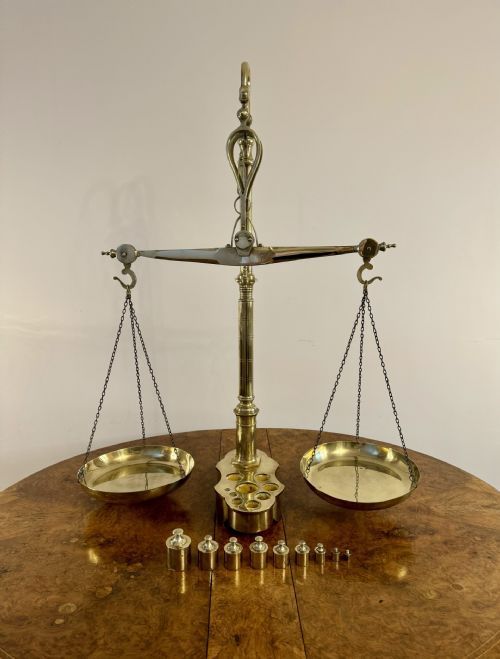
The most common form on this page is the beam scale, often housed in a mahogany or oak case with glass panels and paired with fitted brass weights.
These instruments originate from domestic and institutional settings, including chemist shops, municipal verification offices, and doctors' surgeries.
How they were made
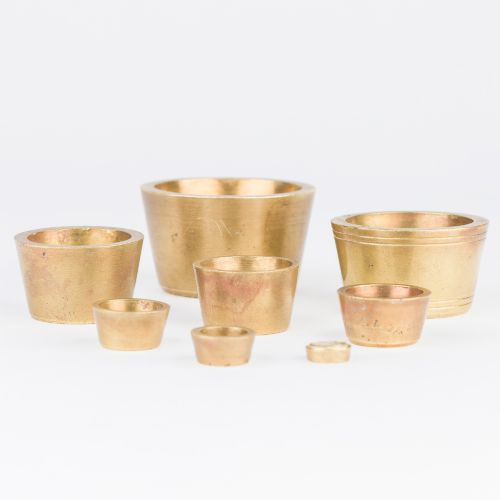
Maker workshops utilised polished brass for the central beams, pans, and intricate balance mechanisms to ensure corrosion resistance and accurate movement.
Cabinetmakers constructed sturdy housings from dense hardwoods such as mahogany and oak, frequently incorporating glazed doors to protect delicate measurements from drafts.
Makers integrated cast iron and steel components into the heavier bases and support structures to provide the necessary rigidity for precise weighing.
Some scales carry the austere stamp of municipal authorities, having once settled disputes over local market produce.
What varies in quality
The distinction between standard utility scales and top-tier instruments rests in the refinement of the maker's finish and the precision of the beam movement.
Examples bearing signatures from renowned makers demonstrate superior metallurgical work in the fulcrum and finer graduation marks on the indicator scale.
The integrity of the original wooden cabinetry and the survival of a matching set of weights in a fitted block elevate the historical completeness of the piece.
Day & Millward·Parnall & Sons of Bristol·De Grave, Short, & Co·Oertling·Bartlett & Sons·Fairbanks Scale Co·De Grave & Co. London
The Brass Apothecary Balance Glossary
- Beam scale
- A weighing device utilising a central pivoting lever with suspended pans at either end. It operates on the principle of moment equilibrium to determine mass.
- Troy ounce
- A unit of mass traditionally used for precious metals and apothecary preparations. It differs from the standard avoirdupois system.
- Verification balance
- A high-accuracy instrument employed by municipal authorities to inspect and certify commercial weights and measures. These units met strict government standards.
- Apothecary
- A historical practitioner who formulated and dispensed medicinal drugs. Their workspaces required precise instrumentation for compounding remedies.
- Fulcrum
- The central pivoting point of a balance beam. Its construction determines the sensitivity and friction of the entire instrument.
Brass Apothecary Balance: Frequently Asked Questions
How do I clean a brass apothecary balance?
Dust the instrument gently with a soft, dry cloth to remove surface particles without disturbing the delicate mechanical balance.
Avoid chemical polishes that strip away historical patination on the brass components and wooden surfaces.
Can I use these scales for accurate weighing?
Many surviving beam scales retain their mechanical precision and can measure small quantities when properly levelled on a stable surface.
Changes in humidity and minor wear over the decades mean they serve primarily as decorative objects rather than certified measuring tools.
How do I identify the period of a balance?
Examine the construction materials, joinery techniques of the wooden case, and any engraved maker signatures or municipal verification stamps.
Victorian examples frequently feature polished mahogany cabinetry and hand-engraved inscriptions, whereas mid-twentieth-century pieces adopt more utilitarian industrial forms.
Where should I display a cased balance?
Position the piece on a sturdy piece of furniture away from direct sunlight and excessive moisture to protect the timber and glass.
Enclosed glazed cabinets shield the delicate hanging pans and internal beam from accidental knocks and dust accumulation.