
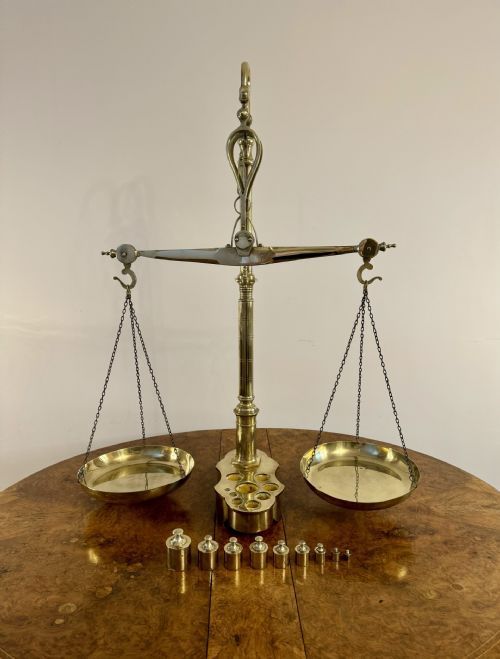


Victorian Apothecary Scales
These victorian apothecary scales are precise instruments of brass and mahogany, prized by collectors for their utilitarian elegance and mechanical integrity.
Victorian Apothecary Scales
When you search for victorian apothecary scales, you encounter functional beam balances, countertop scales, and precision instruments designed for chemists and trade. These pieces originate primarily from the nineteenth century and extend into the early twentieth century, reflecting an era of rigorous standardisation and scientific measurement.
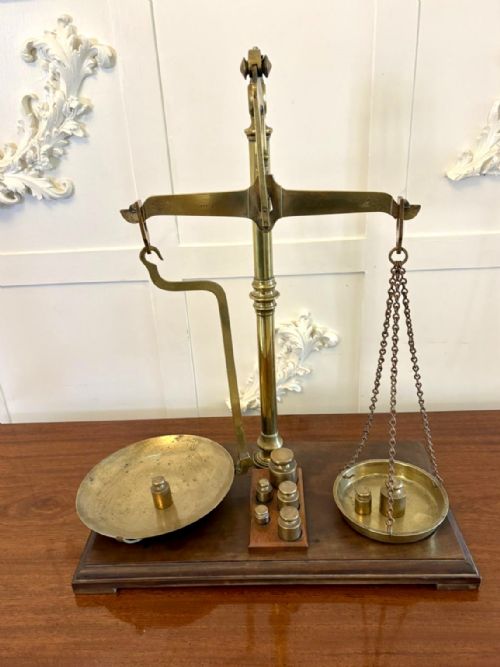
The specimens on this page commonly pair polished brass beams with wooden bases, frequently mahogany or oak, while others utilise wrought iron, copper, and glass. You will find complete sets equipped with original weights in block stands alongside larger institutional balances marked for city boroughs and verification offices.
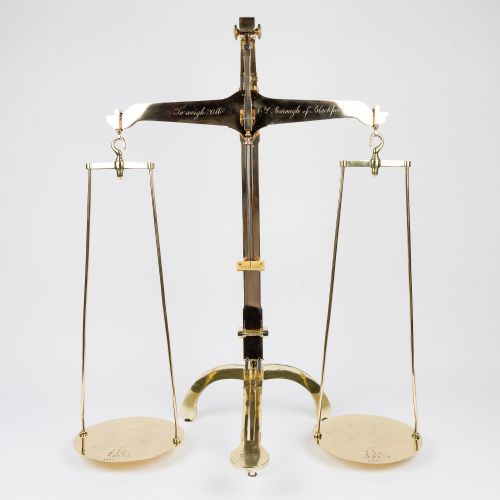
Forms range from compact travelling kits housed in fitted boxes to substantial countertop balances intended for daily dispensary use. Many examples survive with maker inscriptions and local government verification stamps, grounding each instrument in its specific historical workspace.
How they were made
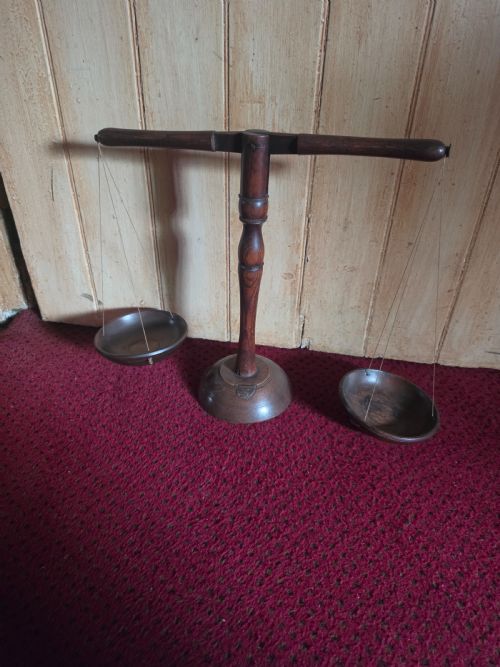
Makers constructed the primary structural components from durable hardwoods like mahogany and oak, forming stable platforms and drawers to house delicate weights. These wooden housings were frequently polished or fitted with brass mounts to protect against chemical spills and daily wear in the dispensary.
The mechanical assemblies rely upon cast brass beams, knife-edge fulcrums, and suspended pans of brass, copper, or glass. Artisans achieved precision through careful balancing and fine adjustment, ensuring repeatable accuracy across small pharmaceutical doses and larger institutional measures.
City boroughs required independent verification balances to keep local merchants honest, meaning some scales spent their lives judging the ginger beer.
What varies in quality
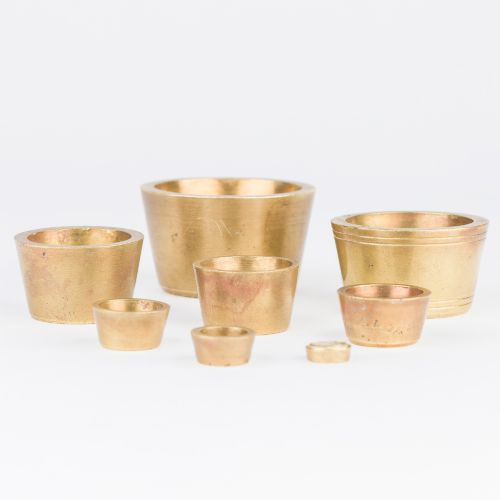
The distinction between standard utility balances and superior pieces rests upon the retention of original components, such as matched weight sets in fitted wooden block stands. Instruments bearing clear maker signatures and verified civic inscriptions command greater interest than unmarked workshop examples.
Mechanical refinement and material selection further differentiate the range, evident in the crispness of the brass casting and the smooth integration of drawers within the hardwood bases. The survival of delicate glass pans and original string or wire suspensions preserves the complete historical integrity of the piece.
Day & Millward·Parnall & Sons of Bristol·Fairbanks Scales·De Grave Short and Co·Bartlett & Sons·May Roberts and Co
The Victorian Apothecary Scales Glossary
- Balance
- A weighing instrument that compares an unknown mass against known weights using a pivoting beam. This design forms the foundational mechanism for precise pharmaceutical measurement.
- Beam
- The central horizontal bar of a scale that pivots on a central fulcrum. Its balance determines the accuracy of the reading.
- Fulcrum
- The pivot point upon which the balance beam rests and oscillates. High-quality instruments utilise hardened steel knife-edge bearings to minimise friction.
- Troy ounce
- A unit of imperial mass traditionally used for precious metals and apothecary preparations. Sets of weights calibrated to this standard frequently accompany medical balances.
- Verification
- The official testing and stamping of a weighing instrument by local authorities for trade use. These marks provide reliable evidence of an item's working history.
Victorian Apothecary Scales: Frequently Asked Questions
How do I date these scales?
Dating relies upon a combination of stylistic markers, construction methods, and any engraved maker details or municipal verification stamps found on the brass beam or wooden base. Many pieces carry patent dates or registry marks that narrow their production era.
Archival records and maker directories further help contextualise the specific workshop signatures, though many utilitarian designs altered little across the late nineteenth and early twentieth centuries.
Were all these scales used for medicine?
While many served in chemists' shops for compounding prescriptions, others fulfilled roles in trade, postal sorting, and municipal verification offices. Institutional examples often bear borough inscriptions indicating their use as official standards.
Travelling sets were specifically built for physicians making house calls, featuring compact wooden boxes designed to withstand transit while protecting delicate glass pans and weights.
How should I clean the brass?
Most collectors prefer to leave natural patina undisturbed, as harsh polishing removes historical character and can alter fine surface details. Gentle dusting with a soft cloth is generally sufficient for regular maintenance.
If cleaning is necessary, use a non-abrasive cleaner specifically formulated for antique metals, taking care to avoid wood surfaces and delicate maker inscriptions.
Are the weights usually original?
Some survivals retain their complete matching weight sets housed in fitted wooden blocks or original boxes, while others have been assembled from loose components over time. Checking for corresponding maker stamps across both the scale and the weights helps determine whether the set is intact.
Even when assembled later, correct period weights allow the balance to function accurately as a mechanical instrument.