
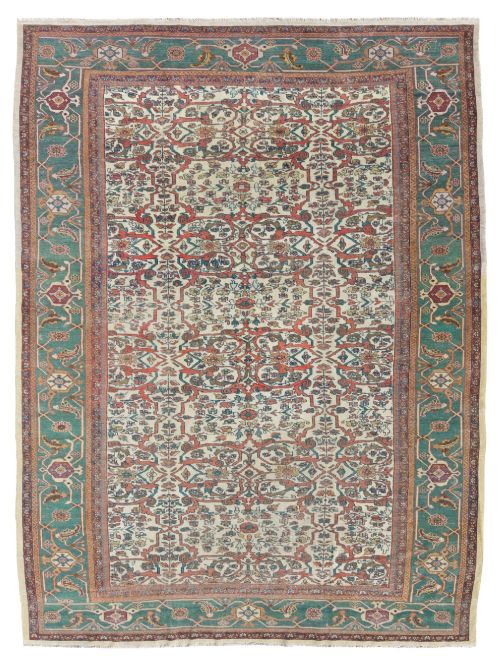


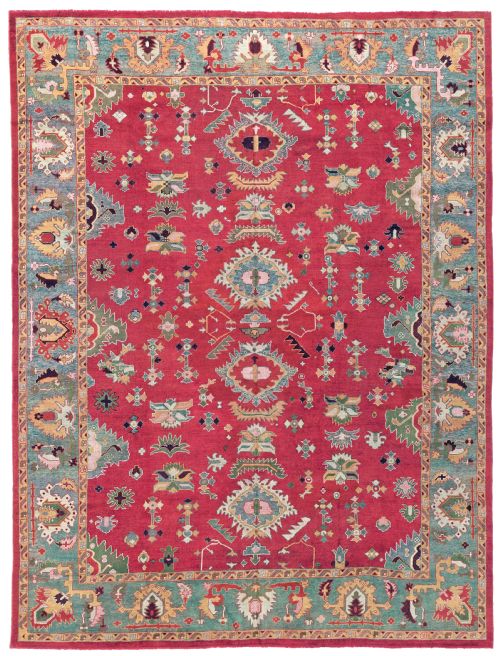
Large Green Oriental Rug
A large green oriental rug anchors a room with deep botanical tones and centuries of weaving tradition.
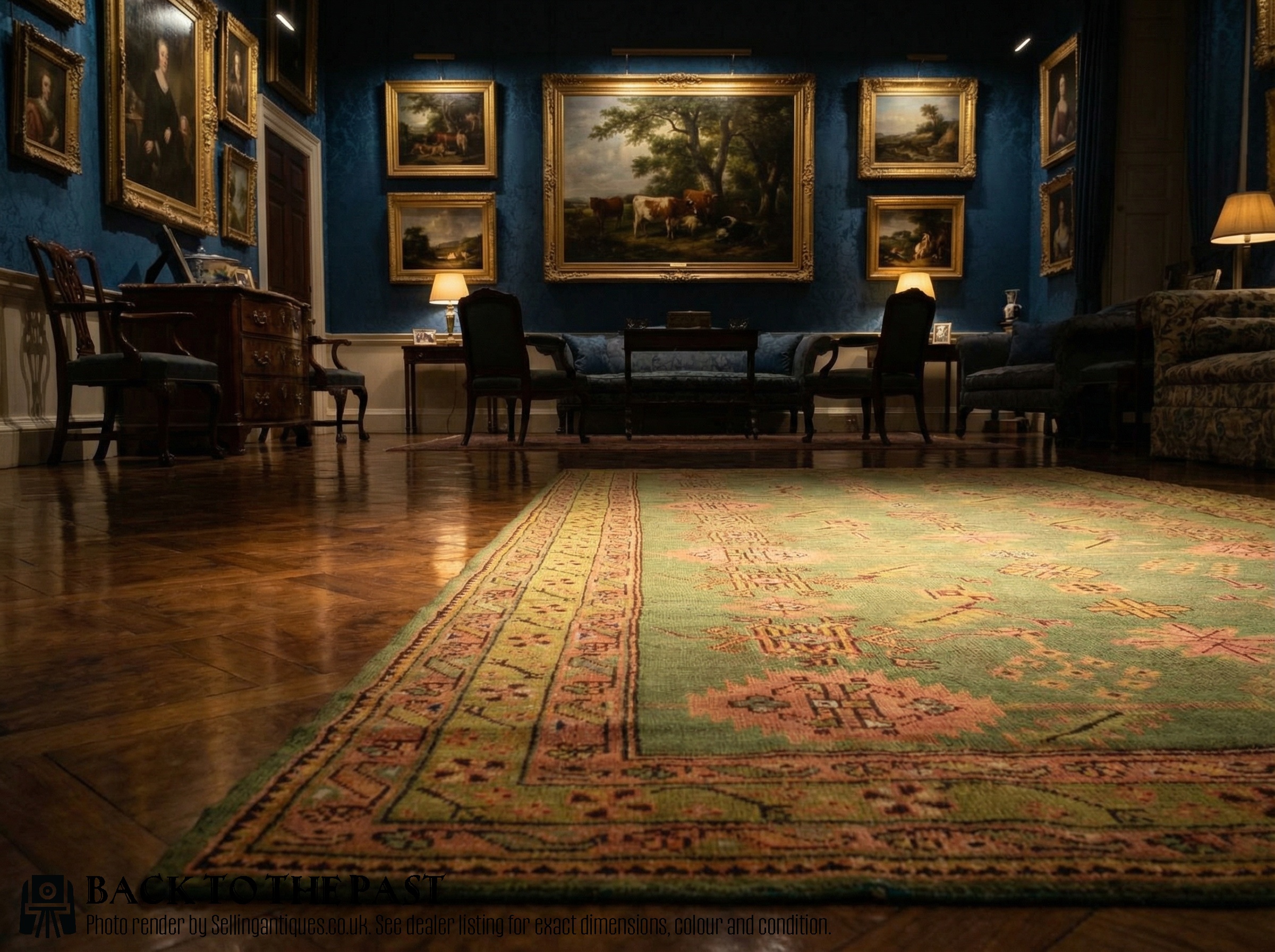
Large Green Oriental Rug
When you search for a large green oriental rug, you are looking at substantial hand-knotted floor coverings originating from Turkey, Persia, the Caucasus, and India. These pieces bring commanding scale and vegetal shades into a space, ranging from soft mossy hues to deep forest tones.
The versions you are most likely to meet on this page span the late eighteenth century through to the early twentieth century. They include majestic Ushak, Sultanabad, Serapi, and Ziegler carpets woven in wool, cotton, and angora wool.
Makers from these diverse regions utilised distinct regional palettes and large-scale floral or geometric motifs. A large green oriental rug serves as a substantial visual anchor, often dominating the room with its botanical field colour.
How they were made
Weavers constructed these large carpets using natural wool and cotton foundations, often employing hand-spun wool for the pile to absorb dye with rich variance. Angora wool also appears in certain fine late nineteenth-century examples, lending a softer handle to the surface.
Natural dye stuffs provided the characteristic green fields and contrasting terracotta, blue, or ivory details seen across Persian and Turkish workshops. Skilled hands knotted each thread individually onto vertical looms before washing and finishing the heavy textile.
Listings feature wool, cotton, and angora wool across Persian, Turkish, Caucasian, and Indian origins.
What varies in quality
The distinction between tiers rests in the handling of the wool, the saturation of the green dye, and the crispness of the large-scale drawing. Finer examples display greater depth in the pile and more sophisticated abrasash in the field.
Proportion and scale dictate the visual success of a large carpet, where balanced borders frame the central green expanse effectively. The integrity of the foundational cotton and wool weave underpins the lasting durability of the piece.
The Large Green Oriental Rug Glossary
- Abrasash
- Natural tonal variation within a single field colour caused by batches of hand-spun yarn taking dye differently. This subtle shifting gives antique oriental carpets their characteristic liveliness.
- Pile
- The vertical tufts of wool or angora that form the soft surface of the rug. It is knotted onto the foundation warps andwefts.
- Warp
- The stationary longitudinal threads stretched tightly on the loom upon which the knots are tied. Cotton is commonly utilised for this structural element.
- Weft
- The horizontal threads passed across the warps after each row of knots to secure them in place. Multiple shots of weft determine the rigidity of the carpet body.
- Field
- The central background area of the rug enclosed by the decorative borders. In these listings, this space is defined by various shades of green.
Large Green Oriental Rug: Frequently Asked Questions
How do I clean a large green oriental rug?
Professional specialist cleaning is essential for antique wool carpets to protect natural dyes and fragile cotton foundations. Regular gentle vacuuming without a beater bar removes surface grit.
Harsh chemical treatments or household detergents will strip the lanolin from the wool and alter the green tones permanently. Consult a conservator experienced in nineteenth-century Persian and Turkish textiles.
Can I place these rugs in high traffic areas?
Sturdy nineteenth-century wool carpets tolerate moderate footfall well when placed over a quality underlay. The dense pile protects the structural foundation from friction.
Keep delicate angora wool examples out of heavy thoroughfares to preserve the fibre. Direct sunlight will also fade natural green dyes over extended periods.
How do I identify an Ushak carpet?
Ushak carpets typically feature large-scale floral motifs, grand medallions, and softer wool on cotton foundations. The palette often relies on muted terracotta, saffron, and unusual green grounds.
Originating from western Anatolia, these nineteenth-century pieces display a looser, more relaxed knotting style than traditional Persian workshop rugs.
What is a Sultanabad carpet?
Sultanabad carpets originate from the Arak region of Persia and are celebrated for grand, open floral designs intended for Western export. They utilise generous proportions and muted vegetal dyes.
The large scale of the patterns suits expansive room settings. Their robust wool construction handles daily life while maintaining decorative presence.