

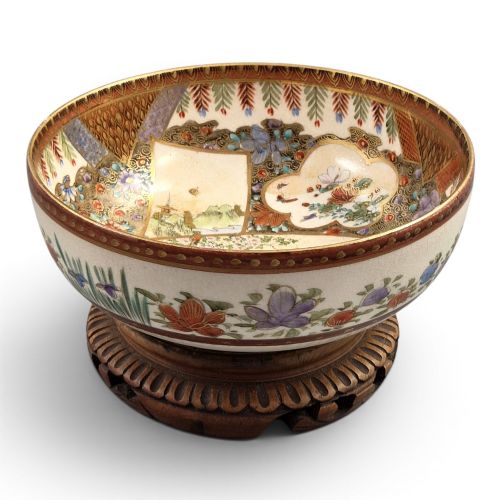


Japanese Enamel Decorative Bowl
A japanese enamel decorative bowl brings cabinet-worthy colour and intricate metalwork into a room, drawing the eye instantly.
Japanese Enamel Decorative Bowl
A japanese enamel decorative bowl encompasses deep copper vessels and porcelain dishes carrying dense surface work, spanning centuries of Far Eastern craftsmanship. These pieces often arrive from the Meiji and Edo periods, displaying both disciplined geometry and organic motifs.
The version most commonly met on this page is the cloisonne enamel charger or bowl, featuring wired cells filled with coloured paste. Alongside these, buyers encounter traditional Imari, Satsuma, and Kutani ceramic forms that bridge the gap between pottery and metalwork.
Forms range from shallow dishes and scallop-edged vessels to large lidded bowls and expansive chargers meant for display. Each object reflects the changing tastes of Japanese workshops and their Western admirers during the height of the Japonisme movement.
Materials and Construction
Makers formed the foundational body of these vessels using hammered copper, brass, or fine porcelain, shaping them into robust bowls and plates. Copper provided a stable base for wirework, while ceramic bodies offered smooth white surfaces for painted pigments and gold leaf.
Cloisonne pieces relied on thin metal wires soldered to the metal ground to form intricate compartments, which artisans then filled with enamel paste before firing. Ceramic bowls utilised high-fired earthenware and porcelain decorated with underglaze cobalt, iron red enamel, and gilding.
The material palette recorded here extends from traditional earthenware and copper to brass, gold leaf, and translucent enamel.
Standards of Quality
Quality rests upon the precision of the wirework and the evenness of the enamel surface, where smoother finishes and tighter cell boundaries indicate superior skill. Master artisans achieved thinner partitions and more complex pictorial depth without pitting or cloudiness in the vitreous paste.
Painted ceramic bowls show distinction through the crispness of the hand-painted motifs and the controlled application of gilding across the rim and interior. Signed works by noted makers and well-documented workshops generally represent the higher tier of surviving examples.
Kozan·Shozo·Baccarat
The Japanese Enamel Decorative Bowl Glossary
- Cloisonne Enamel
- A metalwork technique where thin wires create raised barriers on a vessel body to contain coloured glass pastes fired in a kiln. This method allows for pictorial detail across curved surfaces.
- Imari
- A traditional style of Japanese porcelain featuring a palette of underglaze blue, iron red, and added gold. These pieces were widely exported from the port of Imari during the Edo period.
- Satsuma
- Earthenware pottery originating from Satsuma Province, characterised by a crackled ivory glaze and elaborate polychrome enamel decorations often finished with gold. It became immensely popular during the Meiji period.
- Japonisme
- A Western artistic movement in the late nineteenth century influenced by Japanese art and design. European makers incorporated these aesthetic principles into their own glass and metal production.
- Plique-a-jour
- An enamelling technique similar to cloisonne where the enamel is fired without a backing metal, allowing light to shine through the translucent coloured cells like stained glass.
Japanese Enamel Decorative Bowl: Frequently Asked Questions
How were japanese enamel decorative bowls used?
These vessels served primarily as decorative showpieces in elite interiors rather than utilitarian tableware. Large chargers and deep bowls sat upon tables or within cabinets to display wealth and artistic taste.
Over time, many found their way into European collections influenced by the craze for Eastern goods. Their robust construction allowed them to survive centuries of display without losing their vibrant surface detail.
What is the difference between cloisonne and ceramic bowls?
Cloisonne bowls feature a metal core of copper or brass decorated with wire compartments filled with vitreous enamel paste. They rely on metallic structure and glassy colour gradients for their visual impact.
Ceramic bowls instead use porcelain or earthenware foundations painted with mineral pigments and glazes. While both achieve rich decoration, one builds imagery through metal and glass while the other uses clay and pigment.
How do I date a Meiji period bowl?
Dating relies on stylistic markers, materials, and signatures associated with the reign of Emperor Meiji from eighteen sixty-eight to nineteen twelve. Pieces from this era often display hyper-detailed natural motifs and precise wirework techniques.
Earlier items from the Edo period tend towards different stylistic conventions and heavier ceramic bodies. Comparing the signature style and compositional layout helps narrow the decade of creation.
Can I use these antique bowls for food?
These fragile antique pieces are meant for display and collection rather than daily dining use. The historic enamels and delicate gold leaf can suffer damage from acidic foods, cutlery, or modern dishwashers.
Preserving their condition requires gentle dusting with a soft cloth rather than washing. Treating them as works of art ensures the surfaces remain stable for future years.