
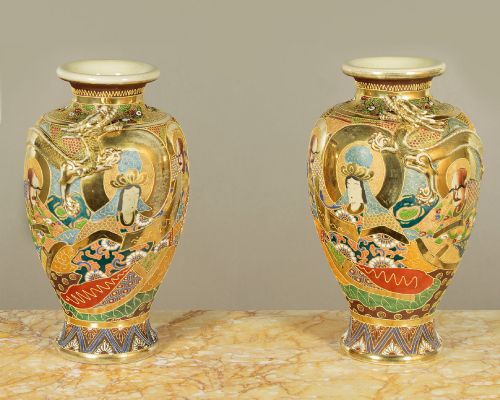


Japanese Arhat Vase
These Japanese arhat vase examples bring together intricate earthenware, porcelain, and gold gilt work from the Meiji and Victorian periods.
Japanese Arhat Vase
A japanese arhat vase presents elaborate depictions of Buddhist sages, frequently accompanied by dragons, geometric panels, and mythical creatures. Such items range from miniature vessels to monumental palace pieces standing over eighty centimetres tall.
The objects on this page belong primarily to the Meiji period and the later Victorian era, executed in earthenware or porcelain. Many showcase hexagonal or polygon profiles alongside traditional forms with elephant handles.
Makers focused heavily on narrative scenes, rendering numerous figures with distinctive facial expressions and flowing robes. Satsuma ware dominates the selection, though Kutani pieces also appear among the offerings.
How they were made
Potters utilised earthenware and porcelain as bases before applying rich polychrome enamel and extensive gold leaf or gold gilt. Skilled artisans painted intricate religious processions and portrait groups directly onto the ceramic surface.
Moriage techniques added raised relief details to robes, borders, and architectural elements, creating tactile depth across the panels. Guilded outlines defined the individual arhats and surrounding dragon motifs against patterned backgrounds.
One grand lidded vessel stands at a towering eighty-four centimetres, ready to oversee the room.
What varies in quality
Execution of the figural painting determines the distinction between standard production and masterwork pieces. The precision in rendering each arhat's expression and the complexity of the accompanying dragon or landscape panels dictate visual success.
The density and purity of the gold gilt application separate routine items from superior examples. Heavy, clean gilding combined with skilful moriage work indicates an atelier of higher standing and artistic ambition.
Hotoda·Seiko-en Chokei·Hattori
The Japanese Arhat Vase Glossary
- Arhat
- An enlightened Buddhist sage or holy person. These figures appear frequently in detailed processions across nineteenth-century ceramic surfaces.
- Satsuma
- A type of Japanese earthenware featuring a crackled ivory glaze. Artisans decorated these ceramic blanks with elaborate polychrome enamels and gold leaf.
- Moriage
- A decorative ceramic technique using piped clay to create raised relief patterns. This method adds a tangible, textured element to panels and borders.
- Meiji Period
- The era in Japanese history spanning from 1868 to 1912. Many decorative export pieces seen today originated during these decades of rapid industrial and artistic output.
- Kutani
- Japanese porcelain or earthenware recognised for bold colour palettes. These items often employ dense geometric patterns alongside figurative scenes.
Japanese Arhat Vase: Frequently Asked Questions
How do I identify a Satsuma vase?
Satsuma ware is characterised by its distinctive cream-coloured earthenware body covered in a fine network of crackled transparent glaze. Artisans painted these surfaces using dense enamel colours and abundant gold gilt.
Most examples from this tradition feature elaborate figural panels, floral borders, or Buddhist iconography created for the international export market.
Where should I display large vases?
Monumental pieces require stable placement on low tables or sturdy pedestals away from heavy foot traffic. Because several vessels exceed eighty centimetres in height, floor placement in corners or hallways provides adequate clearance.
Ensure the display area receives balanced ambient light to properly reveal the reflective gold leaf and intricate enamel details.
What distinguishes Meiji period ceramics?
Meiji period works reflect the artistic standard achieved when Japanese kilns opened fully to Western trade. Craftsmen combined traditional religious subjects with unprecedented technical precision in enamelling and gilding.
Signed pieces from this era often demonstrate a level of narrative complexity and material refinement not found in earlier export wares.