


Islamic Revival Side Table
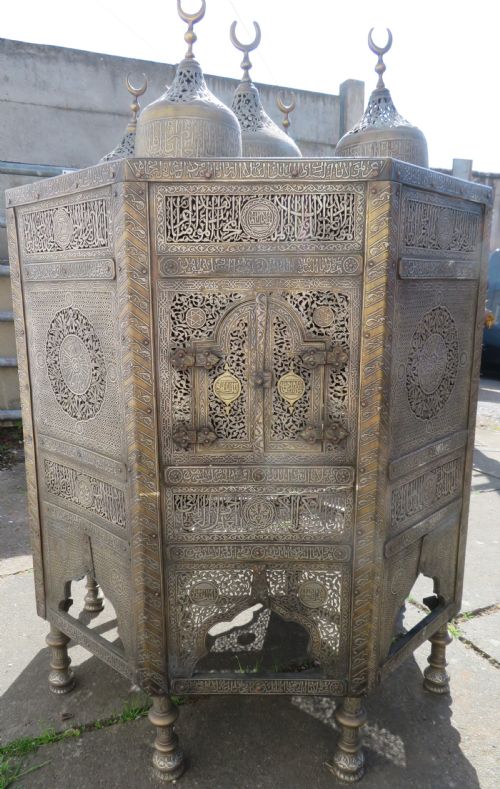
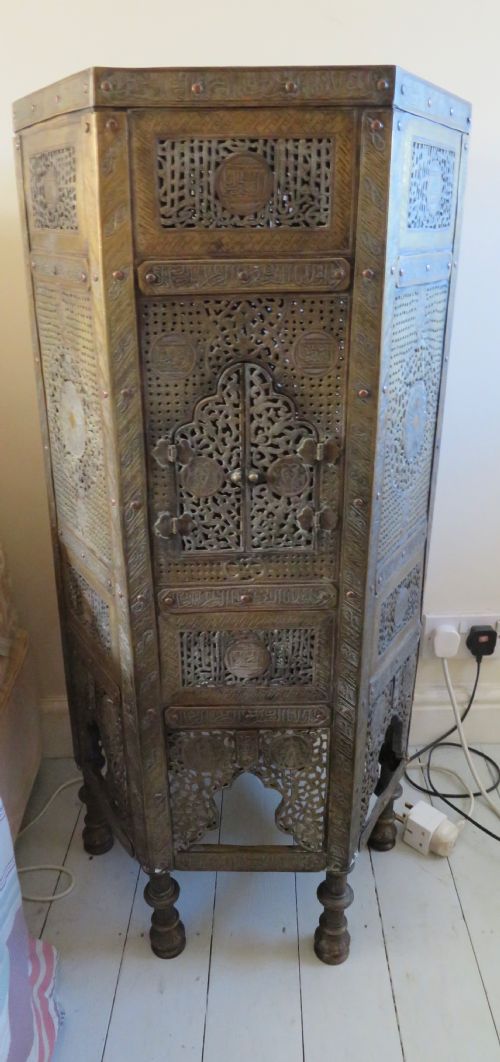
These Islamic revival side tables bring complex geometric patterns and rich metalwork into a room.
Islamic Revival Side Table
When you search for an islamic revival side table, you encounter low occasional furniture built to catch the eye with dense surface decoration. These items range from compact hexagonal side tables to broader centre pieces designed for domestic spaces.
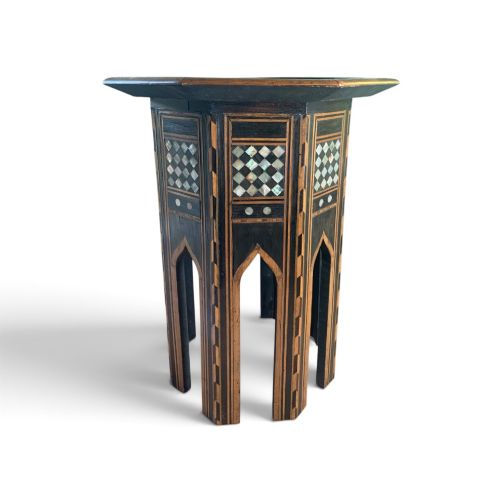
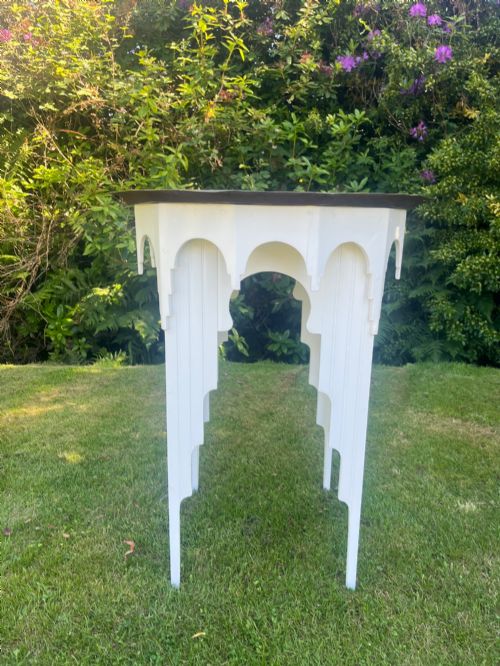
The versions most commonly met on this page span the nineteenth century and the early twentieth century. They draw directly on Moorish and Mamluk design traditions, often taking octagonal or hexagonal forms that function easily as lamp tables.
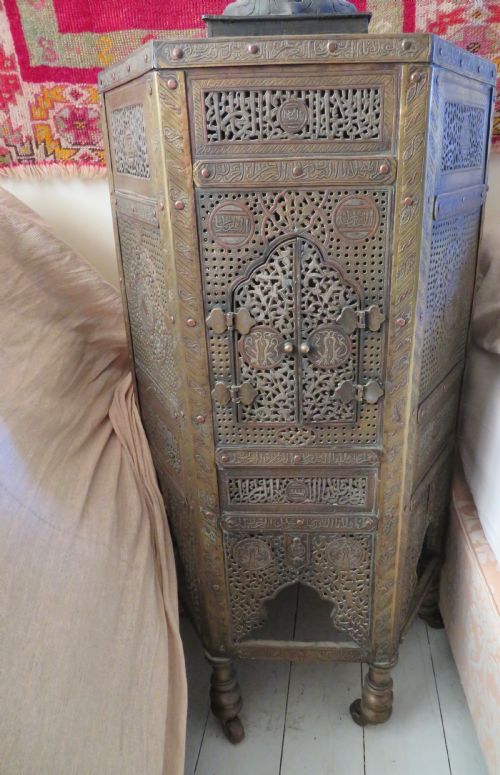
Makers from this tradition utilised distinct regional forms, such as the Cairo-ware kursi or Syrian tables, incorporating intricate openwork and storage cupboards beneath the top surface. Each piece reflects nineteenth-century European and Middle Eastern design exchange.
How they were made
These tables rely on a foundation of hardwood or walnut, shaped into rigid frames that support complex surface ornament. Craftsmen built the structures using geometric joinery to sustain the weight of heavy inlays.
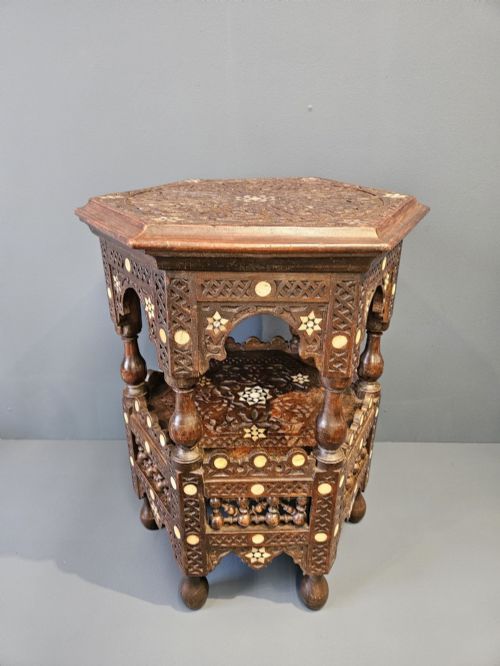
Surfaces feature intricate arrangements of mother-of-pearl, bone, white metal, and copper inlaid into brass. Artisans also employed deep carving and openwork techniques across the wood panels to create textured, layered patterns.
Several tables include clever hidden cupboards beneath their tops, perfect for keeping small secrets away from polite Victorian company.
What varies in quality
The distinction between standard and superior pieces rests on the precision of the geometric inlay and the density of the materials utilised. Finer examples display tightly fitted mother-of-pearl and bone segments with minimal filler.
The ambition of the form also dictates quality, shifting from straightforward carved wooden tables to complex hexagonal kursi inlaid with multiple metals. The depth of the openwork carving and the integration of functional elements like cupboards separate routine production from exceptional craftsmanship.
The Islamic Revival Side Table Glossary
- Kursi
- A low occasional table or stool, often hexagonal, associated with Cairene metalwork traditions. These items serve as central display surfaces in traditional interiors.
- Cairoware
- Metalwork produced in Cairo during the late nineteenth and early twentieth centuries, characterised by brass inlaid with silver, copper, and white metal. This technique creates high-contrast geometric and calligraphic motifs.
- Moorish Revival
- An architectural and decorative style popular in the nineteenth century that draws on North African and Spanish Islamic design. It utilises horseshoe arches, dense geometric carving, and intricate lattices.
- Mamluk Revival
- A decorative movement inspired by the art of the Mamluk Sultanate, focusing on heavy brass work and detailed geometric inlays. Pieces in this style often echo medieval mosque furnishings.
- Octagonal
- Having eight sides and eight angles. This geometric plan provides stability and creates distinct panel faces for inlay work on small tables.
Islamic Revival Side Table: Frequently Asked Questions
What is an islamic revival side table?
These items are nineteenth and early twentieth-century occasional tables influenced by Middle Eastern and North African design traditions. They feature distinct geometric shapes and heavy surface decoration.
Craftsmen built them using native hardwoods adorned with contrasting inlays like mother-of-pearl, bone, and mixed metals to create striking visual textures for domestic interiors.
How do I identify a cairo-ware table?
Cairo-ware tables are distinguished by their brass construction heavily inlaid with copper and white metal in dense calligraphic or geometric patterns. They frequently take a hexagonal form.
The surface metalwork creates a sharp contrast against the dark brass background, marking them out clearly from plain carved wooden occasional furniture.
Were these tables made in Europe?
Many pieces were produced in workshops across the Middle East and North Africa for export to European markets, while European firms also created inspired interpretations.
British retailers like Liberty retailed pieces that reflected this aesthetic, blending traditional techniques with domestic tastes of the period.
How do I care for inlaid wood?
Protect the surfaces from excessive moisture and direct heat to prevent the delicate bone and mother-of-pearl inlays from loosening. Regular dusting with a dry cloth keeps the crevices clear.
A light application of appropriate wax helps nourish the hardwood frame without damaging the surrounding metal and shell elements.