
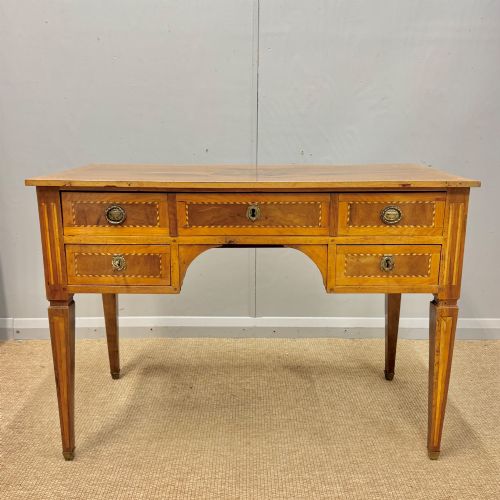

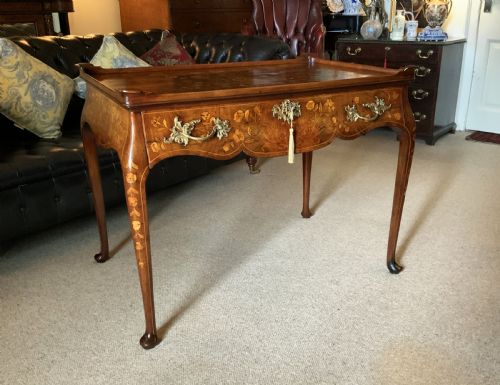


Inlaid Walnut Dressing Table
An inlaid walnut dressing table brings warmth and intricate botanical detail into a bedroom through rich timber and contrasting boxwood.
Inlaid Walnut Dressing Table
An inlaid walnut dressing table spans compact table mirrors and lowboys from the eighteenth century up to substantial Victorian and Edwardian examples. Buyers searching for an inlaid walnut dressing table encounter freestanding desks, French poudreuses, and kneehole chests fitted with mirrors. Pieces originate from English, French, and Dutch workshops across the Georgian and Victorian eras.
The Dutch examples lean heavily into floral marquetry and Rococo outlines, whereas English versions favour figured walnut veneers with understated boxwood lines. French pieces often combine the form with a work table or vanity case, incorporating multiple compartments beneath the lid.
Materials and construction
Cabinetmakers utilised walnut and burr walnut veneers applied to stable secondary timbers, creating rich grain patterns across the main surfaces. Boxwood and fruitwood provided the contrasting tones necessary for delicate floral and geometric marquetry work.
Hardware such as brass handles, mounts, and ormolu accents complemented the dark timber, whilst interior compartments frequently integrated mirrors, glass, and velvet linings for personal grooming items.
Listings feature walnut, brass, glass, and ormolu across pieces spanning the Georgian, Victorian, and Edwardian periods.
Design and execution
Quality rests in the precision of the marquetry and the choice of veneer. Finer pieces display crisp, tight botanical inlays without gaps, utilising burr or figured walnut with strong natural movement.
Construction methods also separate standard items from superior works, particularly in the dovetailing of drawers, the seamless integration of pivoting mirror frames, and the original condition of the brass and glass fittings.
Maples·E and R
The Inlaid Walnut Dressing Table Glossary
- Marquetry
- Decorative patterns formed by fitting together thin slices of wood veneer into pictorial designs such as flowers and birds. This technique defines the surface ornamentation of many Dutch and French pieces.
- Poudreuse
- A French dressing table or vanity fitted with folding lids and an internal mirror. These multi-compartment tables served aristocratic ladies for morning toiletry routines.
- Lowboy
- A small side table with drawers, frequently used as a dressing table during the Georgian period. They typically stand on slender cabriole legs.
- Burr walnut
- Timber taken from a tree growth or wart, yielding highly twisted, swirling grain patterns. It commands attention when used as a primary veneer.
- Kneehole
- A desk or dressing chest featuring a central recess for the legs, flanked by pedestals of small drawers. This form allows the user to sit comfortably close to the mirror.
Inlaid Walnut Dressing Table: Frequently Asked Questions
How do I clean an inlaid walnut surface?
Dust gently with a dry, soft cloth and feed the timber periodically with a traditional beeswax polish. Avoid modern liquid sprays that can penetrate gaps in the marquetry.
Keep the piece away from direct sunlight and radiators to prevent the walnut veneers and boxwood inlays from drying out and lifting.
Are dressing table mirrors original?
Many surviving pieces retain their original glass and swing frames, often identifiable by minor foxing and distortion in the reflection. Replacements are common due to breakage over the centuries.
Inspect the mounting brackets and screw threads to determine whether the mirror frame matches the age and wear of the base table.
Where were these tables made?
Production centres spanned England, France, and the Netherlands, each imparting distinct regional characteristics. Dutch makers preferred heavy floral marquetry, whilst English cabinetmakers focused on figured veneers and boxwood stringing.
French workshops favoured multifunctional designs like the poudreuse, combining writing, dressing, and storage within a single refined frame.
Can I use a antique dressing table daily?
These tables adapt well to modern bedrooms as functional writing surfaces or display consoles. Care must be taken with liquids and cosmetics to protect the historic polish and veneer.
Ensure heavy items stay off delicate folding flaps and interior compartments to preserve the antique hinges and support structures.