

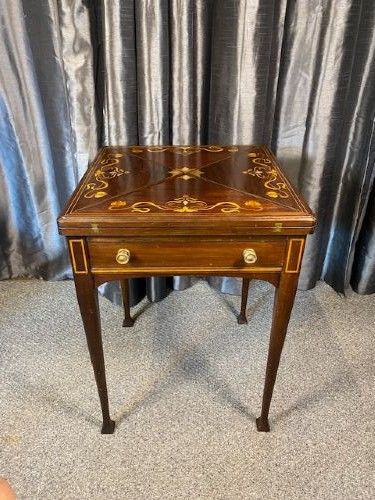
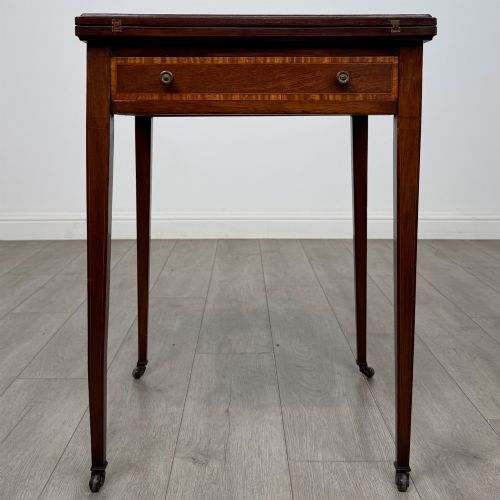
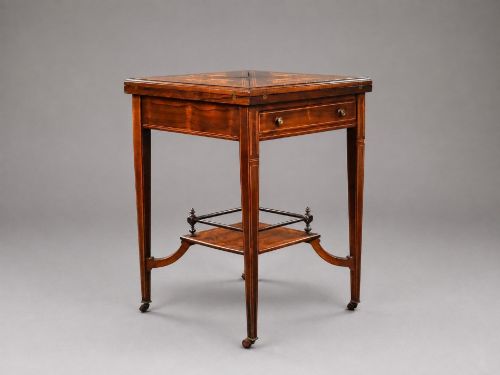


Inlaid Envelope Table
An inlaid envelope table transforms from a compact occasional piece into a generous games surface with the neat rotation of its four folding flaps.
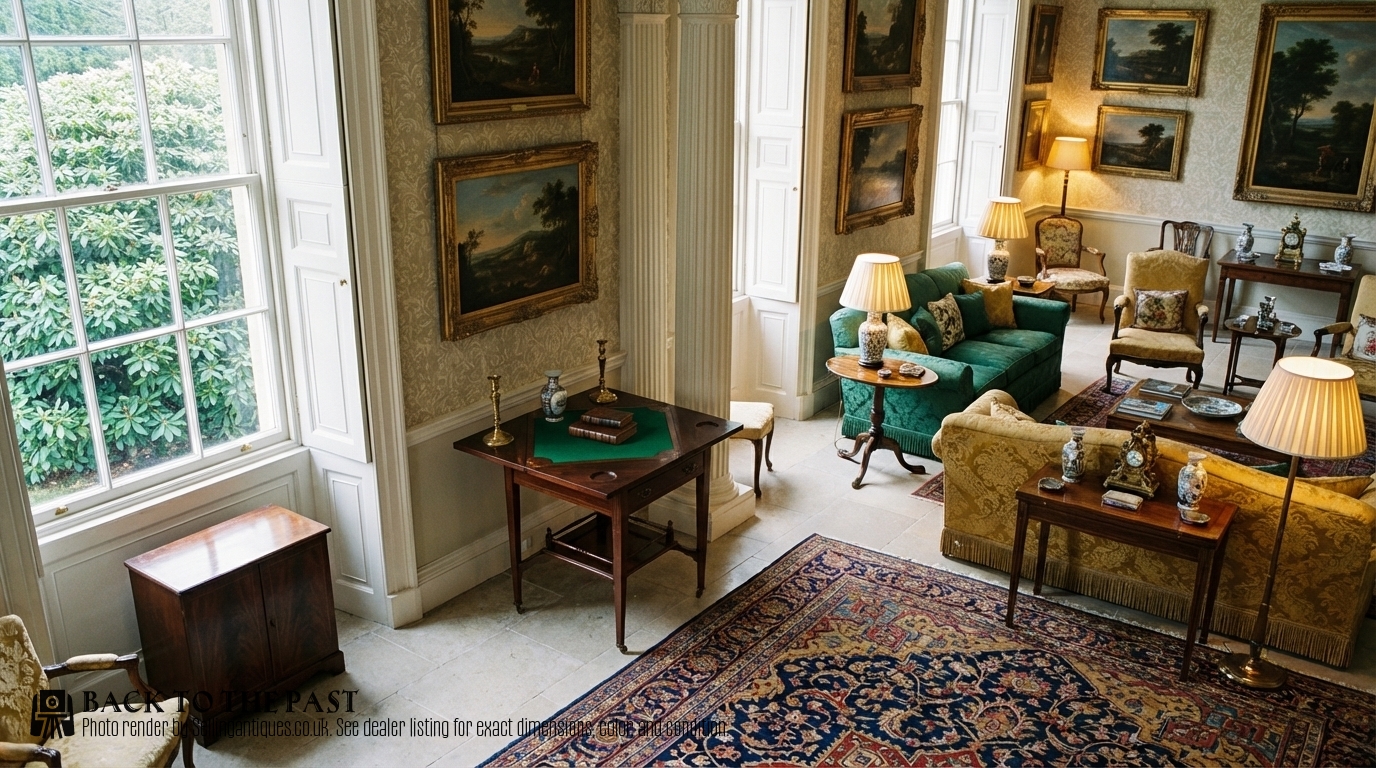
Inlaid Envelope Table
When you search for an inlaid envelope table, you look at ingenious folding furniture designed to serve as a card table, games table, or occasional table. These pieces emerge predominantly from the Edwardian era and the late nineteenth century, though earlier Georgian and Victorian examples appear.
How they were made
Cabinet makers constructed the primary carcass using dense timbers such as mahogany, rosewood, and walnut. These foundational woods provided the necessary stability for the pivoting flap mechanism and the folding legs.
Craftsmen enriched the surfaces using contrasting veneers and detailed stringing, incorporating satinwood, boxwood, and brass inlay. Marquetry and parquetry patterns decorate the tops, turning a functional gaming piece into a display of woodworking skill.
The site listings span from the Georgian period through the Victorian era and into Edwardian production, featuring brass, mahogany, and satinwood.
What varies in quality
The distinction between standard production and superior craftsmanship rests in the precision of the rotating mechanism and the crispness of the timber selection. Finer examples maintain smooth movement across all four flaps without sagging at the joints.
Surface ornamentation also separates grades, with simpler pieces relying on basic stringing while finer specimens display intricate marquetry and thoughtful contrasts between rosewood and satinwood.
Maple and Co
The Inlaid Envelope Table Glossary
- Envelope top
- A table design featuring four triangular flaps that rotate and fold inward to conceal the playing surface. This clever configuration allows the furniture to function as a compact occasional table when closed.
- Marquetry
- A decorative technique of applying pieces of veneer to a structure to form ornamental patterns and pictures. Craftsmen utilise various coloured woods to achieve pictorial depth.
- Parquetry
- Geometric mosaic woodwork used for flooring and furniture surfaces. It relies on symmetrical patterns formed from small rectangular or triangular wooden tiles.
- Stringing
- Thin inlay lines of contrasting wood or metal set into the surface of furniture. This technique outlines drawers, tops, and borders to define the proportions of the piece.
Inlaid Envelope Table: Frequently Asked Questions
How does an envelope table work?
The top consists of four triangular wooden flaps mounted on a central pivoting axis. When you rotate the top forty-five degrees, the flaps clear the frame and fold outward to reveal the baize-lined interior.
Underneath the flaps, small wells appear in the corners to hold gaming counters, coins, or small accessories during play.
What were envelope tables used for?
These pieces served primarily as card and games tables in drawing rooms and parlours during the Victorian and Edwardian periods. Gentlemen and ladies gathered around them for whist, bridge, and board games.
Between gaming sessions, the closed flaps allowed the furniture to function safely as an occasional or lamp table against a wall.
How do I date an envelope table?
Most surviving examples date from the Edwardian era and the late nineteenth century, identified by their rosewood or mahogany timbers and delicate satinwood inlay. Earlier Victorian pieces often show heavier proportions and simpler turning on the legs.
Georgian and early nineteenth-century precursors appear less frequently and typically display different leg structures and cabinet construction methods.
Are these tables sturdy enough for daily use?
The four folding flaps rely on small internal hinges and pivot mechanisms that require gentle handling rather than heavy weight. While they function well as occasional surfaces, they were engineered primarily for card playing rather than heavy domestic tasks.
Regular maintenance of the hinges ensures the swiveling top continues to operate smoothly without straining the surrounding timber.