




Square Folding Games Table
A square folding games table transforms from a compact side piece into a playing surface using clever hinged leaves and rotating tops.
Square Folding Games Table
When you search for a square folding games table, you encounter versatile furniture pieces designed for entertainment across multiple eras. The pieces listed span the Georgian and Edwardian periods, stretching back to the eighteenth century.
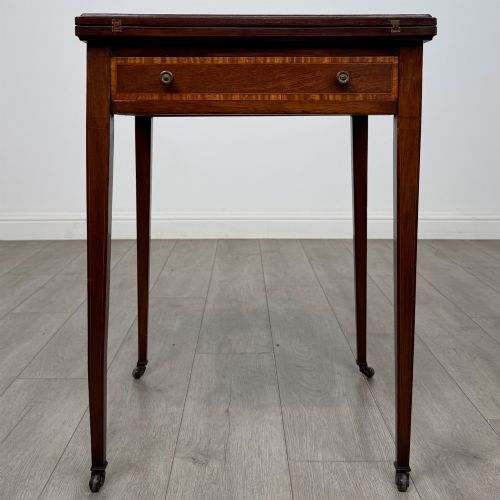
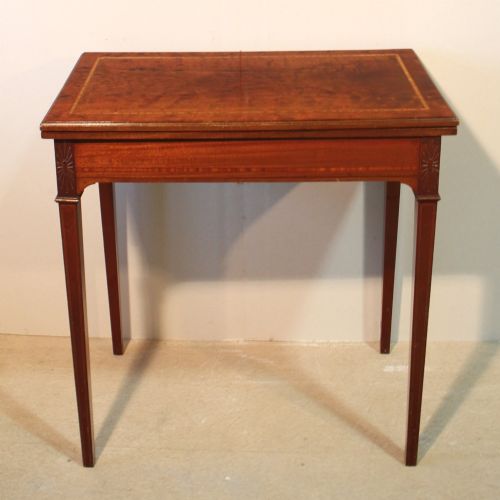
You are most likely to meet mahogany examples from the Edwardian period or the eighteenth century. These items often function as card tables, envelope tables, or occasional tables that fold out to reveal baize-lined playing surfaces.
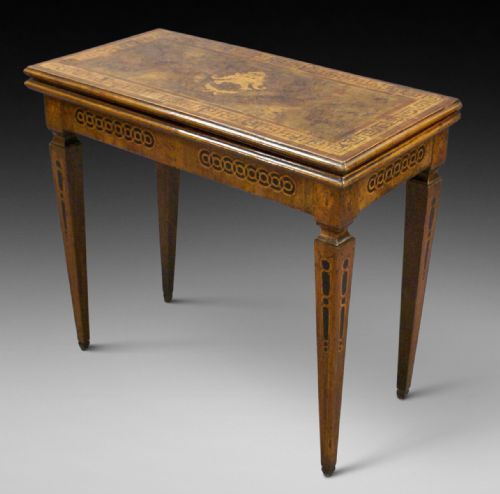
Origins range from British workshops to Italian makers influenced by neoclassical styles. Many incorporate folding or flip-top mechanisms that allow a simple side table to convert instantly for card games.
Materials and construction methods
Cabinet makers relied heavily on solid mahogany and wood veneers to build durable frames. Surfaces often feature marquetry inlay and contrasting woods such as satinwood, boxwood, and fruitwood to create decorative borders.
The engineering relies on specialised joints and actions, including concertina actions and rotating foldover tops. Brass hardware frequently secures the folding leaves and interior compartments.
Mahogany appears across multiple periods in these listings, paired with satinwood inlay and brass hardware.
Distinguishing quality across examples
The sophistication of the timber and the crispness of the marquetry inlay set superior examples apart from standard production. Cabinet makers who invested time in detailed wood veneer patterns and precise boxwood stringing achieved a more refined finish.
The mechanical action of the folding top or concertina frame dictates the functional standard of each piece. Smooth operation and tight joints when closed indicate careful historical joinery.
The Square Folding Games Table Glossary
- Envelope card table
- A square table with four triangular flaps that swivel and fold over one another to enclose the top like an envelope.
- Concertina action
- An expandable frame mechanism that allows the table rails to stretch outward when the top unfolds, supporting the open leaf without blocking the legs.
- Marquetry inlay
- Decorative patterns formed by fitting contrasting pieces of wood veneer into a prepared recess on the table surface.
- Foldover
- A tabletop design featuring a hinged leaf that opens outward to double the surface area for gaming or dining.
- Satinwood
- A pale, lustrous timber utilised for contrasting stringing and decorative inlay work on mahogany furniture.
Square Folding Games Table: Frequently Asked Questions
How do these folding tables work?
These tables utilise hinged leaves, swivel mechanisms, or concertina frames to expand a compact surface into a larger playing area.
When closed, they function as side tables or occasional tables against a wall.
What periods do these pieces come from?
The available selection primarily spans the Georgian and Edwardian eras, alongside pieces from the nineteenth century and the year nineteen hundred.
Craftsmen during these times adapted neoclassical and revival styles to suit contemporary entertaining.
What woods were used to build them?
Makers constructed the primary frames using mahogany and walnut, often applying finer veneers to the tops.
Satinwood, boxwood, and fruitwood provided contrast through detailed inlay and stringing.
Can I use one as a regular side table?
They serve daily purposes as conventional side tables, lamp tables, or tea tables when folded shut.
Opening the top reveals the concealed baize-lined interior only when required for games.