

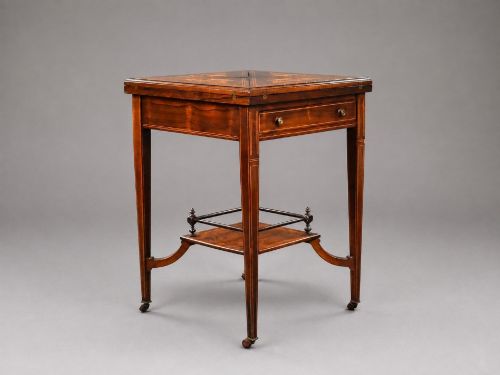


Satinwood Envelope Table
These satinwood envelope tables fold open with ingenious rotating leaves to reveal a baize-lined surface, combining elegance with practical utility for the home.
Satinwood Envelope Table
A satinwood envelope table is a versatile folding piece designed primarily for card games and occasional use in the parlour. The distinctive top comprises four triangular flaps that swivel and fold outwards to reveal the playing surface.
Most examples found here date from the Edwardian period and the year nineteen hundred, though Victorian models also appear in the selection. These tables frequently employ secondary timbers such as mahogany and rosewood alongside the characteristic satinwood.
The forms span card tables, games tables, tea tables, and occasional tables, often featuring compartmented interiors or lower undertiers for storage.
How they were made
Cabinet makers utilised dense hardwoods like mahogany and rosewood as foundational structures, applying pale satinwood veneers across the visible surfaces. Marquetry inlay, boxwood stringing, and satinwood inlay provide decorative contrast along the borders and flaps.
The folding mechanism relies on clever pivoting hinges where each triangular flap operates independently to form a square top when opened. Brass castors and fittings frequently support the legs, ensuring mobility for these multi-functional tables.
Satinwood Envelope Table Retail Price Guide 2026
Typical asking prices for satinwood envelope table among the pieces listed under this phrase on Sellingantiques today, from the lower quarter to the upper quarter. They describe what is for sale here now, not the wider market.
Secret card markers and hidden coin wells occasionally turn up beneath the swiveling flaps, proving that polite parlour games involved serious stakes.
What varies in quality
The refinement of the timber selection and the complexity of the inlay separate standard production from finer cabinet work. Rich satinwood grain figures and intricate marquetry detailing indicate superior workshop execution.
The Satinwood Envelope Table Glossary
- Envelope top
- A table top formed of four triangular flaps that rotate and fold open towards the corners to reveal the surface beneath. This ingenious mechanism was popular for games tables.
- Satinwood
- A hard, durable timber with a natural golden sheen and smooth grain, frequently used as a veneer on fine furniture. It takes a high polish.
- Marquetry
- Decorative patterns formed by fitting together contrasting pieces of wood veneer onto a structural panel. Craftsmen utilise various coloured timbers to create floral or geometric designs.
- Boxwood stringing
- Thin inlay lines of pale boxwood set flush into contrasting wood to outline edges and panels. This subtle banding defines the geometric proportions of Edwardian pieces.
- Undertier
- A secondary lower shelf positioned between the legs of a table to provide additional display space. It also serves to brace the leg structure.
Satinwood Envelope Table: Frequently Asked Questions
What is an envelope table?
An envelope table is a compact occasional table with a folding top composed of four triangular flaps that swivel open to create a larger surface. They were designed for card games and social gatherings in the home.
When closed, they occupy minimal space as square side tables, making them practical for smaller rooms while retaining decorative presence.
How do you open the top?
The mechanism relies on pivoting hinges where each triangular leaf rotates independently towards a corner. As the flaps lift and turn, they lock together to form a square playing surface.
Users should operate each flap gently to test the alignment of the brass pivot mechanism and prevent strain on the surrounding timber.
What woods were used?
Cabinet makers built these tables using satinwood as the primary decorative veneer, often combined with mahogany or rosewood. Boxwood stringing and marquetry inlay added further contrast to the surfaces.
The interior framing typically consists of sturdy secondary timbers to support the folding leaves and internal compartments.
Are these tables Edwardian or Victorian?
The selection includes pieces from both periods, with a strong concentration of Edwardian examples alongside Victorian models. Edwardian pieces often feature lighter satinwood veneers and delicate inlay work.
Victorian versions tend to employ heavier mahogany or rosewood structures with distinct marquetry detailing reflecting earlier nineteenth-century tastes.