

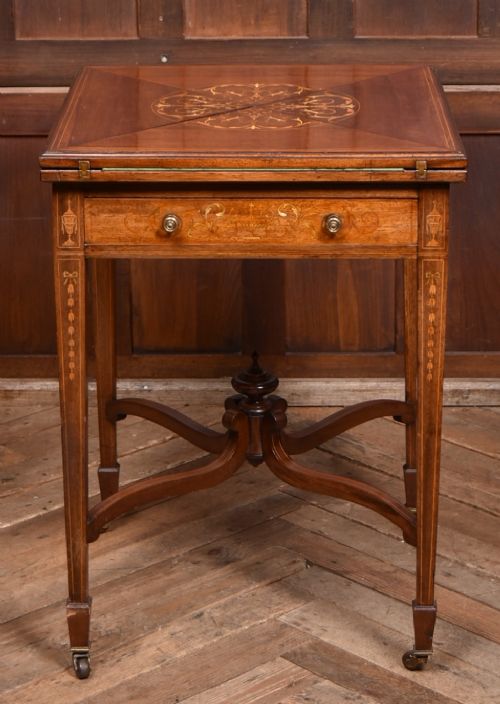
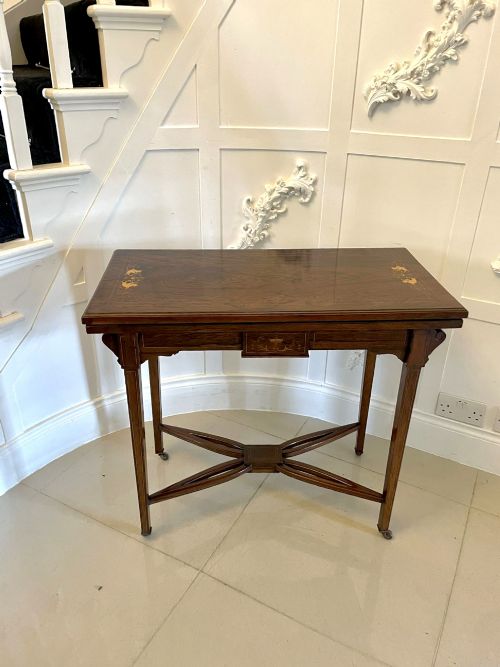
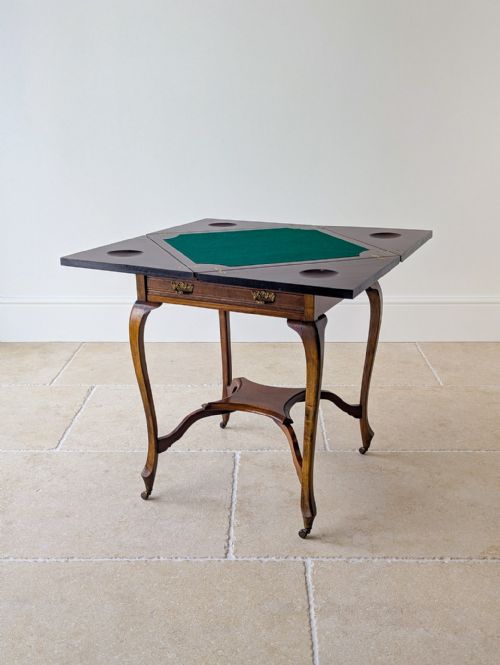

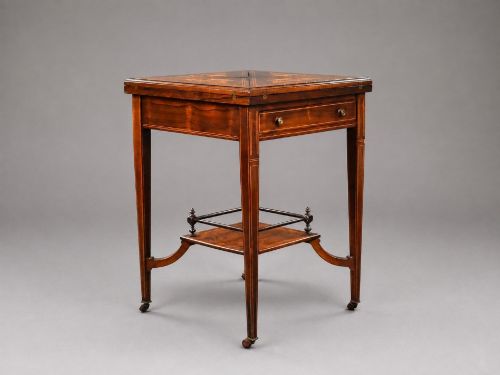


Edwardian Envelope Table
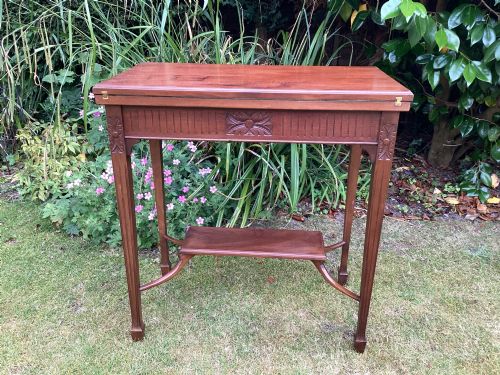
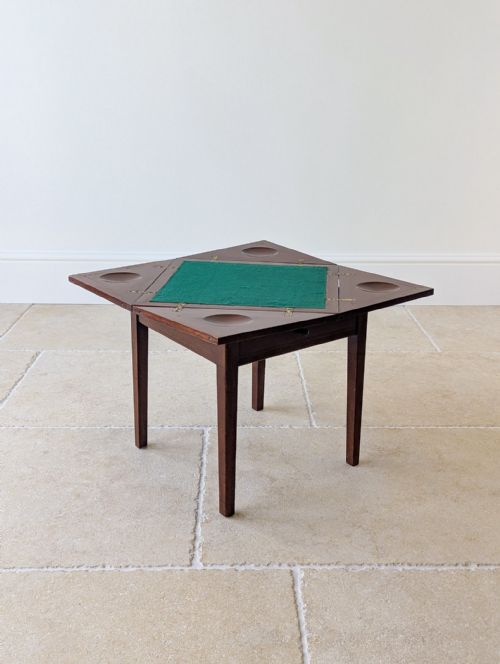
An edwardian envelope table is an ingenious folding games surface that opens with a revolving twist to reveal a baize-lined interior.
Edwardian Envelope Table
An edwardian envelope table is a multi-functional piece designed for parlour games, card playing and tea. The top consists of four triangular flaps that fold inward like an envelope, pivoting open on a swivel mechanism to create a square playing surface. Card tables and games tables dominate the pieces seen, alongside occasional tables and tea tables.
Most examples belong firmly to the Edwardian period or the surrounding decades of 1890 to 1910, though Victorian versions also appear. Mahogany and rosewood form the main body of these pieces, often paired with satinwood or boxwood inlay. Occasional variations include oak, walnut, ebonised wood and brass inlay, reflecting styles from Edwardian Chippendale Revival to Art Nouveau, Aesthetic Movement and Arts and Crafts.
How they were made
Cabinet makers built these tables primarily from solid timber and veneers of mahogany and rosewood, applying satinwood and boxwood inlay to create delicate classical motifs and border stringing. The four folding flaps require precise joinery so that the triangular sections meet evenly at the centre when closed. Underneath, swivel mechanisms and folding support gates allow the flaps to open smoothly without sagging.
Interior surfaces are typically lined with baize, providing a soft, durable playing field for card games. Brass hinges, castors and inlay work add functional and decorative detail, while ebonised wood offers a contrasting dark finish. Marquetry and painted decoration appear on select pieces, executed by hand to embellish the revolving tops.
Edwardian Envelope Table Retail Price Guide 2026
Typical asking prices for edwardian envelope table among the pieces listed under this phrase on Sellingantiques today, from the lower quarter to the upper quarter. They describe what is for sale here now, not the wider market.
Listings demonstrate that mahogany and rosewood dominate these tables, frequently enhanced with satinwood inlay.
What varies in quality
The distinction between standard production and the finest work lies in the selection of timber veneers and the precision of the inlay. Richly grained rosewood and figured mahogany combined with intricate satinwood marquetry elevate a piece, whereas simpler mahogany versions rely purely on form. Maker attribution also separates workshop output, with pieces bearing stamps or attribution to firms such as Maple and Co carrying distinct provenance.
Mechanical integrity dictates daily usability, particularly the smoothness of the swiveling top and the alignment of the four folding flaps. Tables that close flush without gaps and support weight steadily on their gateleg frames demonstrate superior initial construction. Original brass hardware and well-preserved baize linings further distinguish better-surviving examples from heavily restored ones.
Maple & Co.·Howard & Sons Ltd
The Edwardian Envelope Table Glossary
- Envelope top
- A table top formed of four triangular flaps hinged diagonally that fold over one another to resemble an envelope.
- Baize
- A coarse woollen fabric, traditionally green, used to line the playing surface of card and games tables.
- Marquetry
- Decorative patterns formed by inserting pieces of contrasting wood veneer into a solid wood background.
- Stringing
- A narrow strip of contrasting wood inlaid into the surface to create decorative borders and linear patterns.
Edwardian Envelope Table: Frequently Asked Questions
How does an envelope mechanism work?
The tabletop consists of four triangular leaves hinged to a central pivoting square. When the top is rotated diagonally, the four flaps unfold outward simultaneously to create a flat square surface.
Supporting arms swing out from beneath the frame automatically as the flaps open, providing stability underneath each corner of the table.
Were these tables used only for cards?
While primarily designed as card and games tables for evening entertainment, their multi-functional design suited other parlour uses. Some versions served as tea tables or occasional side tables when the flaps remained closed.
Many examples feature a small central drawer beneath the top, originally intended to hold packs of playing cards, counters or small writing accessories.
How do I care for the baize lining?
Baize is a woven wool fabric that requires gentle treatment to preserve its texture and colour over time. Brushing lightly with a soft clothes brush removes dust, while moisture should be kept away entirely to prevent shrinkage or staining.
Direct sunlight will fade the traditional green or coloured wool, so placement away from bright windows helps maintain the original tone.
What styles influenced Edwardian games tables?
Cabinet makers drew upon a mixture of historical revivals and contemporary design movements popular at the turn of the twentieth century. Edwardian Chippendale Revival pieces feature carved cabriole legs and ball-and-claw feet, reflecting eighteenth-century aesthetics.
At the same time, Aesthetic Movement, Arts and Crafts and Art Nouveau influences introduced cleaner structural lines, stylised floral marquetry and simpler geometric brass inlay.