
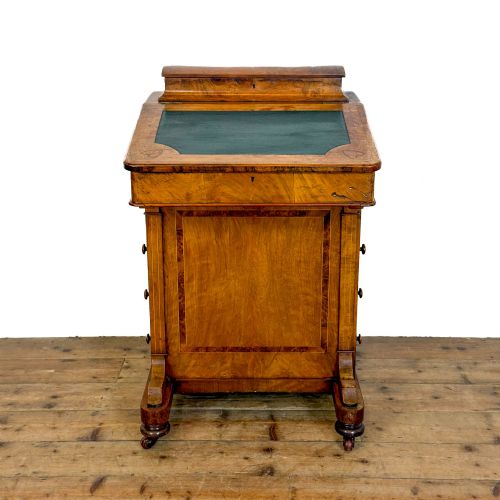


Inlaid Davenport Desk
An inlaid davenport desk brings compact Victorian elegance and clever writing utility to a study through fitted drawers and intricate timber work.

Inlaid Davenport Desk
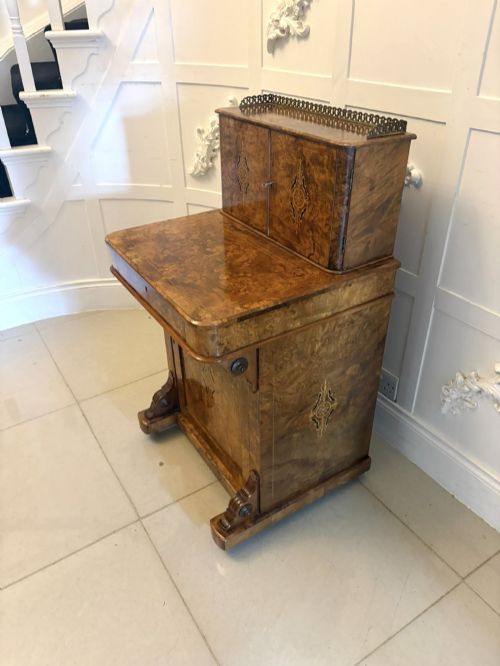
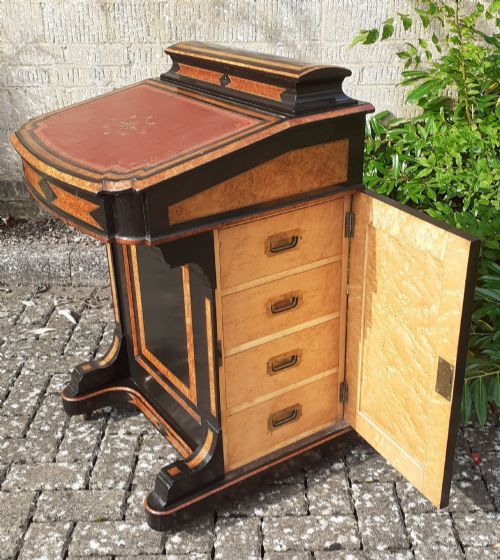
When you search for an inlaid davenport desk, you encounter compact writing furniture primarily from the Victorian and Edwardian eras, spanning the mid-nineteenth to the early twentieth century. These pieces combine a sloping writing surface with a pedestal of side drawers, often incorporating stationery compartments or upper galleries.
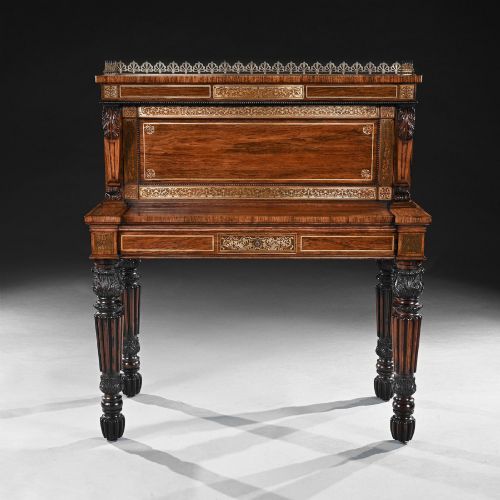
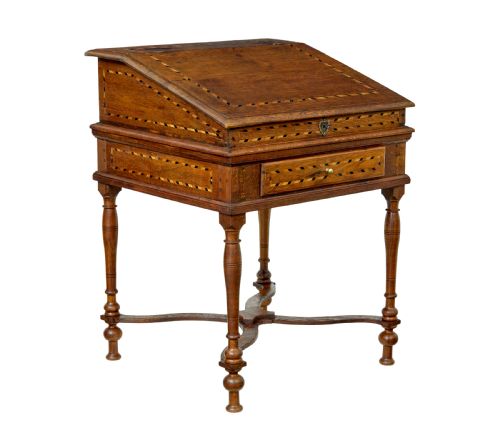
The Victorian examples dominate the selection, heavily featuring burr walnut and rosewood enhanced with marquetry or boxwood and satinwood stringing. Edwardian variations introduce lighter mahogany frames, whilst earlier Georgian roots occasionally surface through robust oak construction.
Materials and Construction
Cabinet makers utilised dense native and exotic timbers like walnut, rosewood, amboyna, and mahogany as the foundational carcasses for these desks. These rich surfaces were then embellished with precise boxwood, satinwood, and brass inlay, often forming delicate floral marquetry patterns across the sloping lids and stationery cabinets.
Structural ingenuity matched the exterior decoration, employing secret compartments, revolving piano tops, and pop-up mechanisms alongside traditional side drawers. Brass fittings and leather writing inserts completed the construction, balancing decorative flourish with practical daily use.
Inlaid Davenport Desk Retail Price Guide 2026
Typical asking prices for inlaid davenport desk among the pieces listed under this phrase on Sellingantiques today, from the lower quarter to the upper quarter. They describe what is for sale here now, not the wider market.
Listings demonstrate a strong preference for Victorian burr walnut, alongside rosewood and Edwardian mahogany.
Assessing Quality
The distinction between standard examples and superior pieces rests on the choice of timber and the precision of the marquetry. Highly figured burr walnut and richly grained rosewood command greater appreciation, especially when paired with crisp, well-defined boxwood inlay rather than simpler painted decoration.
Gillows Oxford Street Workshop·J and T Scott·Morrison of Edinburgh
The Inlaid Davenport Desk Glossary
- Davenport
- A small, pedestal-style writing desk featuring a sloping, hinged desktop over a bank of drawers. It originated in the late eighteenth century and gained immense popularity throughout the Victorian period.
- Marquetry
- Decorative veneer work forming pictorial or geometric patterns using various woods, shells, or ivory. Craftsmen carefully cut these elements to fit flush within the primary timber surface.
- Burr Walnut
- Timber taken from the abnormal growth of a walnut tree, yielding highly swirled and mottled grain patterns. It was frequently utilised by Victorian cabinet makers on high-end writing furniture.
- Boxwood Inlay
- Narrow strips of pale boxwood embedded into contrasting darker timbers to create fine borders, lines, or geometric stringing. This technique highlights the structural contours of the desk.
- Stationery Cabinet
- An upright compartment fixed to the rear top of a davenport to hold paper and envelopes. Some versions feature tambour doors or pop-up mechanisms activated by hidden releases.
Inlaid Davenport Desk: Frequently Asked Questions
What is a davenport desk used for?
These compact desks served as private writing stations for correspondence and record keeping in Victorian drawing rooms and studies. The sloping top provided a comfortable surface for writing letters, while internal partitions and side drawers kept stationery organised.
Unlike large partners desks, their small footprint allowed them to sit comfortably in residential parlours without dominating the room. They functioned as both decorative furniture and practical writing tools for the Victorian household.
How do you tell Victorian from Edwardian models?
Victorian davenport desks generally rely on heavier, highly figured timbers such as burr walnut and rosewood paired with rich floral marquetry. They often feature robust proportions and elaborate stationery galleries mounted to the rear.
Edwardian interpretations tend to use lighter mahogany frames with more restrained satinwood inlay and simpler stringing patterns. The overall aesthetic shifts from the exuberant ornamentation of the mid-nineteenth century to a lighter, more refined look.
Are the writing slopes lined with leather?
Many examples feature a fitted writing surface inset with tooled leather to provide a smooth, tactile base for a pen. These panels are frequently bordered with gilt tooling that matches the decorative tone of the surrounding timber.
While leather was standard for providing grip and protection during writing, some variants utilise plain timber or velvet depending on the specific period and custom commission.