
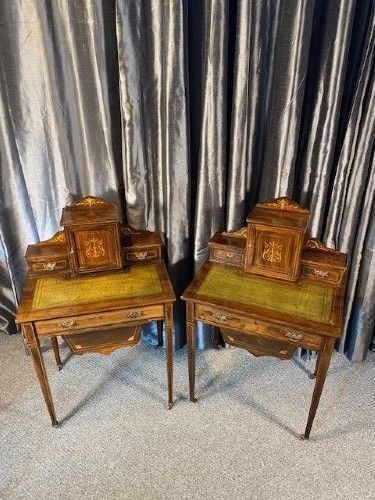


Sheraton Style Writing Cabinet
A sheraton style writing cabinet brings together refined satinwood, mahogany or rosewood and precise inlay to form a workspace of exceptional elegance.

Sheraton Style Writing Cabinet
A sheraton style writing cabinet encompasses forms such as bureau bookcases, secretaire cabinets, writing desks and Davenport desks. These pieces originate across the Georgian period, the nineteenth century and the Edwardian era.
Buyers encounter revival interpretations from around nineteen hundred alongside pieces from the eighteenth century. Bureau bookcases and secretaire variants dominate the available selections.
Every example combines practical storage for correspondence with a dedicated writing surface, often concealed behind a fall front or cylinder lid.
Materials and Construction
Craftsmen utilised mahogany, satinwood and rosewood as primary timbers, frequently supplemented by boxwood and contrasting inlay. Brass fittings and leather writing inserts complete the standard construction.
Marquetry and delicate stringing define the surface decoration on many examples, showcasing precise woodworking techniques from both Georgian workshops and later revival makers.
Secret compartments hidden behind dummy book spines often kept love letters safe from curious family members.
Distinctions in Quality
The sophistication of the timber selection and the crispness of the satinwood inlay set superior examples apart from standard workshop production. Grain matching across drawer fronts and cabinet doors indicates greater care by the maker.
The intricacy of internal pigeonholes, small drawers and hidden compartments demonstrates the level of ambition in the original commission.
Edwards & Roberts·Shoolbred of London·Gillows
The Sheraton Style Writing Cabinet Glossary
- Secretaire
- A piece of furniture featuring a pull-out drawer or drop-front panel that conceals a writing surface and small compartments. This mechanism allows a chest or bookcase to function as a desk.
- Satinwood
- A hard, durable timber with a characteristic golden-yellow sheen that takes a fine polish. It was widely utilised during the Georgian period and subsequent revivals for decorative veneers.
- Marquetry
- The art of applying small pieces of veneer to a structure to form decorative patterns or pictures. Cabinet makers used contrasting woods such as boxwood and mahogany to achieve geometric and floral designs.
- Bureau Bookcase
- A dual-purpose form combining a slant-front desk base with an upper shelving section enclosed by doors. These pieces served as both working desks and libraries for domestic use.
- Davenport
- A compact desk type featuring a sloped writing lid above a pedestal of drawers. The form typically incorporates side drawers and a compartment for stationery.
Sheraton Style Writing Cabinet: Frequently Asked Questions
What is a sheraton style writing cabinet?
A sheraton style writing cabinet is a piece of antique furniture designed for correspondence, combining a desk surface with enclosed storage such as drawers or bookcase shelving. The category spans Georgian originals as well as later revival interpretations.
These pieces typically feature fine timbers like satinwood or mahogany, often enhanced by intricate marquetry or contrasting stringing.
How do I identify a bureau bookcase?
A bureau bookcase combines a lower desk section with a hinged writing flap above an upper shelving unit enclosed by glass or wooden doors. The interior usually contains small drawers and pigeonholes for stationery.
This form provides both display space for books and a private writing area within a single vertical piece.
Where were these cabinets placed?
In period homes, these cabinets occupied libraries, drawing rooms and private sitting rooms where letters were written and household accounts managed. Their refined appearance suited formal reception spaces.
Today, they function equally well in modern studies or living areas as practical desks with built-in display or storage capacity.
How do I tell Georgian from revival pieces?
Georgian pieces date from the eighteenth and early nineteenth centuries, exhibiting construction methods and patination appropriate to that era. Revival pieces typically date from the late nineteenth or early twentieth century, reflecting a renewed interest in classic forms.
Examination of secondary timbers, dovetails and the wear on interior surfaces helps establish the correct period of manufacture.