


Hardwood Stacking Tables
Hardwood stacking tables bring ingenious multi-tier design to any room, offering versatile surfaces that tuck neatly away when not in use.
Hardwood Stacking Tables
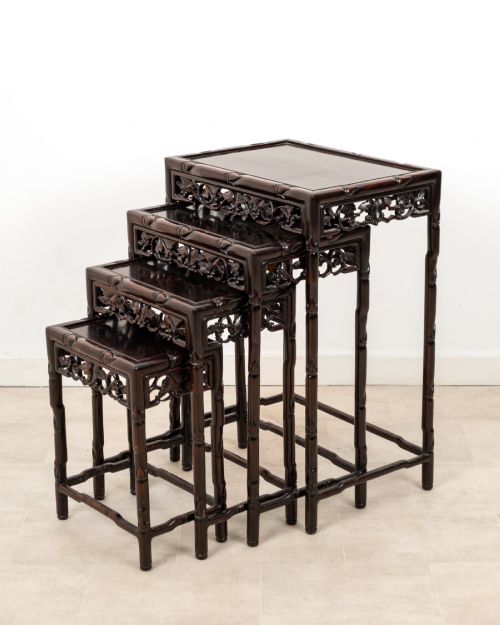
Hardwood stacking tables comprise graduating sets of occasional surfaces designed to slide beneath one another to save floor space. When considering hardwood stacking tables, you will most frequently encounter sets of four tables originating from Chinese export workshops and Edwardian makers.
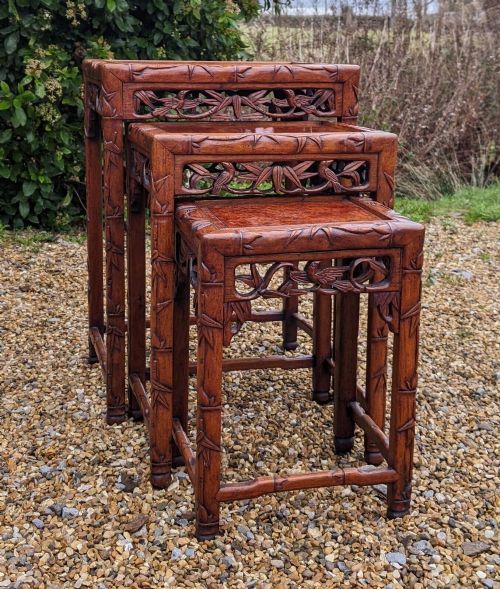
The form typically consists of rectangular tops supported by slender legs, often featuring carved aprons or recessed detailing. These nests function equally well as side tables, coffee tables, or individual surfaces distributed around a room during gatherings.
Originating across the nineteenth and early twentieth centuries, these pieces display regional craftsmanship from Chinese Qing Dynasty styles to Anglo-Indian production. The smaller tables descend in height and width with precise engineering so each tier fits securely into the frame of the one above.
How they were made
Cabinetmakers constructed these tables using dense timbers such as huanghuali, hongmu, rosewood, and teak, which allowed for slender structural members with high load-bearing strength. Artisans relied on traditional joinery methods, including mortise and tenon joints, to build frames capable of withstanding regular withdrawal and stacking.
Surface decoration frequently involved hand-carved detailing along the aprons and edges, executed with chisels and gouges directly into the hardwood. Selected pieces incorporated glass table tops or highlighted the natural grain and colour of the timber through careful polishing.
The smallest table in a set of four often looks like a miniature stool made just for a very polite house cat.
What varies in quality
Quality rests primarily in the selection of the timber and the depth of the grain, where superior sets exhibit rich natural figuring and uniform colour across all four tiers. The crispness of the hand-carved motifs and the precision of the joints separating each graduated table further distinguish finer examples from standard production.
Structural integrity depends on how smoothly the tables slide into one another and whether the frames maintain their alignment without warping over decades of use. Sets that retain their original finish and show harmonious proportions across the entire nested unit command greater appreciation.
The Hardwood Stacking Tables Glossary
- Nest of tables
- A set of graduated occasional tables designed to stack sequentially beneath the largest piece. This space-saving format became particularly popular during the nineteenth and early twentieth centuries.
- Hongmu
- A traditional Chinese term translating to red wood, applied to various dense tropical hardwoods including certain rosewoods. This heavy material provides exceptional durability for intricate carved furnishings.
- Quartetto
- A traditional term for a set of four pieces, frequently applied in nineteenth-century British records to nests of small occasional tables. These sets were often arranged near seating areas for tea and writing.
- Chinoiserie
- European decorative style reflecting Chinese artistic motifs and construction methods. This aesthetic influenced British and colonial makers producing export furniture for Western interiors.
Hardwood Stacking Tables: Frequently Asked Questions
How were hardwood stacking tables used?
These tables served primarily as flexible surface space for tea service, reading materials, and small decorative objects in nineteenth and early twentieth-century drawing rooms. The individual tiers could be dispersed around a room to accommodate guests and then stacked together again to clear floor space.
Their modular design made them particularly practical for smaller apartments and formal entertaining spaces where furniture arrangements needed to change quickly.
What periods do these tables date from?
The pieces seen here span from the nineteenth century through the Edwardian era up to the nineteen-twenties. Earlier examples often align with Qing Dynasty production or Chinese export workshops, while later pieces reflect Edwardian tastes and Anglo-Indian craftsmanship.
Dating relies on timber selection, carving styles, and construction techniques characteristic of these specific decades.
How do I care for hardwood stacking tables?
Maintain these surfaces by dusting regularly with a soft, dry cloth and avoiding placement near direct heat sources or strong sunlight that might dry out the timber. Periodic application of appropriate furniture wax helps preserve the natural sheen of dense woods like rosewood and teak.
Lift each table rather than dragging it across the floor to protect the joinery and prevent wear on the base of the legs.
What is the difference between Chinese export and Edwardian sets?
Chinese export sets typically utilise indigenous hardwoods such as huanghuali, hongmu, or general Asian hardwoods, often featuring traditional carved motifs and mortise joinery. Edwardian and Anglo-Indian pieces frequently incorporate British colonial design sensibilities while maintaining the familiar graduated nest format.
Both traditions focus on space-saving utility, but regional carving details and timber choices set them apart.