




Antique Stackable End Tables
Antique stackable end tables gather together in sets of three or four, offering space-saving surfaces that slide away when floor space matters.
Antique Stackable End Tables
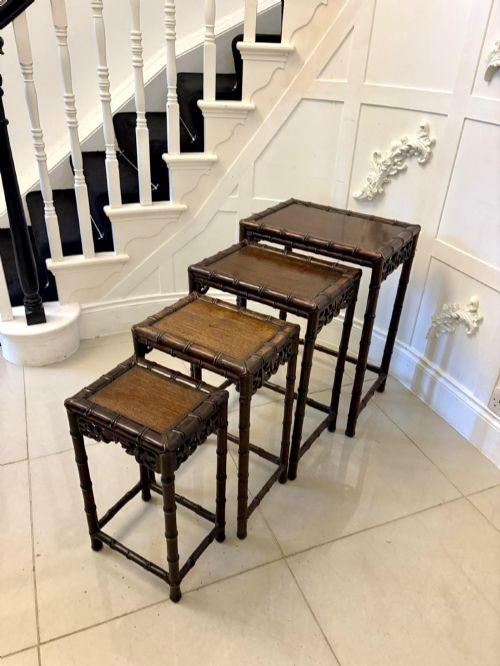
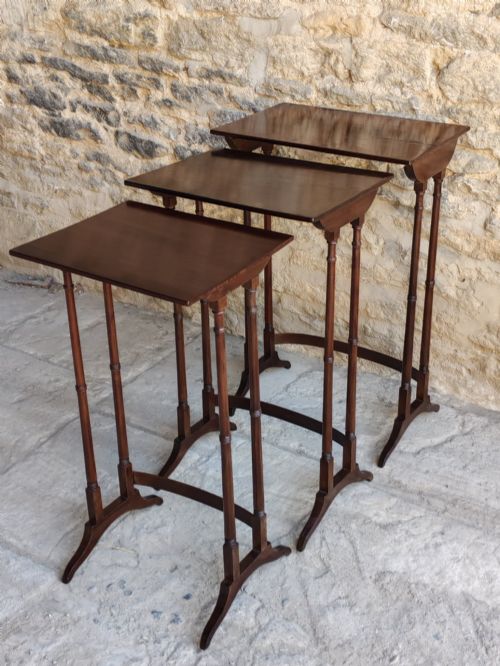
These pieces appear primarily as nests of tables, taking the form of sets containing three or four individual surfaces designed to fit neatly beneath one another. When searching for antique stackable end tables, buyers encounter nested configurations originating from various eras and international traditions.
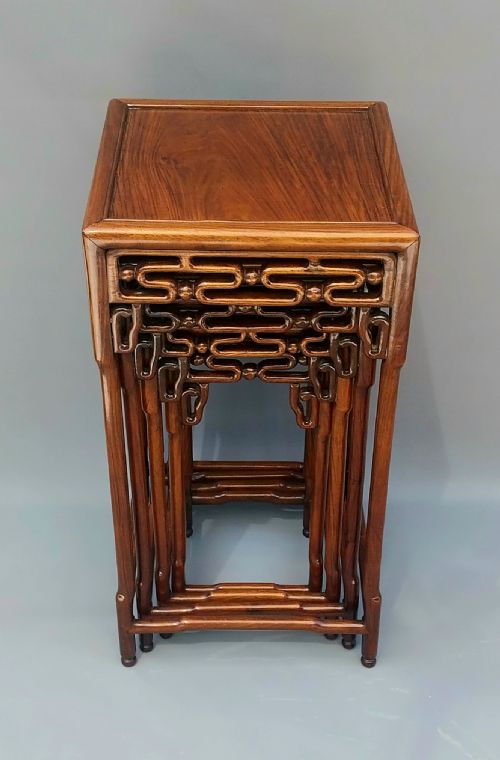
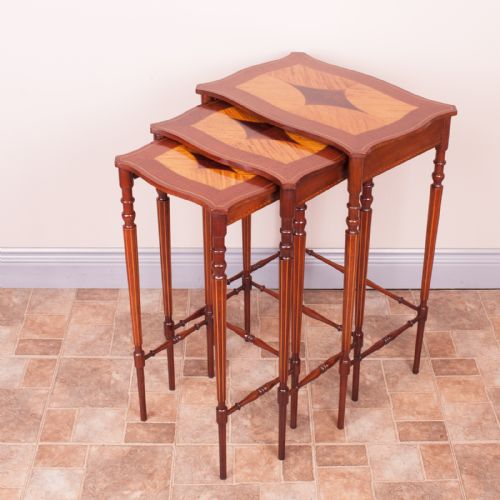
The selections span British periods like the Georgian and Edwardian eras alongside Chinese Qing Dynasty pieces, French walnut examples, and occasional faux bamboo variants. British mahogany and Edwardian inlaid designs appear frequently alongside Chinese hardwood and rosewood versions.
Sets generally comprise either three or four graduated pieces that share a unified design vocabulary, allowing the smaller tables to glide smoothly into the frame of the largest. This structural arrangement provides flexible surface space for lamps or tea without cluttering a room permanently.
How they were made
Cabinetmakers utilised dense timbers such as mahogany, rosewood, hardwood, and walnut to construct frames capable of withstanding the friction of sliding tables. Inlaid versions incorporated contrasting woods like satinwood and boxwood to create decorative borders and motifs across the primary surface.
Asian workshops employed traditional joinery alongside intricate carving, utilising hongmu and lacquer finishes supplemented occasionally by gold leaf. French and British makers applied parquetry patterns and floral inlay to enhance the visual depth of the tabletop surfaces.
Structural integrity relied on precise measurements to ensure each table within the nest cleared the rails of the one above it without sticking. Turned legs, faux bamboo shaping, and subtle edge mouldings finished the construction of these versatile surface sets.
What varies in quality
The refinement of the timber selection dictates much of the distinction between standard examples and superior pieces. Finer sets feature deeply figured mahogany, rich rosewood, or carefully matched walnut parquetry rather than plain secondary woods.
Construction precision separates basic utility sets from finer cabinetwork, particularly in the smoothness of the sliding action and the tightness of the joinery. Subtle details such as crisp inlay work, delicate carving, and well-balanced proportions elevate the overall execution of the set.
The Antique Stackable End Tables Glossary
- Nest of tables
- A set of graduated tables designed to stack neatly one beneath another to save space. This form constitutes the primary arrangement for stackable end tables.
- Quartetto
- A matching set of four tables designed to nest together. This term frequently appears in older descriptions of four-part stackable tables.
- Parquetry
- Geometric patterns formed by fitting small pieces of wood veneer together on a surface. Makers utilised this technique to decorate table tops with repeating motifs.
- Inlay
- Contrasting wood or material inserted into a recessed area of a base timber to form decorative designs. Edwardian and Georgian makers favoured this method for borders.
Antique Stackable End Tables: Frequently Asked Questions
How were stackable tables used historically?
These tables served primarily as flexible surface space in formal sitting rooms, where they could be pulled out for tea or writing and stored away afterwards.
Their nested design allowed households to entertain guests without keeping multiple large tables permanently in the middle of the room.
What is a quartetto nest?
A quartetto nest specifically denotes a set of four tables that descend in size to fit within the largest frame.
This term appears particularly in connection with early twentieth-century mahogany sets.
How do I care for antique mahogany nests?
Keep wooden tables away from direct heat sources and strong sunlight to prevent the timber and polished finish from drying out or fading over time.
Clean surfaces gently with a soft dry cloth and avoid excessive moisture or commercial silicone sprays.
How can I tell Edwardian nests apart from Georgian ones?
Edwardian examples often feature delicate stringing and inlaid borders reflecting the revived Sheraton taste of the early twentieth century.
Georgian pieces rely more upon the deep natural grain of solid mahogany and simpler structural lines without extensive inlay.