


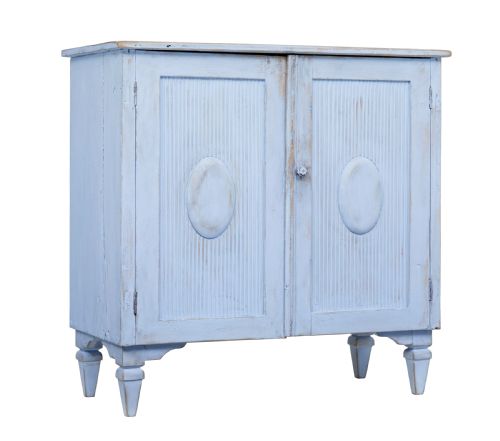


Gustavian Style Sideboard
A gustavian style sideboard brings the pale, balanced elegance of Scandinavian design into a room, offering practical storage disguised in calm, historic paint.
Gustavian Style Sideboard
When you search for a gustavian style sideboard, you encounter large storage forms from Northern Europe, predominantly cupboards, enfilades, and commodes originating in Sweden and Denmark. These pieces date from the eighteenth and nineteenth centuries, spanning eras like the late seventeen-hundreds through to eighteen-eighty.
The most common form on this page is the painted pine cupboard or linen cupboard, alongside Swedish commodes and Dutch pieces. They reflect Scandinavian country and Dutch neoclassical aesthetics, translating formal classical restraint into regional vernacular furniture.
Makers utilised architectural elements such as breakfronts, serpentine facades, and panelled doors on a domestic scale. The resulting forms serve as focal storage units that anchor a dining room or hallway with understated proportion.
How they were made
Construction relies heavily on pine and softwood, shaped into robust carcases designed to withstand regional climates. Joinery is straightforward and utilitarian, hidden beneath thick layers of applied paint that served to protect the timber.
Surface decoration relies on historic paint finishes, with original scraped paint surfaces appearing alongside later or refreshed coats. Iron and brass hardware, including hinges and keyplates, provide functional contrast to the pale timber structures.
Select pieces incorporate heavy marble tops, adding a durable and classical surface to wooden commodes and enfilades. This combination of local softwood and imported stone defines the material palette of the category.
Swedish linen cupboards were traditionally built wide enough to store family textiles flat, ensuring winter blankets stayed crisp.
What varies in quality
Quality rests primarily in the integrity of the paint surface, distinguishing original scraped finishes from later overpainting. Pieces retaining their earliest layers display a nuanced depth that modern repainting cannot replicate.
Proportion and architectural detailing separate basic regional storage from finer examples. Crisp mouldings, well-executed serpentine or breakfront lines, and balanced panel placement elevate the visual weight of the piece.
Hardware authenticity and timber selection also mark the distinction between tiers. Original iron or brass fittings and stable, well-seasoned pine construction indicate superior workshop origin.
The Gustavian Style Sideboard Glossary
- Commode
- A low chest of drawers or cabinet standing on legs, originating in France but adopted across Scandinavia and the Netherlands. These frequently feature serpentine fronts.
- Enfilade
- A suite of rooms or a long cabinet designed with a series of continuous doors, functioning as a sideboard or large storage buffet. Pairs of these appear in mid-nineteenth-century Swedish work.
- Scraped paint
- A conservation method that reveals original historic pigment layers beneath subsequent coats. This technique exposes the authentic early palette of the piece.
- Serpentine front
- A furniture facade curved in a wave pattern, convex at the centre and concave at the sides. This technique requires advanced woodworking skill.
Gustavian Style Sideboard: Frequently Asked Questions
What is a gustavian style sideboard?
A gustavian style sideboard generally refers to painted Scandinavian storage furniture such as linen cupboards, enfilades, and commodes. These pieces originate mainly from eighteenth and nineteenth-century Sweden and Denmark.
They combine neoclassical symmetry with regional country craftsmanship, typically finished in pale or scraped paint. The category encompasses various large storage forms used to anchor dining spaces.
How do I date an old painted cupboard?
Dating relies on examining construction methods, timber types, and paint layers. Eighteenth-century pieces often display hand-planed surfaces and forged iron hardware.
Nineteenth-century examples introduce standardised mill-sawn timbers and different pigment compositions. Evaluating the wear around handles and hinges provides further chronological context.
Are these pieces made of solid pine?
Most listings in this category consist of solid pine or softwood construction. Carpenters utilised these accessible regional timbers because they took paint finishes readily.
Some commodes and cabinets incorporate marble tops for added durability and a classical aesthetic. Iron and brass provide the necessary structural and decorative hardware.
Where were these cupboards made?
The pieces originate primarily from Sweden and Denmark, reflecting Scandinavian country and Dutch neoclassical styles. Workshops in these regions adapted continental European court designs for local domestic interiors.
Regional variations appear in the moulding profiles, foot designs, and paint colours chosen by local joiners.